_1762768699969.webp)

_1782530506402.webp)
(1)_1783045836766.webp)
_1786157639392.webp)
(1)_1780970038980.webp)
Curved Aluminum Square Tube: Complete Guide to Technology, Selection & 2026 Trends
In recent years, curved architecture has become a dominant trend in the global construction industry. From the iconic Guggenheim Museum Bilbao to modern commercial buildings and public spaces, flowing lines and organic shapes are replacing rigid rectangular forms. Curved aluminum square tube has emerged as the material of choice for these projects, offering an unbeatable combination of design flexibility, structural performance and durability.
This article provides a comprehensive overview of curved aluminum square tube, including its core technologies, performance advantages, selection guidelines, installation best practices and future industry trends, serving as a valuable resource for architects, engineers and project managers.
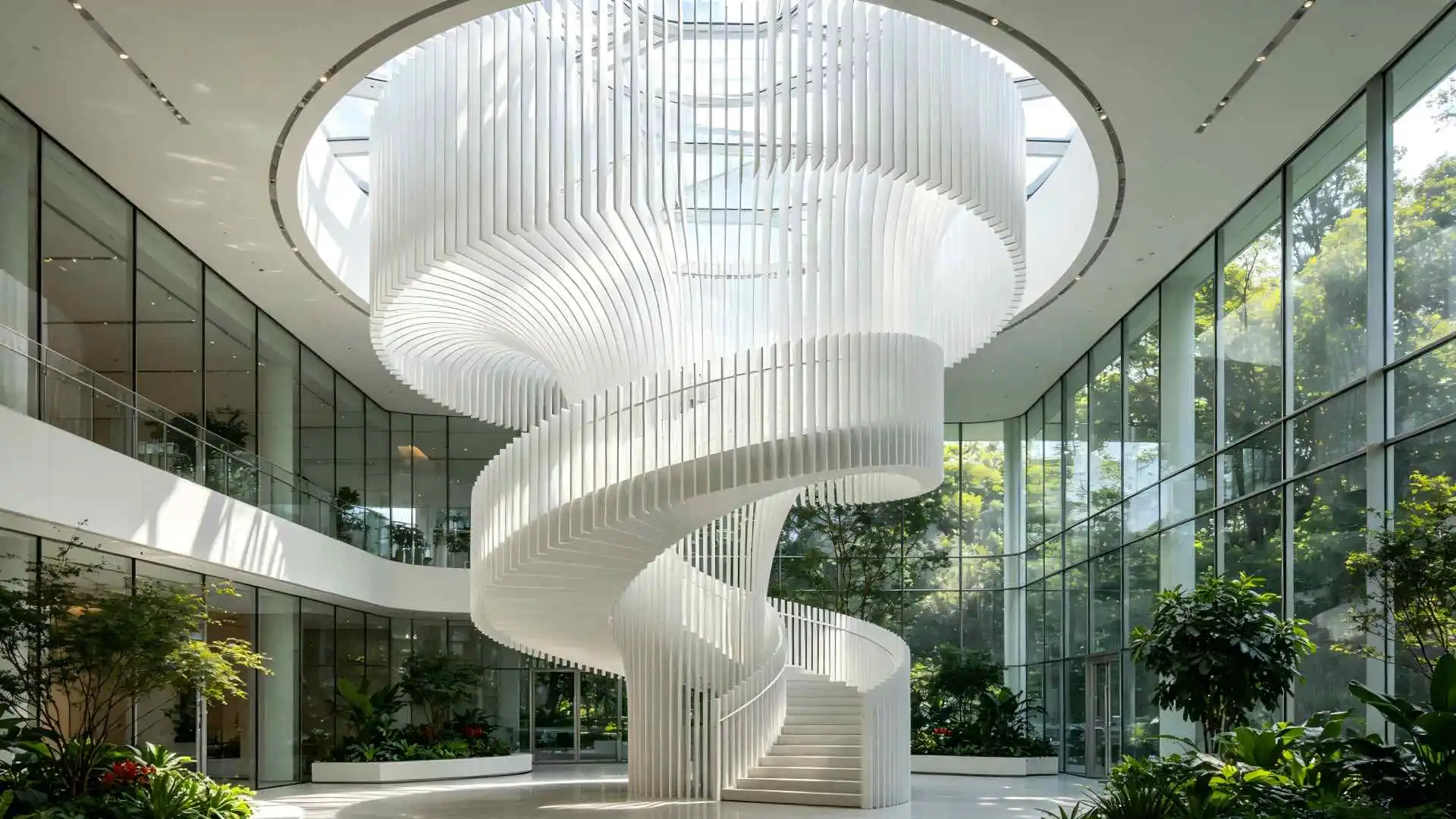
Bending aluminum square tubes for decorative purposes on spiral staircases
1. Core Bending Technologies for Aluminum Square Tubes
There are three main bending technologies used for aluminum square tubes, each with its own advantages and limitations:
-
Stretch Bending The most advanced and widely used technology for architectural applications. It stretches the aluminum tube while bending it around a die, minimizing material thinning and springback. Produces smooth, consistent curves with high precision. Ideal for large-radius bends and complex shapes.
-
Roll Bending Uses three rollers to gradually bend the tube into the desired shape. Suitable for very large radii and thick-walled tubes. However, it has lower precision and may cause slight ovalization of the tube cross-section.
-
Compression Bending Forces the tube around a fixed die using a pressure arm. Fast and cost-effective for simple bends. However, it can cause wall thinning and wrinkling, especially for small radii.
For most architectural projects requiring high precision and aesthetic quality, stretch bending is the preferred technology.
2. Comparison with Other Curved Building Materials
| Material Type | Design Flexibility | Weight | Weather Resistance | Fire Rating | Cost | Maintenance |
|---|---|---|---|---|---|---|
| Curved Aluminum Square Tube | Excellent (Any shape) | Light | Excellent (20+ years) | A2 Non-combustible | Medium | Very Low |
| Curved Steel Tube | Good | Heavy | Poor (Requires painting) | A1 | Medium | High |
| Curved Wood | Good | Medium | Poor | B2 Flammable | High | Very High |
| Curved GRC | Fair | Heavy | Poor | A2 | Low | High |
| Curved Glass | Poor | Heavy | Good | B1 | Very High | Medium |
3. Professional Selection Guidelines
- Project Type: For high-end commercial buildings and cultural landmarks, choose stretch-bent aluminum square tubes with PVDF coating. For interior projects, polyester powder coating is sufficient and more cost-effective.
- Bending Radius: For small-radius bends (less than 500mm), use thicker-walled tubes to prevent deformation. For large-radius bends, thinner-walled tubes can be used to reduce cost.
- Environmental Conditions: For coastal areas and industrial zones, select 6061-T6 aluminum alloy and enhanced PVDF coating to improve corrosion resistance.
- Structural Requirements: For load-bearing applications such as facade supports, use thicker-walled tubes and consult with structural engineers to ensure safety.
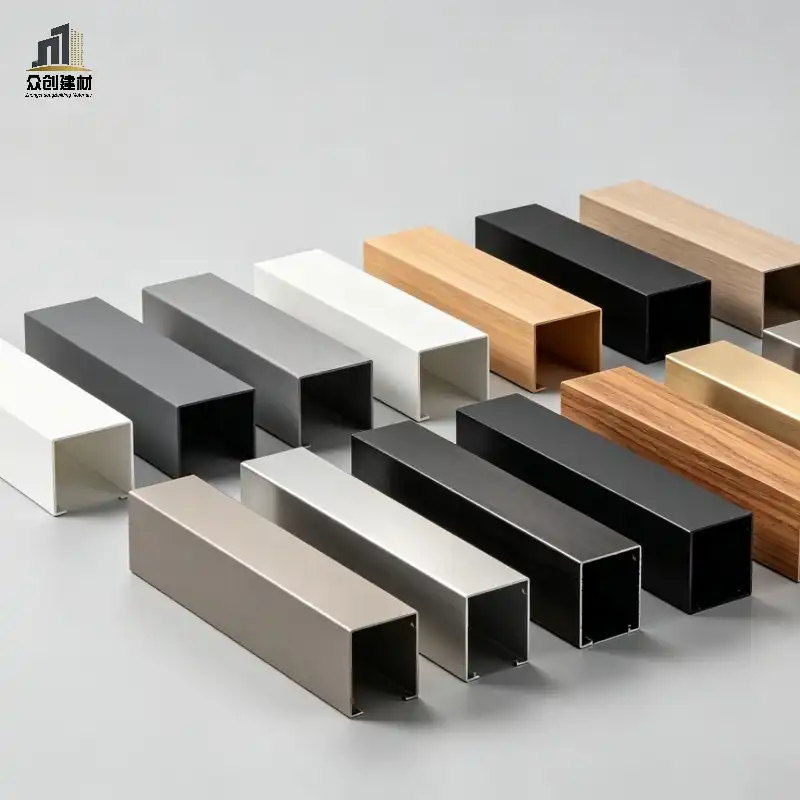
- Aesthetic Requirements: For projects requiring a natural look, choose wood grain or stone grain finishes. For modern and contemporary designs, metallic or matte finishes are more suitable.
4. Installation & Quality Control Standards
- Installation Requirements: Use a laser level to ensure accurate alignment of the curved tubes. The supporting structure must be strong enough to bear the weight of the tubes. Reserve appropriate expansion joints to accommodate thermal expansion and contraction.
- Quality Control: Before installation, inspect each tube for surface defects, color consistency and bending accuracy. Check the alignment and spacing of the tubes during installation. Conduct a final inspection after completion to ensure the overall effect meets design requirements.
- Safety Considerations: Follow proper safety procedures during installation, especially for high-altitude work. Ensure all fasteners are securely tightened to prevent accidents.
5. 2026 Industry Development Trends
-
Increasing Demand for Complex Shapes Architects are creating more complex organic shapes that require advanced bending technology. Manufacturers will continue to invest in CNC equipment and 3D scanning technology to meet this demand.
-
Integration with Smart Building Systems Curved aluminum square tubes will be integrated with LED lighting, sensors and other smart building technologies to create multi-functional architectural elements.
-
Sustainable Manufacturing Practices The use of recycled aluminum and low-VOC coatings will become standard. Manufacturers will also focus on reducing energy consumption and waste in the production process.
-
Customization as Standard One-of-a-kind custom designs will become more common, with manufacturers offering fully customizable solutions for every project.
-
Expansion into New Applications Curved aluminum square tubes will find new applications in residential architecture, landscape design and furniture manufacturing.
Conclusion
Curved aluminum square tube has revolutionized modern architecture by enabling the creation of stunning curved forms that were once impossible or prohibitively expensive. As technology continues to advance and demand grows, it will play an even more important role in shaping the buildings of the future. By understanding the technology, selection criteria and installation standards, architects and project managers can make the most of this versatile material and create truly exceptional architectural works.