_1762768699969.webp)

_1782530506402.webp)
(1)_1783045836766.webp)
_1786157639392.webp)
(1)_1780970038980.webp)
Material Selection Logic for Storefront Panels
Choosing storefront aluminum panels starts with three core questions: usage environment, design complexity, and budget. These factors determine the selection of base alloy, thickness, and surface finish.
-
Environment: Fully exposed storefronts must use PVDF fluorocarbon coating; semi-exposed or canopy-covered areas can use weather-resistant polyester; interior feature walls can use standard powder coating.
-
Complexity: Flat panels can use 1.5–2.0mm; curved or shaped panels should be 2.5mm minimum; double-curved surfaces require 3.0mm with specialized forming processes.
-
Budget: Powder coating offers the best value; wood-grain transfer is mid-range; PVDF and UV printing cost more but deliver superior durability.

Thickness Is Not "Thicker Is Better"
Many customers mistakenly believe "thicker = safer." In reality, panel thickness should be determined based on span and wind load calculations. Blindly increasing thickness not only adds cost but also increases structural load.
|
Gauge |
Max Panel Width |
Typical Use |
Deflection |
|---|---|---|---|
|
1.5mm |
≤1000mm |
Interior feature walls, small storefronts |
Fair, requires closer subframe spacing |
|
2.0mm |
≤1200mm |
Standard storefronts, commercial facades |
Good |
|
2.5mm |
≤1500mm |
Exterior storefronts, wide panels |
Excellent, mainstream choice |
|
3.0mm |
≤1800mm |
Coastal high-wind, cantilevered structures |
Superb, requires structural review |
How to Choose Surface Coating
Surface coating is the biggest differentiator in storefront panel performance, directly affecting appearance 10 years later. Three mainstream options compared:
|
Coating |
Warranty |
UV Resistance |
Best Environment |
Cost |
|---|---|---|---|---|
|
Polyester Powder (PE) |
5–10 years |
Fair |
Interior, semi-covered |
Low |
|
Fluorocarbon (PVDF) |
15–20 years |
Excellent |
Full exterior, coastal, strong sun |
Medium–High |
|
Wood-Grain + UV |
10–15 years |
Good |
Semi-exposed, design-driven |
Medium |
Critical Installation Details
Installation quality directly determines the final result and service life of storefront panels. The following details require special attention:
-
Corner Finishing: Right-angle corners should use 45° miter or single-piece brake forming to avoid uneven gaps from direct butt joints.
-
Waterproof Sealing: Leave 3–5mm expansion gaps between joints, sealed with neutral-cure weatherproof silicone to prevent water ingress.
-
Subframe Protection: Internal framing must be hot-dip galvanized; coastal projects should add a rust-inhibiting primer.
-
Access Provision: If lighting or wiring runs above the storefront, at least one removable access panel is required.
Common Misconceptions
In project practice, clients commonly fall into the following misconceptions:
-
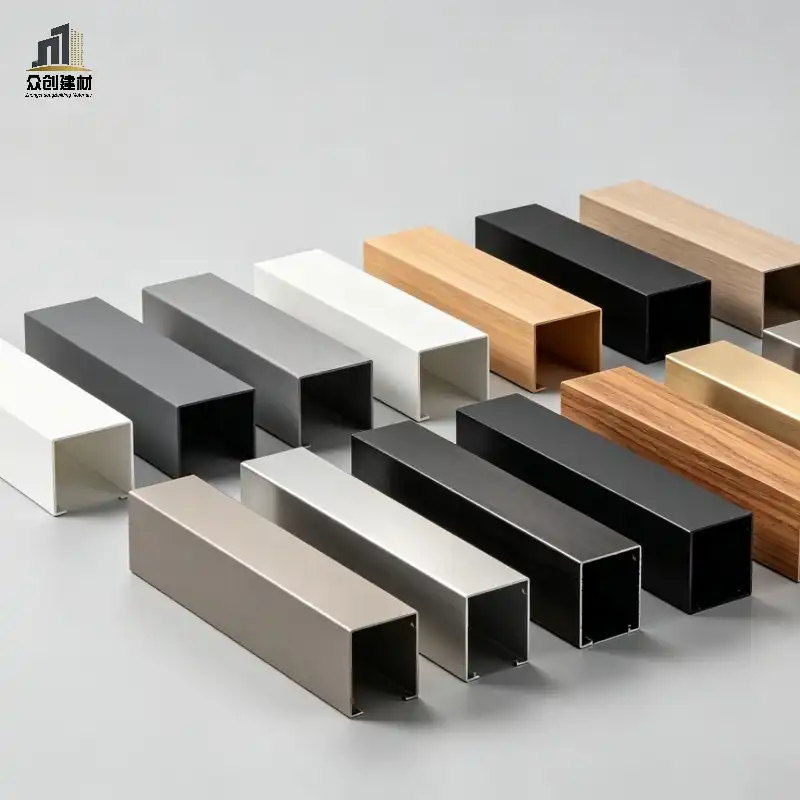
Myth: Wood-grain transfer cannot be used outdoors. In reality, wood-grain panels with a PVDF topcoat can last 15+ years outdoors; the key is whether a UV-protective layer is applied.
-
Myth: Perforation reduces strength. As long as the perforation ratio is kept below 30% and away from load-bearing edges, the impact on overall structural strength is negligible.
-
Myth: Aluminum panels are less premium than stone. Modern PVDF and wood-grain transfer finishes are highly realistic, and aluminum's lightweight advantage makes it safer for high-rise applications.