_1782530506402.webp)
Double-Layer Aluminum Ceiling — Product News
Company Focus: Double-Layer Ceilings Become a Key Category for 2026
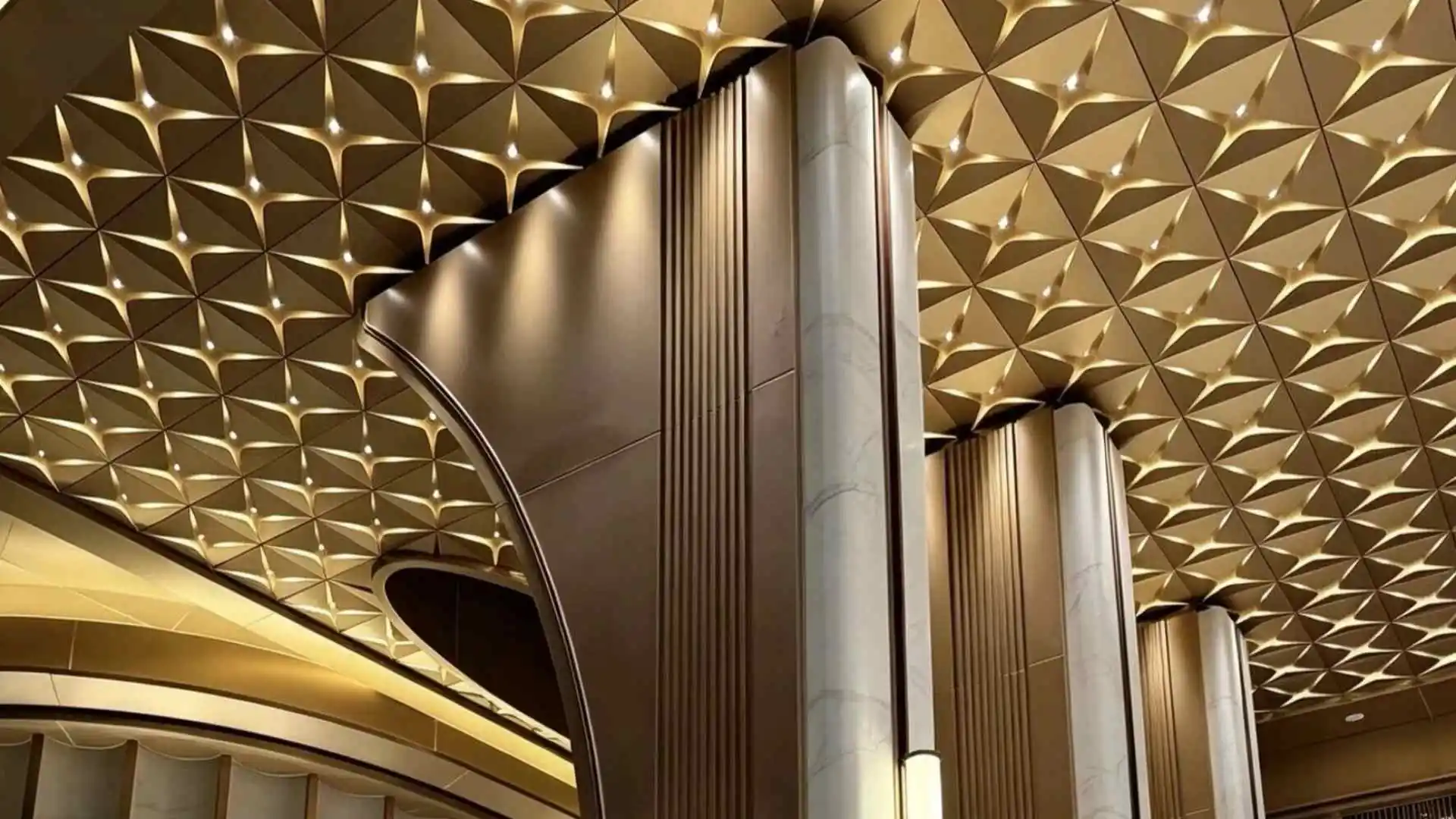
Leveraging Foshan's aluminum industry chain, Guangdong Zhongchuang Architectural Decoration Materials Co., Ltd. has positioned double-layer aluminum ceilings as a key interior ceiling category for 2026. The company has built a complete chain from form detailing, CNC bending and pyramid pressing, center perforation, and interlayer assembly to light pre-installation and test-lighting. Its main forms cover pyramid relief, four-point star, diamond facets, petal curves, wave undulation, and free-form surfaces, with unit sizes of 300–1200mm and interlayer cavities of 20–80mm customizable per project.
Products are exported to Australia, the United States, Southeast Asia, the Middle East, and Europe. In 2026, inquiries for double-layer ceilings have risen notably, and the company has become a stable supply source for international hotel and commercial projects.

Market Trends: The Ceiling Becomes the Fifth Facade
Interior design in 2026 shows a clear shift: the ceiling is no longer treated as a "back side" to be hidden but as a fifth facade equal in importance to the walls. Owners expect the ceiling to carry brand character, spatial ceremony, and nighttime identity rather than merely conceal services. Double-layer construction provides the path — one layer for form, one layer for light.
Fifth Facade Awareness: Ceilings enter the primary visual design rather than the finishing stage.
Light Without Seeing Fixtures: As chandelier-free design spreads, sources hide in the interlayer to avoid glare.
Dual Day-Night Expression: One ceiling presents two characters by day and night, raising spatial value.
Modular Fast Installation: Unitized assembly replaces on-site wet work, shortening commercial schedules.
Maintainability First: Replaceable sources and removable units lower long-term operating costs.
Applications Expand: From Hotel Lobbies to Offices and Transport Spaces
The application boundary continues to expand. 2026 trends show that beyond traditional hotel lobbies and ballrooms, office foyers, corporate showrooms, cultural venues, transport hubs, and sales centers are new sources of demand — with office and showroom projects growing fastest, driven by a demand for order plus technological character.
|
Application |
Common Form |
Core Value |
Trend |
|---|---|---|---|
|
Hotel lobbies and ballrooms |
Four-point star / pyramid |
Ceremony, star matrix, refinement |
Steady growth |
|
Commercial atriums |
Wave / large grid units |
Visual guidance, nighttime focus |
Rapid growth |
|
Office foyers |
Diamond facets |
Sense of order, modern corporate character |
Rapid growth |
|
Corporate showrooms |
Free-form / tunable color |
Technological feel, supports exhibition themes |
Rapid growth |
|
Cultural venues |
Petal / free-form |
Artistic tension, sculptural quality |
Steady growth |
|
Transport hubs |
Modular standard units |
Large-space adaptability, easy maintenance |
Rapid growth |
Technology Upgrade: Pre-installed Lighting and Drilling-Free Maintenance
Industry focus centers on two directions. First, lighting moves forward into the factory: strips and point lights are pre-installed and test-lit before shipment, leaving only wiring and dimming on site, which avoids the coating damage caused by the conventional sequence of finishing the ceiling and then drilling for fixtures. Second, maintenance practice changes: unitized hanging with concealed hatches lets a single panel be removed to replace its source without disturbing the whole ceiling.
In addition, heat dissipation in the interlayer cavity is gaining attention. If heat from continuous LED operation stays sealed inside, light decay and coating aging accelerate. Cavity depth and ventilation paths must therefore be calculated during detailing rather than set purely by form requirements.
Delivery Capability: Global Logistics and Certification
As a ceiling system supplier serving the global market, the company has built a complete international delivery system. From custom wooden-case packaging, full-container sea freight, and export customs clearance to a full set of international certifications, the company supports diversified trade terms including FOB, EXW, CIF, DAP, and DDP, with T/T and letter-of-credit settlement, and provides one-stop service from form detailing and unit fabrication drawings to on-site installation guidance.