_1762768699969.webp)


_1782530506402.webp)
(1)_1783045836766.webp)
_1786157639392.webp)
(1)_1780970038980.webp)
Acoustic Design of Ceiling Aluminum Baffles: How to Achieve Noise Reduction Effect in Public Spaces
Public spaces such as airports, stations, shopping malls, stadiums, offices usually have high floor heights, dense personnel, and many hard surfaces, which are prone to acoustic problems such as excessive reverberation time, poor speech intelligibility, and excessive noise, seriously affecting the user experience. Although traditional closed ceilings can block top pipelines, they have limited sound absorption effect, and will reduce floor height and create a sense of oppression. As an open ceiling system, ceiling aluminum baffles can achieve excellent noise reduction effect through reasonable acoustic design, while maintaining the transparency of the space, making it an ideal choice for acoustic ceilings in public spaces.
The noise reduction principle of aluminum baffle ceilings mainly includes two aspects: first is sound absorption, by adding sound-absorbing materials into the aluminum baffle system to absorb sound energy and reduce reverberation time; second is diffusion effect, the strip structure of aluminum baffles can diffuse sound waves, avoid sound focusing, and make the sound field distribution more uniform. Ordinary aluminum baffles are metal materials with very low sound absorption coefficient, only about 0.05, almost no sound absorption, but aluminum baffles are open structures, sound waves can pass through the gaps between baffles to reach the sound-absorbing layer on the upper part of baffles, which is the basis for aluminum baffle ceilings to achieve sound absorption effect.

The acoustic design of aluminum baffle ceilings needs to determine the target reverberation time according to the use function of the space, then calculate the required sound absorption coefficient, and select the appropriate sound absorption structure. The optimal reverberation time varies for different public spaces: 0.8-1.2 seconds for ordinary offices, 1.0-1.4 seconds for conference rooms, 1.5-2.0 seconds for shopping malls, 1.8-2.5 seconds for stadiums, 2.0-3.0 seconds for airport terminals. Too short reverberation time will make the sound dry, too long will lead to muddy sound and poor speech intelligibility. Acoustic design is usually simulated and calculated by professional acoustic designers using professional software to determine the type, thickness and arrangement of sound-absorbing materials.
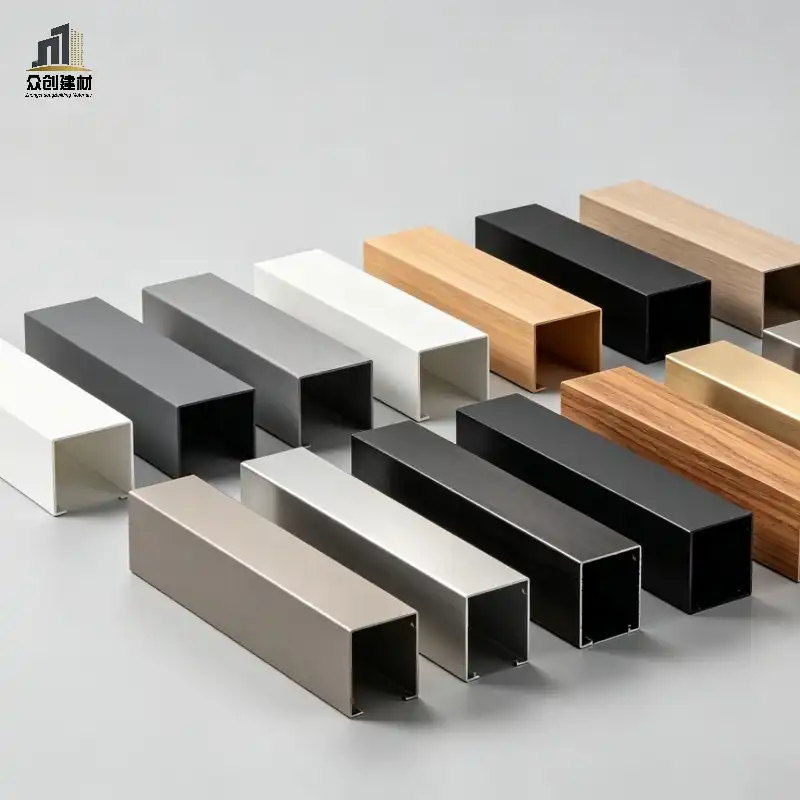
There are three main forms of sound absorption structure for aluminum baffle ceilings. The first is pasting sound-absorbing non-woven fabric on the back, which is the simplest sound absorption method. Paste a layer of 0.2-0.5mm thick sound-absorbing non-woven fabric on the back of aluminum baffles, or paste sound-absorbing film at the gaps between baffles. The noise reduction coefficient NRC of this method is about 0.3-0.4, which can reduce medium and high frequency noise, suitable for ordinary offices, corridors and other spaces with low acoustic requirements, with little cost increase, and does not affect the appearance of aluminum baffles, easy to install. The second is laying sound-absorbing cotton on the upper part, laying 50mm thick, 32kg/m³ density centrifugal glass wool or rock wool between the keels on the upper part of aluminum baffles, and wrapping the sound-absorbing cotton with sound-transparent non-woven fabric to avoid glass wool fiber scattering. The noise reduction coefficient NRC of this structure can reach 0.6-0.75, which has good absorption effect on medium and low frequency noise, suitable for shopping malls, supermarkets, school classrooms and other spaces with high acoustic requirements, and is the most widely used sound absorption structure at present. The third is resonant sound absorption structure, designing resonant cavities inside aluminum baffle profiles, or perforating on the back of baffles, filling with sound-absorbing cotton, using Helmholtz resonance principle to absorb low-frequency noise. The noise reduction coefficient NRC of this structure can reach more than 0.8, with good absorption effect on low-frequency noise, suitable for stadiums, high-speed railway stations, airports and other large spaces with prominent low-frequency noise, but the cost is relatively high.
There are multiple factors affecting the sound absorption effect of aluminum baffle ceilings. The first is the opening rate of aluminum baffles, that is, the ratio of the gap area between baffles to the total area. The higher the opening rate, the easier sound waves reach the upper sound-absorbing cotton, the better the sound absorption effect. The opening rate is determined by the bottom width and spacing of baffles. The smaller the bottom width and the larger the spacing, the higher the opening rate. When the bottom width of ordinary U-shaped aluminum baffles is 50mm and the spacing is 100mm, the opening rate is about 67%; when the bottom width is 80mm and the spacing is 100mm, the opening rate is about 56%. To ensure the sound absorption effect, the opening rate is preferably not less than 50%, that is, the baffle spacing is not less than the bottom width. The second is the thickness and density of sound-absorbing cotton. The thicker the sound-absorbing cotton and the higher the density, the better the sound absorption effect, especially for low-frequency sound. 50mm thick 32kg/m³ glass wool is the most cost-effective choice, with good absorption effect on medium and high frequency sound. Increasing the thickness to 100mm can significantly improve low-frequency sound absorption performance. The third is the height of aluminum baffles. The greater the baffle height, the greater the cavity depth between baffles, which is equivalent to increasing the air layer behind the sound-absorbing cotton, and the better the absorption effect on low-frequency sound. The low-frequency sound absorption coefficient of 100mm high baffles is about 20% higher than that of 50mm high baffles. The fourth is installation height. The greater the distance between aluminum baffle ceiling and structural roof, the better the sound absorption effect, especially for low-frequency sound. When the space height in the ceiling is not less than 300mm, better low-frequency sound absorption effect can be obtained.
In addition to the sound absorption structure, the arrangement of aluminum baffles also affects the acoustic effect. Transversely arranged baffles have good diffusion effect on sound propagating along the length direction, and crisscross arranged baffles have good diffusion effect on sound in all directions, making the sound field more uniform. For spaces with clear noise sources, such as subway platforms, baffles can be arranged perpendicular to the noise source direction to increase the number of sound reflections and improve sound absorption efficiency. In areas with particularly high noise, the thickness of sound-absorbing cotton can be locally increased or high sound absorption aluminum baffle products can be adopted for key noise reduction.
Several common acoustic design misunderstandings need to be noted: first, think that as long as sound-absorbing cotton is placed, there will be good sound absorption effect. If the sound-absorbing cotton is sealed with airtight metal plates or plastic films, sound waves cannot enter the sound-absorbing cotton, and there will be no sound absorption effect. Sound-absorbing cotton must be wrapped with sound-transparent non-woven fabric or glass silk cloth; second, only pay attention to high-frequency sound absorption, ignore low-frequency sound absorption. Many noises in public spaces are low-frequency air conditioning noise and equipment vibration noise. These low-frequency noises propagate far and are not easy to absorb, requiring sufficient thickness of sound-absorbing cotton and cavity depth to effectively absorb; third, uneven arrangement of sound-absorbing materials, only arranging sound-absorbing materials locally will lead to uneven sound field distribution and acoustic defects.
Reasonably acoustically designed aluminum baffle ceilings can reduce the reverberation time of public spaces by 30%-50%, improve speech intelligibility by more than 20%, reduce space noise by 5-10 decibels, significantly improve user experience, while maintaining the advantages of beautiful, transparent and easy installation of aluminum baffle ceilings, making it one of the best choices for modern public space ceilings.