_1782530506402.webp)
(1)_1783045836766.webp)
_1786157639392.webp)
(1)_1780970038980.webp)
Entrance Shaped Aluminum Ceiling Selection Guide
Common Shaped Types & Visual Features
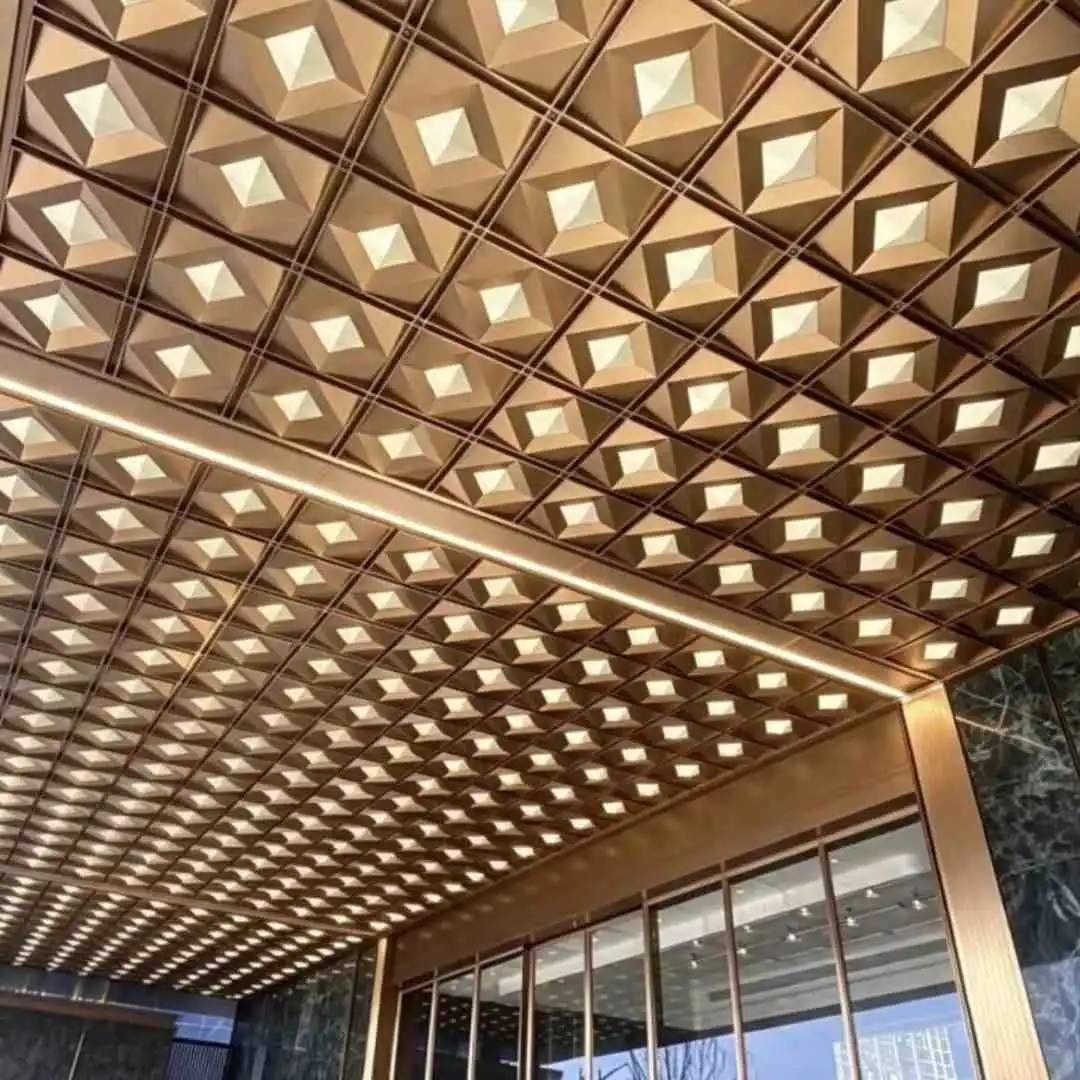
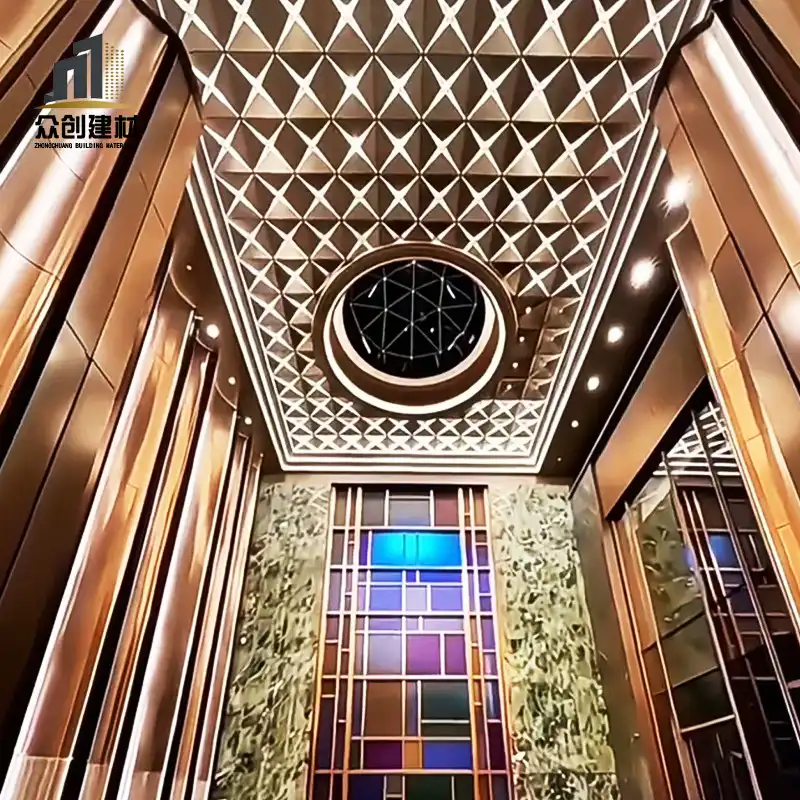
Understanding shaped types is the first step in selection. Entrance shaped aluminum ceilings can be divided into the following types by design language:
|
Shaped Type |
Form Feature |
Visual Feature |
Application |
|---|---|---|---|
|
Wave form |
Continuous undulating surface |
Flowing rhythm, soft and modern |
Lobbies, foyers |
|
Petal form |
Radial petal units |
Blooming, artistic tension |
Hotel entrances, showrooms |
|
Streamlined form |
Free curve extension |
Futuristic, dynamic and fluent |
Commercial complex entrances |
|
Folded form |
Multi-angle folded panels |
Geometric, powerful and modern |
Office foyers |
|
Perforated irregular |
Custom pattern perforation |
Light-and-shadow play, brand symbol |
Brand spaces, transport hubs |

Shaped Aluminum Ceilings vs. Other Ceiling Materials
When selecting, designers typically weigh multiple options: shaped aluminum ceilings, standard aluminum tiles, mineral wool ceilings, and gypsum forms. Key differences:
|
Dimension |
Shaped Aluminum |
Standard Aluminum Tiles |
Mineral Wool |
Gypsum Forms |
|---|---|---|---|---|
|
Shaping ability |
Strong (free-form surfaces) |
Weak (regular squares) |
Weak (mostly flat) |
Strong (on-site built) |
|
Precision |
High (factory ±1mm) |
High |
Medium |
Workmanship-dependent |
|
Installation time |
Short (factory pre-fab) |
Short |
Short |
Long (on-site plastering) |
|
Fire rating |
Class A |
Class A |
Class A |
Class A (with treatment) |
|
Moisture & mold resistance |
Excellent |
Excellent |
Poor (absorbs moisture) |
Poor (cracks and molds) |
|
Maintenance |
Removable |
Removable |
Removable |
Not removable |
|
Cost |
Medium-high |
Low |
Low |
Medium |
Four Points of Shaping Precision and Detailing
The final effect of a shaped ceiling is determined by detailed design, forming precision, joint treatment, and lighting coordination. Note the following during design:
-
Detailed Design First: Complex forms must have surface development drawings and unit fabrication drawings to avoid on-site rework.
-
Precision Control: Control forming precision within ±1mm to ensure continuous, smooth multi-unit splicing.
-
Joint Treatment: Design joints as reveal gaps or shadow grooves, turning seams into part of the design language.
-
Lighting Coordination: Align light coves with form curves to avoid uneven light patches.
Forming Process Comparison
|
Process |
Feature |
Suitable Form |
Cost |
|---|---|---|---|
|
CNC bending |
Precise angles, high efficiency |
Folded and geometric forms |
Low |
|
Curved forming |
Roll bending or die forming, smooth surfaces |
Wave and streamlined forms |
Medium |
|
Laser / punch cutting |
Precise perforation patterns |
Perforated irregular forms |
Medium |
|
Welded assembly |
Strong integrity, complete forms |
Complex large-volume forms |
High |
Common Installation Issues & Solutions
Although shaped ceiling installation seems straightforward, the following issues are frequently overlooked:
-
Grid Layout: Shaped ceilings demand high grid positioning accuracy; mark out per detailed drawings and recheck elevations.
-
Hanger Load Capacity: Large shaped units are heavy; hanger spacing and specification must be determined by load calculation.
-
Step Transitions: Set transition edge trims at steps to avoid visible misalignment or gaps.
-
Pre-embedded Access Hatches: Reserve hatches at equipment locations in the factory; on-site cutting damages coating and forms.
-
Color Consistency: Order all units for one shaped area in a single batch to avoid batch color variation.
How to Evaluate a Supplier
When selecting an entrance shaped aluminum ceiling supplier, consider the following:
-
Detailed Design Capability: Can the supplier produce surface development drawings, unit fabrication drawings, and grid layout drawings from your renderings?
-
Forming Equipment Capability: Does the supplier have CNC bending, roll curving, laser cutting, and welding capability, and can it guarantee ±1mm precision?
-
Complex Project Experience: Does the supplier have actual project experience with large-volume, multi-surface splicing?
-
Certifications and Export Experience: AAMA 2605, CE, and ISO 9001 certification, plus export experience with international packaging and customs clearance.