_1762768699969.webp)

_1782530506402.webp)
(1)_1783045836766.webp)
_1786157639392.webp)
(1)_1780970038980.webp)
How to Choose Wave Texture Size for Wavy Aluminum Panels
Introduction
3D wavy aluminum panels (also called undulating aluminum cladding or organic wave aluminum facade) have become one of the most popular custom decorative facade materials for modern buildings, thanks to their dynamic light-shadow effect and sculptural look. However, choosing the wrong wave texture size is the most common cause of poor visual results: waves that are too small look flat from a distance, while waves that are too large feel oppressive in small spaces and increase cost unnecessarily.
This guide explains the two core parameters that define wave texture size, the key factors to consider when selecting, scenario-based size recommendations, common mistakes to avoid, and a quick reference selection table for architects and designers.
Understanding Wave Texture Parameters: Amplitude & Wavelength
Before selecting wave size, it is critical to understand the two independent parameters that define every wavy panel:
- Wave Amplitude (Wave Height/Depth): The vertical height difference between the wave peak and trough, measured in millimeters. Common amplitudes range from 10mm to 100mm. Amplitude determines how "deep" and dramatic the texture looks.
- Wavelength (Wave Pitch/Spacing): The horizontal distance between two adjacent wave peaks, measured in millimeters. Common wavelengths range from 100mm to 600mm. Wavelength determines how dense or spread out the waves appear.
These two parameters work together:
- Large amplitude + short wavelength = Dramatic, dense, sculptural texture
- Large amplitude + long wavelength = Flowing, gentle, large-scale waves
- Small amplitude + short wavelength = Fine, subtle, rippled texture
- Small amplitude + long wavelength = Almost flat, minimal subtle texture
Core Factors That Determine Wave Size Selection
Viewing Distance
Viewing distance is the single most important factor. The human eye cannot resolve fine texture from far away:
- For viewing distances over 20m (building facades, large atriums): Use amplitude ≥ 60mm, wavelength ≥ 300mm, otherwise the texture will look flat
- For viewing distances 5-20m (lobbies, corridors, medium rooms): Use amplitude 30-80mm, wavelength 150-400mm
- For viewing distances under 5m (feature walls, small rooms, close-up areas): Use amplitude 15-40mm, wavelength 100-250mm for fine detail
Space Size & Proportion
Wave size must be proportional to the space:
- Large spaces over 500m² or ceilings over 5m high: Large waves work well and add scale
- Small spaces under 50m² or ceilings under 3m high: Small to medium waves only; large waves will make the space feel cramped and busy
- As a rule of thumb: maximum wave amplitude should not exceed 1/20 of the ceiling height or wall width
Design Style & Desired Effect
- Bold, sculptural, contemporary style: Large amplitude (80-150mm), irregular wavelength
- Soft, organic, minimalist style: Medium amplitude (30-60mm), regular smooth wavelength
- Subtle, refined, luxury style: Small amplitude (15-30mm), fine regular wavelength
- Industrial, dramatic style: Large amplitude, short wavelength for high contrast
Lighting Conditions
Wave texture relies on light to create shadow and depth:
- Side lighting, wall washers or low angle light: Even small amplitude waves will show good texture
- Flat overhead lighting or diffuse daylight: Need 30-50% larger amplitude to achieve the same visible effect
- For exterior facades: Low morning/evening sun creates the best shadow; midday sun flattens texture, so use slightly larger amplitude for all-exterior use
Cost & Structural Considerations
- Larger amplitude requires thicker base material (minimum 2.0mm for amplitude over 80mm) and internal stiffeners, increasing material cost by 20-50%
- Very short wavelength (under 100mm) with large amplitude increases fabrication difficulty and cost
- For exterior use, very large amplitude can increase wind load and wind noise; always confirm structural calculation for amplitudes over 100mm on high-rise buildings

Wave Size Selection by Application Scenario
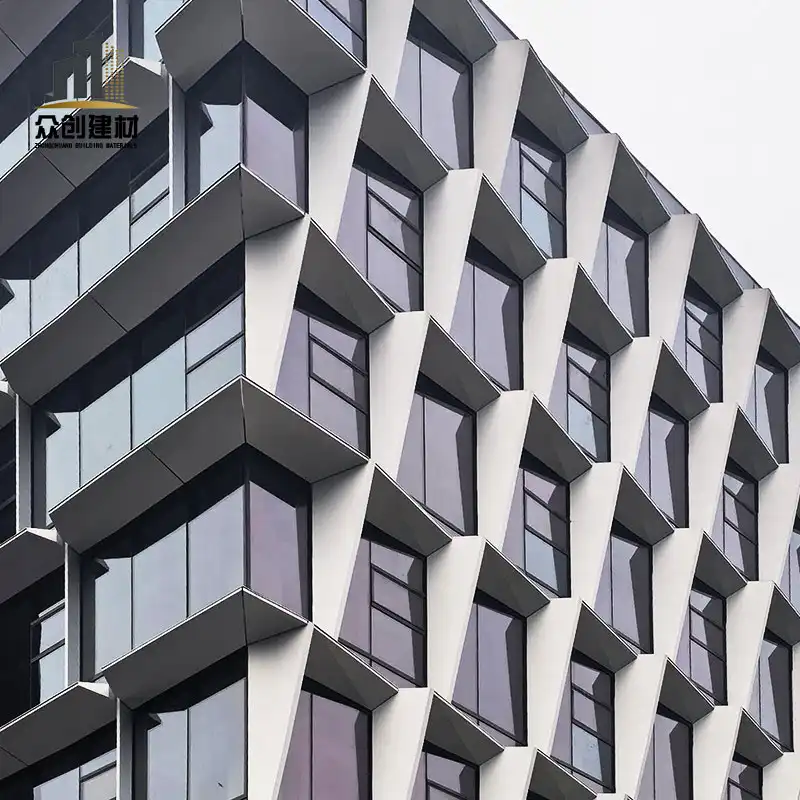
Exterior Building Facades & Large Elevations
- Recommended: Amplitude 80-150mm, Wavelength 300-600mm
- Why: Large waves are visible from street level, create dynamic shadow changes throughout the day, and the open wave shape drains water well. Regular wavelength is preferred for large facades to avoid visual chaos.
- Note: Use minimum 2.5mm panel thickness and internal stiffeners for amplitudes over 100mm.
Hotel Lobbies, Atriums & Large Public Spaces
- Recommended: Amplitude 40-80mm, Wavelength 200-400mm
- Why: Medium waves balance visual impact and comfort, adding texture without overwhelming large open spaces. Works well with both side and overhead lighting.
- Note: For very high atriums over 8m, increase amplitude to 60-100mm.
Interior Feature Walls, TV Walls & Accent Walls
- Recommended: Amplitude 15-40mm, Wavelength 100-250mm
- Why: Small to medium waves create fine, detailed texture for close viewing, adding warmth and depth without making the wall feel heavy.
- Note: For luxury hotel and residential feature walls, 20-30mm amplitude with 150mm wavelength is the most popular choice.
Ceilings & Corridors
- Recommended: Amplitude 20-50mm, Wavelength 200-400mm
- Why: Low to medium amplitude waves add texture to ceilings without reducing perceived headroom. Long wavelength creates a flowing, linear effect that extends space.
- Note: Avoid amplitude over 60mm for ceilings under 3m, as it will make the space feel lower.
Storefronts, Signage & Brand Facades
- Recommended: Amplitude 40-80mm, Custom wavelength matching brand identity
- Why: Medium waves create high visual impact from street level, and custom wave patterns can be designed to match brand geometry or logo forms.
- Note: Backlit or edge-lit wave panels work best with 30-50mm amplitude to show light gradient.
Common Size Mistakes & How to Avoid Them
- Using small waves on large exterior facades: From 10+ meters away, 20mm amplitude waves look completely flat. Always use minimum 60mm amplitude for exterior use.
- Using large waves in small rooms: 100mm amplitude waves in a 2.6m high room will feel oppressive and busy. Keep amplitude under 30mm for small residential spaces.
- Ignoring stiffeners for large amplitude: Panels over 80mm amplitude without internal stiffeners will rattle in wind and may deform over time. Always specify stiffeners for large waves.
- Too short wavelength for large areas: Wavelength under 100mm on a 100m² wall will look overly busy and collect dust. Use minimum 200mm wavelength for large areas.
- Forgetting lighting effect: A 20mm wave under flat overhead light looks almost flat. Always plan lighting alongside wave selection, or increase amplitude for flat light environments.
Quick Reference Selection Table
| Application Scenario | Recommended Amplitude | Recommended Wavelength | Visual Effect | Key Note |
|---|---|---|---|---|
| High-rise exterior facade | 100-150mm | 400-600mm | Bold, sculptural | Min 2.5mm thickness + stiffeners |
| Low-rise commercial facade | 60-100mm | 300-500mm | Dynamic, modern | Confirm wind load |
| Hotel lobby / atrium | 40-80mm | 200-400mm | Flowing, elegant | Increase for >8m height |
| Office / public corridor | 30-50mm | 200-350mm | Subtle, professional | Avoid >60mm for low ceilings |
| Residential / hotel feature wall | 20-30mm | 120-200mm | Fine, luxurious | Best for close viewing |
| Retail storefront / signage | 40-80mm | Custom 150-400mm | High impact, brandable | Works well with backlighting |
| Interior ceiling | 20-50mm | 250-400mm | Flowing, space-extending | Keep amplitude <1/20 ceiling height |
Real Project Reference Cases
- Commercial complex facade, Guangzhou: 120mm amplitude, 500mm wavelength regular waves on 8,000m² exterior. The large waves are clearly visible from the street, with changing shadow effects throughout the day. Structural calculation confirmed wind load resistance for the local 35m/s wind speed.
- Boutique hotel lobby, Chengdu: 50mm amplitude, 250mm wavelength smooth waves on 300m² lobby wall. Medium waves create a soft, organic backdrop that works with both daylight and warm evening lighting, without overwhelming the 4.5m high space.
- Luxury villa TV wall, Shenzhen: 25mm amplitude, 150mm wavelength fine waves. The subtle texture adds depth and warmth to the 3.2m high living room, with side wall washer lighting highlighting the wave detail.
Frequently Asked Questions
Q: Is larger wave size always better?
A: No. Larger waves cost more, require thicker material, and can look oppressive in small spaces. Choose wave size based on viewing distance and space proportion, not just visual impact.
Q: Can small spaces use large decorative waves?
A: Only for small accent walls under 5m². For full walls or ceilings in small spaces, keep amplitude under 30mm to avoid making the space feel cramped.
Q: What is the maximum wave amplitude available for exterior use?
A: Standard fabrication can achieve up to 200mm amplitude, but amplitudes over 150mm require custom structural engineering, thicker material and internal stiffeners, and are only recommended for low-rise feature facades.
Q: Do wavy panels collect more dust than flat panels?
A: Very dense short-wavelength waves can collect dust on horizontal troughs. For interior use, choose wavelength over 150mm and smooth wave profiles for easy cleaning. Exterior waves are self-cleaning with rain.
Q: Can I customize irregular wave patterns?
A: Yes. Custom irregular, organic or parametric wave patterns can be fabricated to match specific design requirements, with custom amplitude and wavelength variation across the panel surface.