_1762768699969.webp)

_1782530506402.webp)
(1)_1783045836766.webp)
_1786157639392.webp)
(1)_1780970038980.webp)
Irregular Wavy Aluminum Panels for Public Buildings: Hotel, Mall & Airport Application
Unlike standard flat panels or regular corrugated materials, organic undulating aluminum panels create a flowing, three-dimensional surface that adds movement and artistic value to large spaces. This guide breaks down why wavy aluminum panels are ideal for public buildings, their core applications in hotels, malls and airports, material comparisons, latest design trends and practical specification tips for large-scale projects.

Why Irregular Wavy Aluminum Panels Are Ideal for Large Public Buildings
Wavy aluminum panels solve many of the unique challenges of public building decoration:
- Large-span prefabrication capability: Panels can be prefabricated in large sizes up to 6m long, making them suitable for high-ceiling lobbies, atriums and large open spaces with minimal joints.
- Lightweight & high safety: Weighing only 4-7kg per square meter, wavy aluminum panels add minimal structural load even for large ceiling installations, with no risk of falling heavy materials — a critical safety requirement for high-footfall public spaces.
- Dynamic light & shadow effect: The undulating surface creates constantly changing light patterns that make large open spaces feel less empty and more immersive, without requiring additional decorative elements.
- Low maintenance & high durability: A2 non-combustible, waterproof, stain-resistant PVDF coating requires only annual cleaning, with 20+ years of service life — perfect for public buildings that operate 365 days a year with limited downtime for maintenance.
- Unlimited design freedom: Wave amplitude, wavelength, curve shape and finish can all be fully customized to match any design concept, from subtle texture to bold sculptural features.
Core Application Scenarios in Hotels, Malls & Airports
Hotel Applications
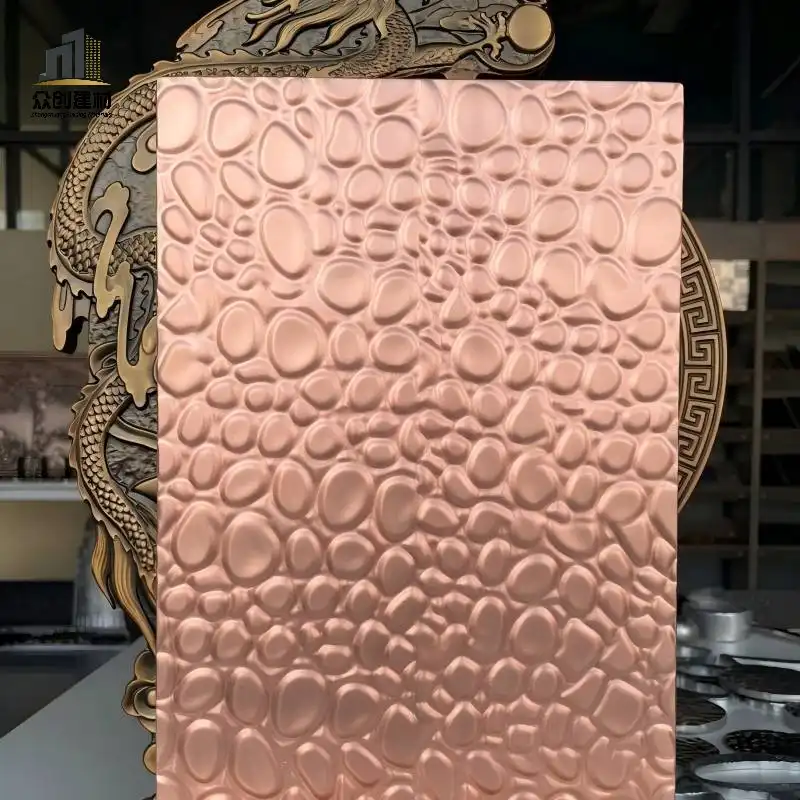
- Lobby & reception feature walls: Large rose gold or bronze wavy panels create a luxurious, welcoming first impression, with integrated lighting highlighting the flowing curves.
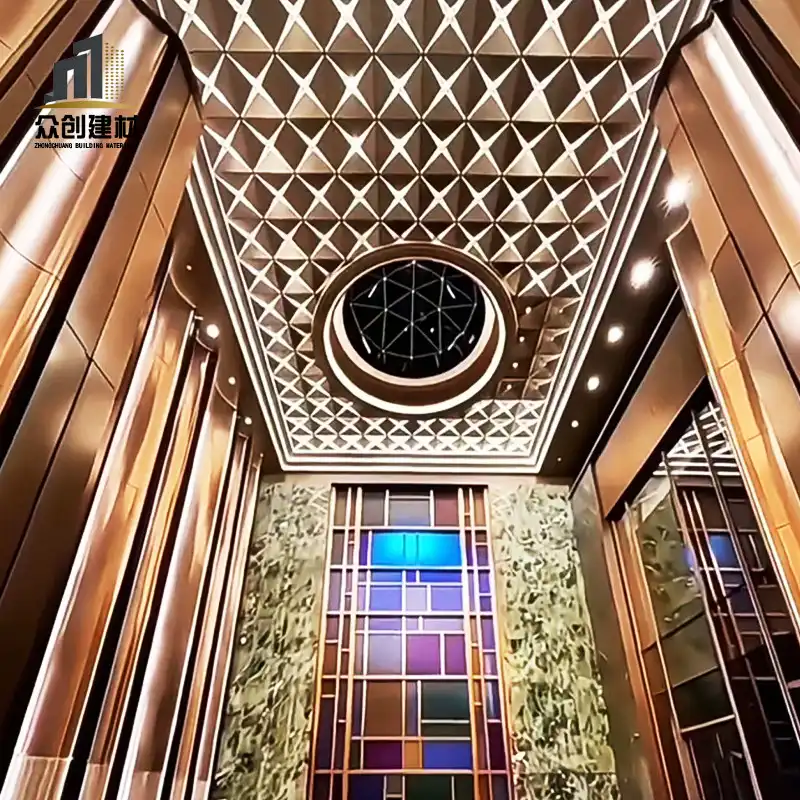
- Corridor & elevator hall ceilings: Low-amplitude wavy ceilings add subtle texture to long narrow corridors, reducing the monotony of long hallways and hiding MEP services.
- Ballroom & function room walls: Acoustic-backed wavy panels combine decorative effect with sound absorption, improving audio quality in large event spaces.
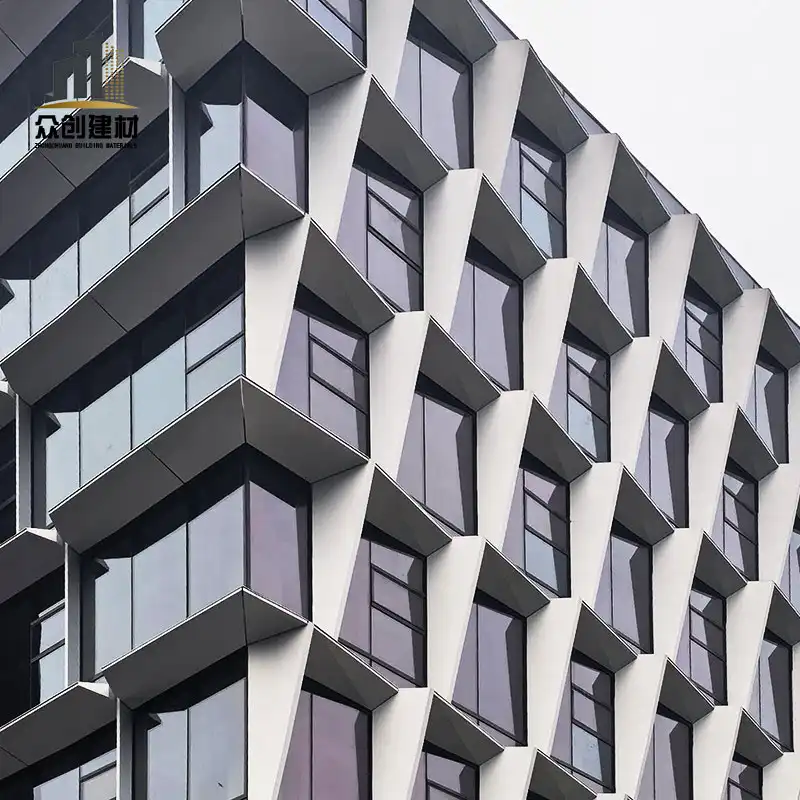
- Exterior facade accents: Organic wave cladding adds a premium, distinctive look to hotel exteriors, helping properties stand out in competitive markets.
Shopping Mall Applications
- Atrium ceilings: Large-span white or light-colored wavy ceilings are the most popular application, creating a bright, open and dynamic central space that draws visitors through the mall.
- Main entrance facades: Bold dark or metallic wavy cladding creates a strong visual identity for mall entrances, improving footfall and brand recognition.
- Corridor & walkway ceilings: Gradient wave panels guide visitor flow through the mall, with different wave amplitudes used to zone different retail areas.
- Food court & leisure area walls: Easy-to-clean wavy panels add a fun, modern atmosphere to high-traffic F&B areas, with stain-resistant coating that withstands frequent cleaning.
Airport & Transportation Hub Applications
- Check-in hall ceilings: Lightweight, fire-rated wavy aluminum ceilings create a calm, spacious feeling in busy check-in areas, while hiding complex MEP and lighting systems.
- Departure lounge feature walls: Subtle wave texture reduces the visual coldness of large airport spaces, creating a more pleasant waiting environment for passengers.
- Baggage claim ceilings: Durable, impact-resistant wavy panels withstand heavy use and luggage trolley impacts, with easy access for maintenance of above-ceiling services.
- Exterior facade & drop-off areas: Weather-resistant PVDF wavy cladding creates a modern, iconic first impression for airport terminals, with 20+ years of low-maintenance performance.

Performance Comparison vs. Common Public Building Decorative Materials
| Material | Weight (kg/sqm) | Fire Rating | Exterior Suitability | 20-Year Maintenance Cost | Shape Freedom | Installation Speed |
|---|---|---|---|---|---|---|
| Irregular Wavy Aluminum | 4-7 | A2 Non-Combustible | Excellent | Very Low | Very High | Fast |
| GRG (Glass Fiber Reinforced Gypsum) | 25-40 | A2 Non-Combustible | Interior Only | High (easily damaged) | High | Slow |
| Natural Stone | 40-60 | A1 Non-Combustible | Excellent | Medium | Low | Very Slow |
| Curved Glass | 25-35 | A1 Non-Combustible | Excellent | Medium | Medium | Slow |
| Fabric / Membrane | 1-2 | Flammable | Limited | High (replacement every 5-7 years) | Medium | Medium |
Wavy aluminum panels deliver the best balance of safety, durability, design freedom and lifecycle cost for most public building applications.
Latest Design Trends for Public Building Wave Panel Applications
Parametric Gradient Waves
Designers are increasingly using parametric design to create wave patterns that gradually change amplitude or direction across large surfaces, guiding visitor flow and creating a sense of movement through space. This effect is especially popular in mall atriums and airport corridors.
Integrated Light & Shadow Design
Instead of separate lighting fixtures, LED strips are integrated into the wave valleys to create soft, indirect lighting that highlights the curved shape. This eliminates visible light fixtures and creates a seamless, immersive surface effect.
Acoustic Composite Panels
For noisy public spaces like airport terminals and food courts, wavy panels are manufactured with micro-perforations and acoustic backing to deliver NRC 0.7-0.8 sound absorption, combining decoration and acoustic treatment in one system.
Multi-Material Combinations
Wavy aluminum panels are increasingly combined with wood grain, stone texture and glass elements to create layered, textured effects. For example, wood grain wave panels in hotel lobbies add warmth, while metallic panels create a modern, high-tech feel in airports.
Sustainable & Circular Design
As public buildings prioritize sustainability, aluminum's 100% recyclability and long service life make wavy panels a preferred choice. Many new projects use recycled aluminum content and design panels for disassembly and future reuse.
Common Design & Specification Mistakes for Public Projects
- Overly large wave amplitude for high ceilings: Very deep waves collect dust and are difficult to clean in high spaces. For ceilings over 5m high, keep amplitude under 150mm for easy maintenance.
- Ignoring acoustic requirements: Large hard-surfaced wavy panels can cause echo in big spaces. Always specify perforated acoustic backing for areas with high noise levels.
- Not planning for maintenance access: Large wavy ceiling systems require integrated access panels for above-ceiling MEP services. Plan access points during design, not after installation.
- Choosing the wrong finish for high-traffic areas: Matte finishes show fingerprints and scuffs in high-touch areas. Use semi-gloss or anti-fingerprint coating for walls within reach of visitors.
- Underestimating structural requirements: Even though aluminum is light, large wavy ceiling panels require proper structural calculation for wind load (for exterior) and seismic requirements. Always work with an experienced supplier for structural design.
Practical Tips for Specifying Wave Panels in Public Projects
- Involve suppliers early: Engage your panel supplier during schematic design to get input on manufacturability, cost optimization and installation details.
- Test full-scale samples: Always order a 1:1 scale sample of the wave shape and finish to verify light effect and appearance before mass production.
- Standardize panel modules: Use repeating panel sizes where possible to reduce cost and speed up installation, even with irregular wave shapes.
- Plan for cleaning access: For high ceilings, integrate access points or specify self-cleaning PVDF coating to reduce long-term maintenance.
- Verify fire certificates: For airports, malls and hotels, always require national and international fire test certificates for all panel materials.
Frequently Asked Questions
Q: Are wavy aluminum panels approved for airport fire safety requirements?
A: Yes. Aluminum panels are A2 class non-combustible, meeting all international airport and public building fire safety standards. They do not burn or release toxic fumes in a fire.
Q: Are large wavy ceiling systems safe in high-footfall public areas?
A: Yes. All our public project ceiling systems are engineered with redundant safety fixings and structural calculations to meet public building safety standards, with zero risk of panel fall.
Q: How do you clean wavy aluminum panels in public spaces?
A: The smooth PVDF coating can be cleaned with mild detergent and water, either by manual wiping for low walls or high-pressure washing for high ceilings. The non-porous surface does not stain easily.
Q: How does the cost of wavy aluminum compare to GRG for public projects?
A: Upfront material cost is 10-20% higher than GRG, but total lifecycle cost is 40% lower due to zero maintenance, longer service life and faster installation. For exterior or high-moisture areas, aluminum is the only viable option.