_1762768699969.webp)

_1782530506402.webp)
(1)_1783045836766.webp)
_1786157639392.webp)
(1)_1780970038980.webp)
LED Integrated Architectural Metal Ceiling Manufacturing Process
Introduction
LED integrated architectural metal ceilings combine decorative aluminum panels, backlighting systems and structural suspension into a single unified solution. For commercial project buyers, fabrication process quality directly determines luminous uniformity, service lifespan, fire safety and long-term maintenance costs. Many purchasers only evaluate appearance and price while overlooking underlying process differences that drive long-term performance. This guide breaks down the standard manufacturing workflow, critical quality checkpoints and process selection criteria aligned with international architectural industry standards.
Core Raw Materials for LED Integrated Metal Ceilings
The performance of finished luminous ceilings starts with raw material selection, with four core components:
- Aluminum face panel substrate: Standard grades include 3003-H24 aluminum alloy for regular indoor projects and 5052-H14 marine-grade alloy for high-humidity coastal or swimming pool applications. Common thickness ranges from 1.5mm to 3.0mm depending on span requirements.
- LED light source: Commercial-grade SMD LED chips with CRI Ra≥85 standard (Ra≥90 for premium display applications). Color temperature options cover 3000K warm white, 4000K neutral white and 6000K cool white.
- Optical layer assembly: Includes light guide plate (LGP) for uniform light diffusion, reflective backing layer and matte diffuser face film to eliminate visible light points and glare.
- LED driver & electrical components: Isolated constant-current drivers with overvoltage, overcurrent and short-circuit protection, compliant with international electrical safety standards.

Step-by-Step Standard Fabrication Process
1. CNC Panel Cutting & Forming
Production begins with precision CNC cutting of aluminum coils to custom panel dimensions, with dimensional tolerance controlled within ±0.5mm. For perforated pattern or custom logo luminous ceilings, laser etching or CNC punching is performed at this stage to create the required light-transmitting patterns. Panels then undergo CNC edge bending to form the mounting flange, with bending angle accuracy of ±0.1° for consistent joint alignment.
2. Surface Finishing Treatment
Formed panels go through pre-treatment including degreasing, phosphating and chromate conversion to improve coating adhesion. Two standard finish options are available:
- Polyester powder coating for standard indoor applications (10-year finish warranty)
- PVDF fluorocarbon coating for outdoor or high-humidity areas (20+ year weather resistance) Batch color difference is controlled within ΔE ≤ 0.5 to ensure visual consistency across large ceiling areas.
3. Optical Component Assembly
In a dust-free assembly workshop, the reflective layer, light guide plate, diffuser film and LED strip light sources are sequentially installed inside the panel frame. Special attention is paid to edge sealing to prevent light leakage, with light source spacing calibrated to ensure fully uniform surface brightness without dark zones or visible individual light points.
4. Electrical Safety & Luminous Performance Testing
Every assembled panel undergoes two mandatory tests before leaving the factory:
- Electrical safety test: Insulation resistance, grounding continuity and withstand voltage testing to ensure compliance with commercial building electrical codes
- Luminous uniformity test: 24-hour aging test under rated voltage to verify no flicker, no dark spots and consistent brightness across the full panel surface
5. Keel System Matching & Packaging
Panels are matched with corresponding hook-on keel suspension systems, with pre-drilled mounting points for fast on-site installation. Finished products are packed with protective foam and corner guards to prevent transport damage to panel edges and optical layers.
Critical Quality Control Points in Production
Three process indicators are the strongest predictors of long-term product performance:
- Luminous uniformity: High-quality panels achieve ≥90% brightness uniformity across the full surface, with no visible LED dot matrix or edge dark zones. Low-quality assemblies often show visible light points or uneven brightness within 1-2 years of use.
- Circuit sealing & insulation: Fully sealed wire connections and insulated internal wiring prevent moisture ingress and short-circuit risks, which is especially critical for humid environments like spas and swimming pool ceilings.
- Panel flatness tolerance: Premium fabrication maintains panel flatness within ≤0.5mm per meter, ensuring tight, uniform joints between adjacent panels after installation.
Common Process Types & Performance Comparison
| Process Type | Fabrication Difficulty | Relative Cost | Best Application Scenarios |
|---|---|---|---|
| Flat diffused luminous ceiling | Low | Base level | Large open offices, lobbies, corridors |
| Perforated pattern luminous ceiling | Medium | 15-25% higher | Brand stores, corporate image walls, feature ceilings |
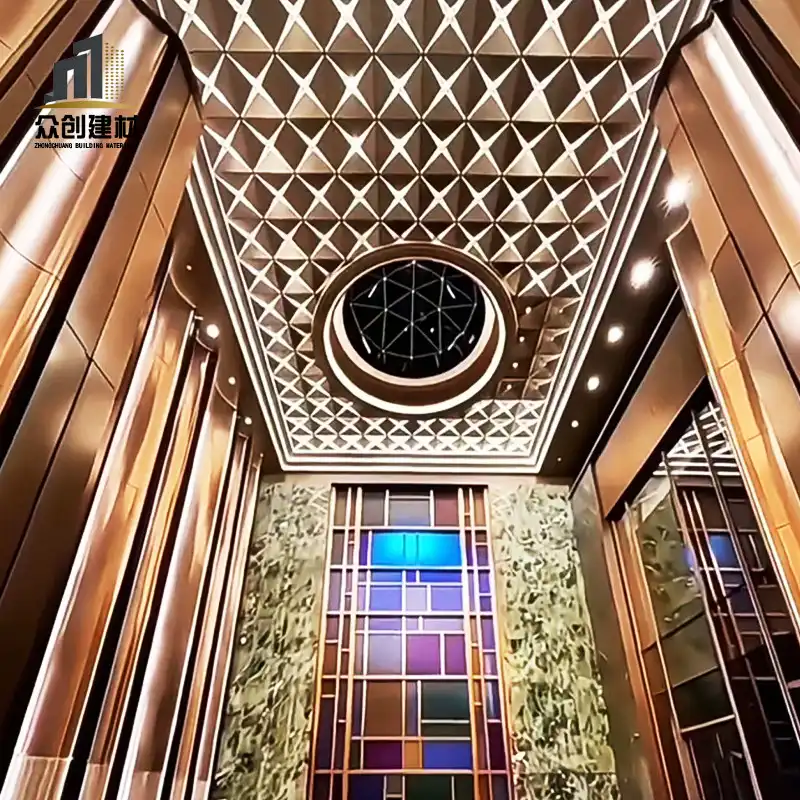
| Linear strip luminous ceiling | Medium-low | 10% higher | Corridors, elevator lobbies, retail display areas |
| Custom shaped curved luminous ceiling | High | 50-100% higher | Luxury hospitality, cultural venues, landmark projects |
Key Process Indicators to Verify for Procurement
When evaluating suppliers, buyers should request verification of five core process metrics rather than relying only on price:
- Official luminous uniformity test report (target ≥90% uniformity)
- LED chip brand and rated lifespan specification (minimum 50,000 hours for commercial grade)
- Fire safety test report for the full panel assembly (A2 non-combustible rating required for commercial buildings)
- Sample panel 72-hour aging test results to rule out early light decay
- Dimensional tolerance and flatness inspection data for batch consistency
Final Recommendations
For most commercial office, hospitality and retail projects, standard flat diffused LED integrated metal ceilings deliver the best balance of performance, cost and durability. For brand-focused or high-end design projects, perforated pattern custom ceilings offer unique brand expression value while retaining all the structural and safety benefits of aluminum ceiling systems.
Buyers should prioritize suppliers with dedicated dust-free assembly workshops and formal luminous performance testing capabilities, as these process capabilities directly determine the long-term reliability of the finished product.