_1762768699969.webp)

_1782530506402.webp)
(1)_1783045836766.webp)
_1786157639392.webp)
(1)_1780970038980.webp)
Ventilation Design of Exterior Wall Aluminum Baffles: Performance Advantages of Open Curtain Walls
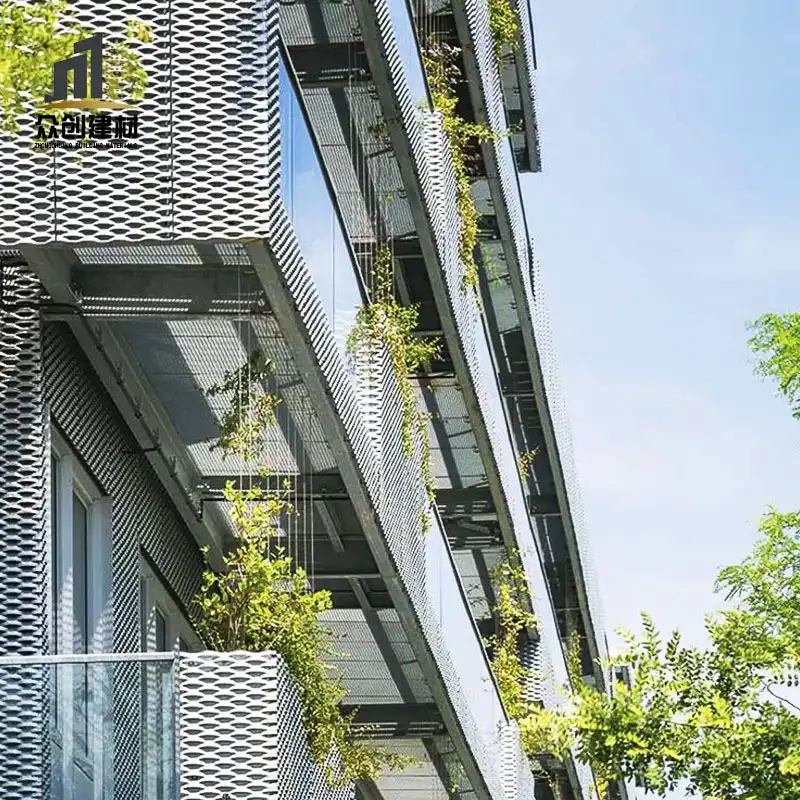
Traditional closed aluminum veneer curtain walls have problems such as poor thermal performance, easy condensation, rainwater leakage, high maintenance costs, etc. The open curtain wall with exterior wall aluminum baffles sets up a ventilation air layer between the decorative layer and the structural layer, realizes natural air circulation using the chimney effect, and fundamentally solves many defects of closed curtain walls, which is the development direction of building exterior wall decoration at present.
The ventilation principle of open aluminum baffle curtain walls is the chimney effect under thermal pressure. The sun shines on the outer aluminum baffles, the baffles absorb solar radiation and the temperature rises, heating the air in the ventilation layer. The hot air density decreases and rises, discharging from the ventilation outlet at the top of the curtain wall, and fresh outdoor cold air supplements into the ventilation layer from the air inlet at the bottom of the curtain wall, forming a continuous natural air circulation. This circulation process can take away the heat and moisture in the ventilation layer, make the temperature in the ventilation layer close to the outdoor air temperature, greatly reduce the heat entering the room, keep the insulation layer dry at the same time, improve the insulation effect, and extend the service life of the curtain wall.

Ventilation layer design is the core of open curtain walls. The thickness of the ventilation layer, that is, the distance from the back of aluminum baffles to the waterproof back plate, is usually designed as 50mm-100mm, minimum not less than 40mm, maximum not more than 200mm. If the ventilation layer is too thin, air circulation resistance is large, ventilation effect is poor; if the ventilation layer is too thick, it will increase the overall thickness of the curtain wall, waste space, and easy to form turbulence, but reduce the ventilation effect. The ventilation layer should form an air passage that runs through up and down, there should be no closed partitions in the middle, and deflectors should be set between each floor to guide air to flow upward and avoid air short circuit between floors. Air inlets are set at the bottom of each floor curtain wall, air outlets are set at the top of each floor curtain wall. The area of air inlets and outlets is not less than 50% of the cross-sectional area of the ventilation layer, preferably more than 80%, to ensure smooth air circulation. Air inlets should be equipped with insect-proof nets to prevent mosquitoes from entering the ventilation layer; air outlets should be equipped with rain-proof louvers to prevent rainwater from entering.
Ventilation volume calculation is the key to ventilation design. According to the thermal pressure principle, ventilation volume is proportional to ventilation layer thickness, height difference between air inlets and outlets, and internal and external temperature difference. Generally, when the ventilation layer thickness is 80mm, height difference between air inlets and outlets is 3 meters (standard floor height), and internal and external temperature difference of ventilation layer is 15℃ in summer, the air flow rate in the ventilation layer can reach 0.3-0.5m/s, and the ventilation volume per hour per meter length of curtain wall can reach 100-150 cubic meters, which is enough to take away the heat in the ventilation layer. For super high-rise buildings, the influence of wind pressure on ventilation should also be considered. The wind pressure on the windward side is large, air will be pressed into the ventilation layer from the air inlet, and the ventilation effect is better; the wind pressure on the leeward side is small, mainly relying on thermal pressure ventilation, and the area of air inlets and outlets on the leeward side should be appropriately increased during design.
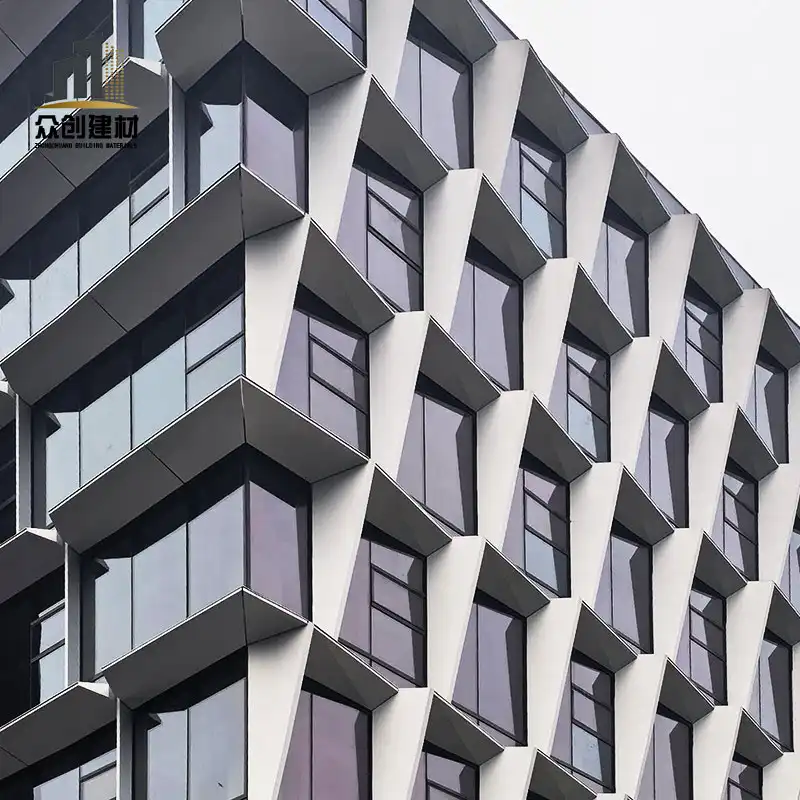
Open aluminum baffle curtain walls have significant performance advantages over traditional closed curtain walls. First is energy saving advantage. More than 80% of solar radiation heat is blocked by the outer aluminum baffles in summer, and air circulation in the ventilation layer takes away most of the heat. According to actual tests, the inner surface temperature of open curtain walls in summer is 8-12℃ lower than closed curtain walls, the heat entering the room through the exterior wall is reduced by 40%-60%, which can reduce air conditioning energy consumption by more than 30%; in winter, the air layer in the ventilation layer is equivalent to an insulation layer, reducing indoor heat transfer outward, which can reduce heating energy consumption by more than 15%, with significant annual energy saving effect. Second is waterproof advantage. Open curtain walls adopt isobaric waterproof principle, the pressure in the ventilation layer is basically equal to the outdoor pressure, rainwater will not enter the curtain wall due to pressure difference, and a small amount of rainwater entering will flow along the waterproof back plate to the drainage tank for discharge, fundamentally solving the persistent problem of easy water leakage of closed curtain walls, and waterproof reliability is greatly improved. Third is durability advantage. Air circulates in the ventilation layer, no condensation, the insulation layer always keeps dry, will not reduce insulation effect due to moisture, will not breed mold and corrode metal components due to long-term humidity, the service life of curtain walls can be extended from 15-20 years of closed curtain walls to 30-50 years, and the life cycle cost is greatly reduced. Fourth is maintenance advantage. Aluminum baffles are open, ventilated and self-cleaning, not easy to accumulate dust, surface dirt can be washed away by rain, no need for regular cleaning, single damaged baffle can be replaced separately, low maintenance cost. Fifth is visual advantage. Aluminum baffles have strong line sense, rich layers, good light and shadow effect, and the building facade has more texture.
Several issues need attention in ventilation design. First is fire protection design. The ventilation layer runs through up and down, in case of fire, flame and smoke will spread along the ventilation layer, so fire sealing must be set at each floor slab position, using 1.5mm thick galvanized steel plate plus fire rock wool to seal the ventilation layer, the air passage at the fire sealing is disconnected to prevent vertical spread of fire, and each floor forms an independent fire compartment. Second is drainage design. Although there is little rainwater in the ventilation layer, drainage gutters and drainage holes should be set at the bottom of each floor to discharge the entered rainwater in an organized manner. The diameter of drainage holes is not less than 8mm, spacing not more than 1000mm, to avoid water accumulation. Third is wind protection design. The wind speed in the ventilation layer of super high-rise buildings may be very high, so waterproof back plates and insulation layers should be fixed to prevent being blown by wind. Fourth is noise reduction design. Air flow in the ventilation layer may produce wind noise. Setting silencing louvers at air inlets and outlets, or pasting sound-absorbing cotton in the ventilation layer can effectively reduce wind noise.
Many people worry that open curtain walls will let in dust and insects. In fact, as long as the air inlets are equipped with qualified insect-proof nets, the air in the ventilation layer flows from bottom to top, dust is not easy to deposit, and a small amount of dust will be washed away by rain, so no dust will accumulate after years of use. Others worry that open curtain walls have poor insulation effect. In fact, dry air is a poor conductor of heat, the existence of ventilation layer improves insulation effect, and the insulation layer will not be damp, insulation performance is stable for a long time, much better than closed curtain walls where insulation layer is easy to get damp and fail.
The technology of open curtain walls with exterior wall aluminum baffles is very mature, which has been applied for decades in developed countries such as Europe and Japan, and has been widely promoted in China in recent years. It is the development direction of future building curtain walls. Its excellent energy saving performance, waterproof performance and durability have obvious technical and economic advantages compared with traditional curtain walls.