_1762768699969.webp)

_1782530506402.webp)
(1)_1783045836766.webp)
_1786157639392.webp)
(1)_1780970038980.webp)
What Is Seamless Tight-Joint Aluminum Ceiling?
Introduction
As high-end commercial and public spaces raise the bar for interior finish quality, seamless tight-joint aluminum ceilings have emerged as a fast-growing premium ceiling category, replacing traditional gypsum board and standard grid aluminum ceilings in many premium projects. Unlike regular metal ceilings with obvious visible grid lines, this system delivers a smooth, monolithic ceiling surface while retaining all the functional benefits of aluminum construction.
This guide breaks down the definition, core technology, performance advantages, common misconceptions and application scenarios for seamless aluminum ceiling systems, helping architects, project owners and buyers understand the product and make informed specification decisions.

Definition & Core Principle of Seamless Tight-Joint Aluminum Ceilings
A seamless tight-joint aluminum ceiling is a high-precision architectural metal ceiling system that achieves near-invisible panel joints through precision fabrication and a dedicated hidden keel installation system.
It is important to note that "seamless" refers to a visual effect rather than absolute zero gaps. High-quality systems control installed joint width to below 0.3mm — thin enough to be virtually unnoticeable from normal standing height — creating the appearance of a single continuous ceiling surface.
Unlike fully welded one-piece ceilings, tight-joint systems retain modular panel design, meaning individual panels can be removed for ceiling cavity maintenance without damaging the surrounding finish. This balance of monolithic aesthetics and practical maintainability is the core value of the product category.
How It Differs From Traditional Aluminum Ceiling Systems
| Ceiling Type | Joint Width | Visual Effect | Hygiene Performance | Installation Difficulty | Relative Cost |
|---|---|---|---|---|---|
| Seamless Tight-Joint Aluminum | ≤0.3mm | Monolithic, no visible grid | Excellent (no dust accumulation in gaps) | High (precision leveling required) | 1.8-2.5x |
| Concealed Grid Aluminum Ceiling | 1-2mm | Minimal visible joints | Moderate (small gaps collect dust) | Medium | 1.2-1.5x |
| Exposed Grid Aluminum Ceiling | 5-10mm | Obvious grid lines | Poor (wide gaps trap large amounts of dust) | Low | 1x (baseline) |
The core difference lies in dimensional precision and support system design. Standard aluminum ceilings have panel dimensional tolerances of ±0.5mm or more, making tight joints impossible, while seamless grade panels are manufactured to ±0.1mm tolerance with precision-machined edges for consistent gap alignment.
Core Technology That Achieves Near-Invisible Joint Effect
Three key technologies enable the tight seamless finish:
- CNC precision edge machining: Each panel edge is cut and finished with four-axis CNC equipment to ensure straightness within 0.05mm per meter, creating perfectly straight mating edges for uniform joints.
- Hidden leveling keel system: The dedicated hidden keel system supports micro height adjustment at every connection point, allowing installers to eliminate height differences between adjacent panels that would create visible shadow lines.
- Full-process tolerance control: Premium manufacturers control dimensional tolerance through every production step from stamping to coating, ensuring every panel in a project matches within 0.1mm for consistent joint width across the entire ceiling.
Key Advantages Over Other Ceiling Materials
vs. Seamless Gypsum Board Ceilings
Seamless aluminum ceilings are fully moisture and mold resistant, with no cracking or yellowing issues common to gypsum board in humid environments. Installation is 2-3 times faster, and the modular design allows easy access to ceiling utilities without patching and repainting.
vs. Mineral Fiber / Acoustic Ceilings
Aluminum systems achieve A2 class non-combustible fire rating with far higher durability and stain resistance, making them suitable for high-traffic public spaces. The smooth non-porous surface is fully sanitizable for healthcare and food industry applications.
vs. Residential Integrated Ceilings
Commercial-grade seamless aluminum ceilings support much larger panel sizes (up to 2400×1200mm) with far tighter joint control, delivering a premium monolithic appearance suitable for large commercial spaces, rather than the small-panel segmented look of residential integrated ceilings.
Common Misconceptions About Seamless Aluminum Ceilings
Misconception 1: "Seamless means there are zero gaps between panels"
No modular panel ceiling can achieve absolute zero gaps due to thermal expansion requirements. High-quality seamless systems achieve 0.3mm or smaller micro gaps that are invisible from normal viewing height, delivering the visual effect of seamless without sacrificing practicality.
Misconception 2: "Any aluminum ceiling can be installed to be seamless"
Seamless effect requires both precision-manufactured panels with tight dimensional tolerance and a dedicated leveling keel system. Standard low-tolerance aluminum panels cannot achieve consistent tight joints even with skilled installation.
Misconception 3: "Seamless aluminum ceilings are much more expensive than regular ceilings"
While material and installation costs are higher than basic exposed-grid ceilings, when total lifecycle cost is considered — including lower maintenance, longer lifespan and no repair repainting costs — seamless aluminum ceilings are cost-competitive with high-end gypsum board ceilings for commercial projects.
Ideal Application Scenarios for Tight-Joint Seamless Ceilings
Seamless aluminum ceilings are preferred for spaces requiring both premium aesthetics and high functional performance:
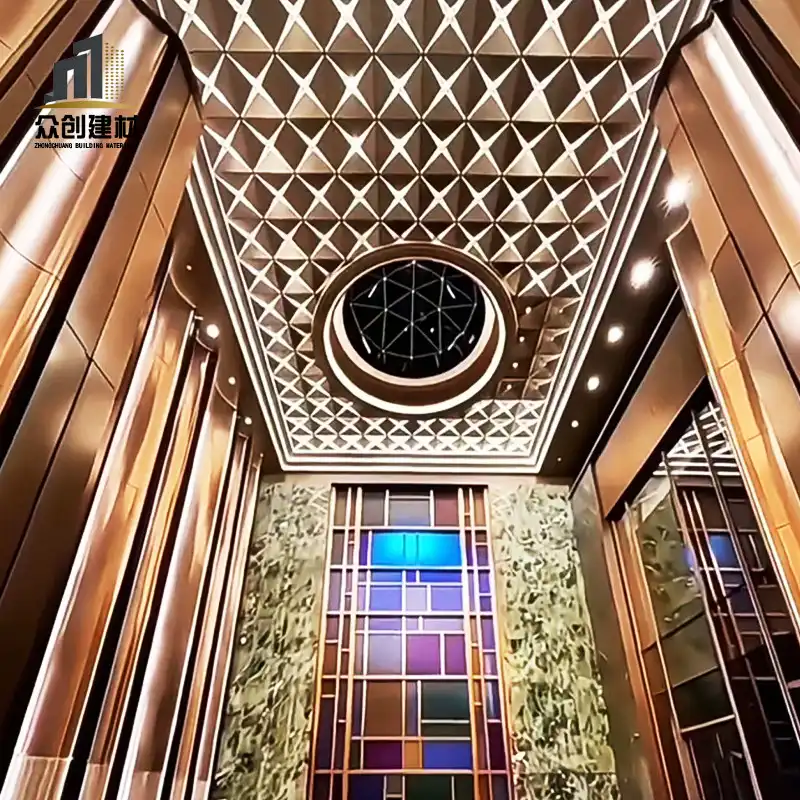
- High-end hospitality: Luxury hotel lobbies, banquet halls and executive suites, where a premium finish is a core brand requirement
- Healthcare & clean environments: Hospital clean wards, operating rooms, pharmaceutical cleanrooms and food processing facilities, where dust-tight joints and sanitizable surfaces are mandatory
- Premium commercial offices: Grade A office lobbies, executive floors and client meeting areas, where a sleek, high-end interior reflects company brand
- Cultural & exhibition spaces: Museums, galleries and exhibition halls, where uniform lighting and unbroken ceiling surface support optimal display conditions
- Transportation hubs: Airport VIP lounges, high-speed rail station premium waiting areas and metro station public zones, where durability and easy maintenance are critical
How to Choose a Qualified Seamless Aluminum Ceiling Supplier
When evaluating suppliers, verify four key criteria:
- Dimensional tolerance specification: Confirm panel edge tolerance is ±0.1mm or tighter, with formal inspection reports
- Dedicated keel system: Ensure the supplier provides a purpose-built hidden leveling keel, not standard grid keels repurposed for "seamless" installation
- Large project case reference: Review completed large-scale commercial projects to verify real-world joint quality and long-term performance
- Full certification: Check for A2 fire rating, coating durability certification and relevant industry quality standards
Frequently Asked Questions
Q: Can seamless aluminum ceilings be made into curved or irregular shapes?
A: Yes. Premium manufacturers offer custom curved and shaped seamless panels using CNC roll-forming technology, with the same tight joint tolerance as standard rectangular panels for curved ceiling applications.
Q: What is the typical lifespan of a seamless aluminum ceiling system?
A: With standard indoor powder coating, the system has a 15-20 year service life with no fading, deformation or rust. PVDF coated versions for semi-outdoor areas last 25+ years.
Q: Can acoustic performance be added without ruining the seamless look?
A: Yes. Micro-perforated panels with sound-absorbing backing deliver NRC 0.7-0.9 acoustic performance. The perforations are small enough to remain nearly invisible from normal height, preserving the monolithic seamless appearance.