_1762768699969.webp)

_1782530506402.webp)
(1)_1783045836766.webp)
_1786157639392.webp)
(1)_1780970038980.webp)
Wood Grain Aluminum Wall Panel Industry Guide: From Process Principles to Selection and Application
In the field of architectural decorative materials, "simulating wood with metal" is not a new concept. However, achieving realistic wood appearance with performance that comprehensively surpasses natural wood is the result of material processing advances over the past decade. As an important subcategory of metal decorative panels, wood grain aluminum wall panels are rapidly replacing natural wood and traditional decorative boards worldwide, becoming one of the mainstream choices for interior and exterior wall decoration.
This article systematically examines the material composition, process principles, performance comparisons, selection methods, application trends and common misconceptions of wood grain aluminum wall panels from an industry perspective, providing a comprehensive professional reference for architects, designers and procurement specialists.

What Is a Wood Grain Aluminum Wall Panel: Definition and Composition
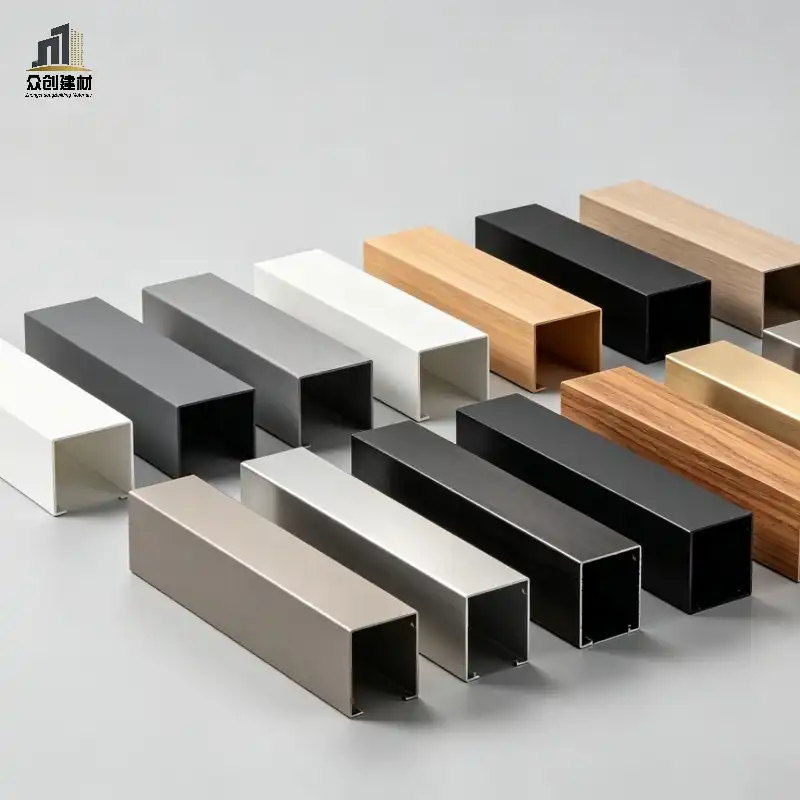
A wood grain aluminum wall panel is a decorative panel that uses an aluminum alloy sheet as the substrate and presents natural wood grain texture and color on the metal surface through surface treatment processes. It is not a simple composite of "wood veneer" or "wood grain film lamination." Instead, through thermal transfer or 3D stereoscopic wood grain processes, the wood grain texture is deeply integrated into the coating, forming a decorative surface layer that is unified with the metal substrate.
Substrate layer. Typically made of 3003 or 5005 series aluminum alloy, with thickness ranging from 1.0mm to 3.0mm. 3003 alloy offers good formability and moderate cost, suitable for interior and general exterior applications. 5005 alloy provides higher strength and better corrosion resistance, suitable for coastal areas and high-demand exterior facades. The alloy grade and thickness of the substrate directly determine the panel's strength, flatness and wind pressure resistance.
Conversion coating layer. The substrate undergoes chromating or chromium-free passivation to form a dense chemical conversion coating on the surface. This is the "adhesive" between the coating and the metal substrate, directly affecting coating adhesion and corrosion resistance. Quality manufacturers strictly control the coating weight and uniformity of the conversion film.
Base coat layer. A primer matching the wood grain base color is applied over the conversion coating, usually polyester powder coating or PVDF fluorocarbon coating. The base coat not only provides the fundamental tone of the wood grain but also serves UV resistance and corrosion protection functions. Exterior products must use PVDF fluorocarbon base coat, while interior products may use polyester powder coating.
Wood grain layer. The wood grain pattern is transferred onto the base coat through the thermal transfer process. The wood grain ink sublimates at high temperature and penetrates into the coating, forming a permanent texture. The quality of the wood grain layer depends on the pattern precision of the transfer film and the control accuracy of transfer temperature and time.
Protective clear coat layer. The outermost layer is a transparent PVDF fluorocarbon clear coat or acrylic clear coat, protecting the wood grain layer from abrasion, scratches and chemical erosion, while providing gloss control (matte, semi-gloss, high-gloss). Exterior products must use PVDF clear coat to ensure weather resistance.
Wood Grain Aluminum vs. Natural Wood vs. Other Decorative Materials
To understand the industry positioning of wood grain aluminum wall panels, a systematic comparison with mainstream alternative materials is necessary:
|
Performance |
Wood Grain Aluminum |
Solid Wood |
Film-Laminated Panel |
Wood Grain HPL |
|---|---|---|---|---|
|
Fire Rating |
Class A Non-combustible |
Class B Combustible |
Class B Combustible |
Class B1 Flame-retardant |
|
Moisture Resistance |
Fully moisture-proof |
Absorbs water, warps |
Edges susceptible |
Good |
|
Outdoor Durability |
10+ years |
Needs maintenance every 2-3 years |
Peels in 1-2 years |
Not recommended outdoors |
|
Weight (kg/m2) |
4-8 |
15-25 |
8-12 |
10-15 |
|
Eco-friendliness |
100% recyclable |
Consumes forest resources |
Contains adhesive, hard to recycle |
Contains adhesive, hard to recycle |
|
Maintenance Cost |
Nearly zero |
Regular repainting required |
Replacement of peeled areas |
Low |
|
Design Flexibility |
High (irregular/perforated) |
Limited by wood dimensions |
Moderate |
Moderate |

The comparison shows that wood grain aluminum wall panels comprehensively lead in five core dimensions: fire resistance, moisture resistance, weather resistance, weight and eco-friendliness. This is the fundamental reason for their rapid replacement of natural wood in commercial and public buildings. The only irreplaceable advantage of natural wood lies in "authentic touch" and "unique grain individuality," but for most commercial projects, consistency and durability matter far more than uniqueness.
Thermal Transfer Wood Grain Process: Technical Principles and Development
Thermal transfer printing is currently the mainstream process for wood grain aluminum wall panels, based on the sublimation phenomenon of dyes:
Process principle. A transfer film printed with a wood grain pattern (typically PET-based with disperse dyes) is tightly laminated onto the pre-coated aluminum panel and placed in a thermal transfer oven. At temperatures between 180 and 200 degrees Celsius, the disperse dyes on the transfer film sublimate directly from solid to gas and penetrate into the softened base coat. Upon cooling, the dyes re-solidify within the coating, forming a wood grain texture integrated with the coating. Because the dyes penetrate into the coating rather than adhering to the surface, problems common with film lamination, such as peeling and delamination, do not occur.
Development history. The first generation of wood grain products used PVC wood grain film directly adhered to aluminum panels, offering low cost but poor weather resistance, with edge peeling and fading occurring within 1 to 2 years outdoors. The second generation used thermal transfer after powder coating, but imprecise temperature control resulted in insufficient wood grain clarity and consistency. The third generation (current mainstream) uses fully automatic thermal transfer production lines with precise control of temperature curves, pressure and time, combined with high-definition transfer films, greatly improving wood grain clarity and weather resistance. The fourth generation (emerging technology) uses 3D stereoscopic wood grain transfer, creating micro-concave textures during transfer so that the product not only looks like wood visually but also feels like wood tactilely.
Key quality control points. The quality of thermal transfer wood grain depends on three core parameters: transfer temperature (too low results in insufficient dye penetration, too high causes coating discoloration), transfer time (too short results in unclear texture, too long causes base color shift), and transfer pressure (uneven pressure leads to inconsistent wood grain depth). Quality manufacturers use fully automatic continuous production lines with temperature fluctuation controlled within plus or minus 3 degrees Celsius, minimizing color variation between batches.
How to Select High-Quality Wood Grain Aluminum Wall Panels
Faced with wood grain aluminum wall panels of varying quality in the market, procurement specialists and designers should evaluate from the following dimensions:
First, examine wood grain realism. High-quality products have clear and natural wood grain texture, coherent grain direction, soft color transitions, and no obvious repeating unit feel. Compare samples with real wood under natural light to observe color and texture differences. Inferior products often have blurry texture, strong repetition and dull colors.
Second, verify the coating system. For exterior products, confirm that both the base coat and clear coat are PVDF fluorocarbon coatings (with fluorocarbon content of no less than 70%), and request AAMA 2605 or equivalent test reports from the manufacturer. For interior products, polyester powder coating is acceptable, but coating thickness should be confirmed (primer no less than 40 microns, topcoat no less than 30 microns).
Third, test adhesion. A simple cross-cut test can be performed: score 1mm x 1mm squares on the coating surface, apply tape and peel off quickly. High-quality products should show no coating detachment (Grade 0). If patchy peeling occurs, it indicates inadequate conversion coating treatment, and the product will quickly peel in outdoor use.
Fourth, inspect substrate quality. Check panel flatness (use a straightedge, warpage no greater than 1mm/m), cut edge quality (no burrs, no coating chipping), and thickness uniformity. High-quality products use alloy aluminum sheets from reputable aluminum mills, while inferior products may use recycled aluminum with high impurity content and low strength.
Fifth, require warranty commitment. Quality manufacturers should provide written warranty commitments, with exterior product wood grain color warranty of no less than 10 years and interior products no less than 15 years. The warranty scope should explicitly cover common issues such as fading, peeling and cracking.
Design and Application Trends of Wood Grain Aluminum Wall Panels
As the process matures and design concepts evolve, the applications of wood grain aluminum wall panels are showing the following trends:
From interior to exterior. Early wood grain aluminum wall panels were mainly used for interior walls. With the maturation of PVDF thermal transfer technology, an increasing number of building exteriors are adopting wood grain aluminum solid panels. The wood grain appearance allows modern buildings to blend into natural surroundings, especially popular in cultural tourism buildings, wellness projects and eco-parks.
From flat to three-dimensional. Designers are no longer satisfied with flat wood grain panels. Instead, they combine the wood grain process with bending, curving and irregular fabrication to create three-dimensional wood grain building envelopes. Innovative forms such as folded wood grain panels, curved wood grain panels and wavy wood grain panels are constantly emerging.
From single color to mixed matching. Multiple wood grain colors are mixed and matched on the same facade, creating rich facade layers through depth contrast and texture differences. Combined applications of wood grain with solid-color aluminum panels and perforated aluminum panels are also becoming increasingly common.
From decorative to functional. Wood grain aluminum wall panels are beginning to combine with functionality, such as wood grain perforated acoustic panels (combining wood grain decoration with acoustic function), wood grain insulation integrated panels (wood grain decoration composited with insulation layer), and wood grain photovoltaic panels (wood grain appearance combined with solar power generation).
From standardization to customization. Clients have increasingly diverse demands for personalized wood grain colors and textures. Manufacturers are launching small-batch customization services, developing exclusive wood grain patterns based on wood samples or images provided by clients.
Common Questions and Misconceptions
Misconception 1: Wood grain aluminum wall panels are simply "aluminum panels with wood grain paper stuck on." This is the most common misunderstanding. High-quality wood grain aluminum wall panels use the thermal transfer process, where wood grain dyes penetrate into the coating and integrate with it, rather than simple adhesion. Film-laminated products and thermal transfer products have essential differences in weather resistance and service life, and should be clearly distinguished during procurement.
Misconception 2: The darker the wood grain color, the better the quality. Wood grain color depth is unrelated to quality; it is simply a design choice. However, dark wood grain absorbs more UV radiation in outdoor use, so its fading rate is usually slightly faster than light wood grain. Therefore, dark wood grain products have higher requirements for PVDF coating.
Misconception 3: Wood grain aluminum wall panels cannot be used in humid environments. On the contrary, the metal substrate does not absorb water or grow mold, making wood grain aluminum wall panels ideal for humid environments (bathrooms, swimming pools, coastal buildings). It should be noted that cut edges and installation joints require proper sealing to prevent moisture from entering the back of the substrate through cut edges.
Misconception 4: All thermal transfer wood grain products have the same quality. Equipment precision, transfer film quality, temperature control and coating system in the thermal transfer process all significantly affect final product quality. Imported versus domestic equipment, high-definition versus ordinary transfer films, PVDF versus polyester coatings, the resulting differences in weather resistance and realism are substantial, with price differences of 30% to 50%.
Misconception 5: Wood grain aluminum wall panels can only be made as flat panels. Wood grain aluminum wall panels can undergo various fabrication processes including bending, curving, perforation and welding, with the wood grain process remaining intact after fabrication. However, it should be noted that wood grain at bent areas will experience slight tensile deformation, and wood grain continuity on curved panels requires special design during layout.
Conclusion
The rise of wood grain aluminum wall panels is essentially a "performance substitution" driven by advances in material processing. It is not a simple imitation of natural wood, but rather retains the aesthetic value of wood while providing durability, safety and eco-friendliness that natural wood cannot match. With the continuous upgrading of thermal transfer technology and ongoing innovation in design applications, wood grain aluminum wall panels are expected to replace natural wood in more architectural scenarios, becoming a mainstream decorative material in the era of green building.
For industry practitioners, understanding the process principles and quality standards of wood grain aluminum wall panels is the foundation for making correct procurement decisions and design choices. We hope this article provides valuable professional reference for your projects.