_1762768699969.webp)

_1782530506402.webp)
Exterior Wall Aluminum Baffles: Performance Requirements and Construction Key Points for Building Facade Decoration
Exterior wall aluminum baffles are one of the fastest-growing building facade decoration materials in recent years. Compared with traditional glass curtain walls, stone curtain walls and aluminum veneer curtain walls, aluminum baffle exterior walls have the advantages of light weight, ventilation, strong visual layering, rich light and shadow effects, low installation cost, and convenient maintenance. They are widely used in facade decoration and sunshade systems of various buildings such as commercial buildings, office buildings, industrial parks, schools, hospitals, and cultural venues. As part of the building envelope structure, exterior wall aluminum baffles directly withstand the test of harsh outdoor environments such as wind load, rainwater, ultraviolet rays, and temperature changes. Their performance requirements and construction standards are much higher than indoor aluminum baffles, and must be designed, produced and constructed in strict accordance with relevant specifications.
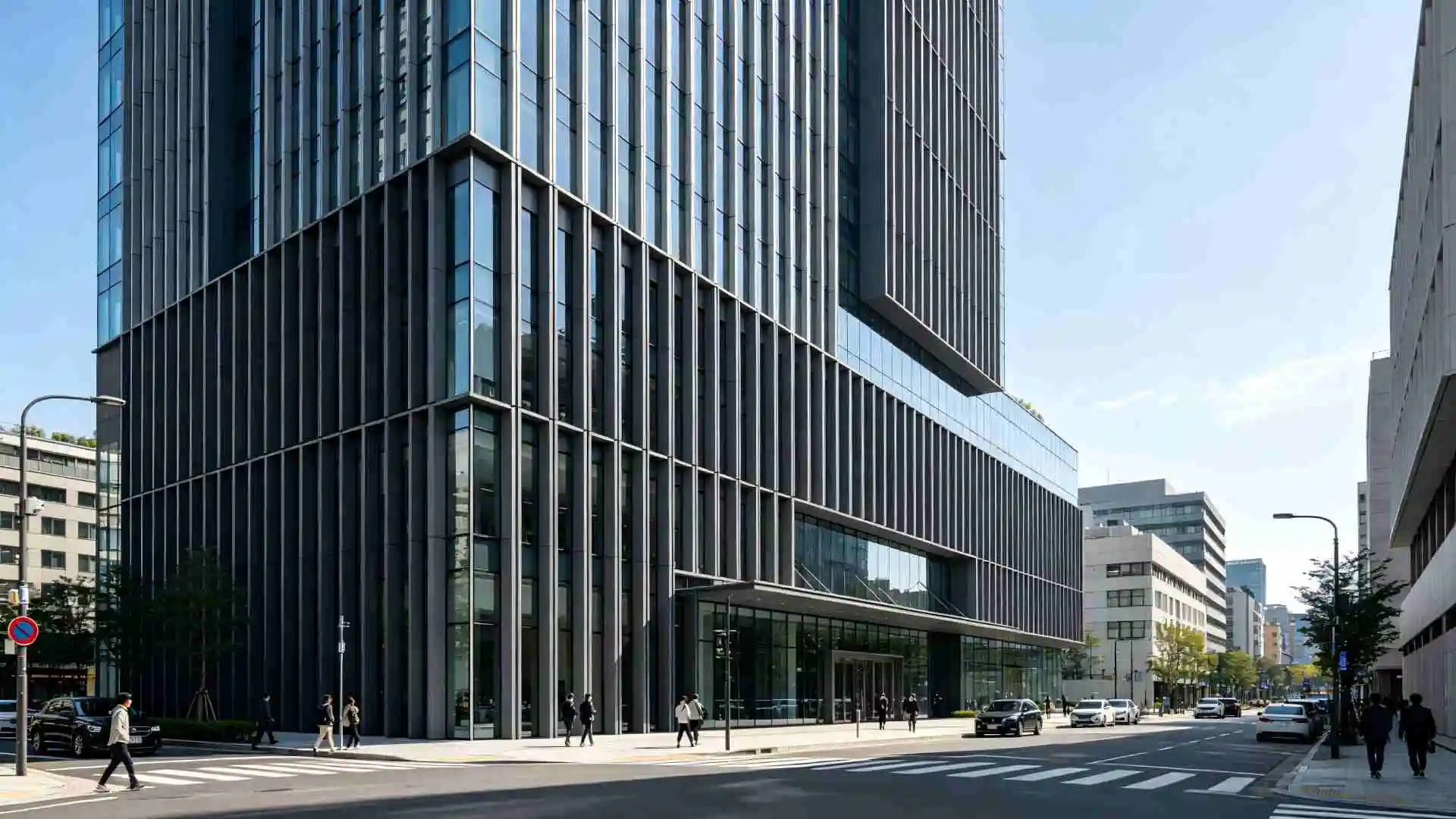
Dark gray fluorocarbon-coated vertical aluminum baffles with a glass curtain wall create a modern commercial building facade effect.
In terms of material selection, exterior wall aluminum baffles must use 3003-H24 or 5005-H24 series aluminum alloy substrates, and 1100 series pure aluminum substrates are prohibited. Pure aluminum substrates have insufficient strength and hardness, and are prone to deformation, falling off and other safety hazards under outdoor wind loads. In terms of substrate thickness, the thickness of exterior wall aluminum baffles shall not be less than 1.2mm; when the baffle height exceeds 150mm or the installation height exceeds 20 meters, the thickness shall not be less than 1.5mm; when the baffle height exceeds 250mm or the installation height exceeds 50 meters, the thickness shall not be less than 2.0mm to ensure sufficient structural strength. All aluminum alloy materials must comply with the relevant standards of GB/T 3880 "Wrought Aluminum and Aluminum Alloy Plates, Sheets and Strips for General Engineering", and provide material reports and quality certificates.
Surface treatment is the core factor determining the service life of exterior wall aluminum baffles. Aluminum baffles used outdoors must be treated with fluorocarbon spraying, and powder coating or polyester spraying is prohibited for exterior wall surface treatment. The fluorocarbon coating must adopt three-coat two-bake process, with primer thickness not less than 5μm, color paint thickness not less than 25μm, varnish thickness not less than 10μm, total coating thickness not less than 40μm, and polyvinylidene fluoride (PVDF) content in the coating not less than 70%, complying with AAMA 2605 American Architectural Manufacturers Association standard, which can ensure no fading, chalking, falling off or cracking for more than 15 years of outdoor use. After surface treatment is completed, coating performance tests must be carried out, including adhesion test, hardness test, salt spray resistance test, accelerated artificial weathering aging test, etc., and can only leave the factory after passing the tests. In terms of color selection, exterior wall aluminum baffles should prefer medium and low brightness colors with good weather resistance, and avoid high saturation colors such as bright red and yellow, which have relatively poor weather resistance and are more prone to fading.
In terms of structural design, the exterior wall aluminum baffle system must undergo strict mechanical calculations. According to the basic wind pressure, ground roughness category, installation height, baffle specification and spacing and other parameters of the project location, calculate the standard value of wind load, and check the strength and deflection of the baffle and the structural safety of the keel system. The deflection of aluminum baffles shall not be greater than L/180 (L is the baffle span) to avoid obvious deformation or resonance under wind load. The keel system usually adopts galvanized steel keel or aluminum alloy keel. The column adopts hot-dip galvanized square tube with wall thickness not less than 3mm, and the beam adopts hot-dip galvanized angle steel or special aluminum alloy beam with wall thickness not less than 2mm. All connectors must be made of 304 stainless steel, and ordinary steel or galvanized steel is prohibited as connecting pendants to avoid electrochemical corrosion caused by contact between different metals. The connection between aluminum baffles and keels must adopt a floating connection structure. Each baffle is provided with at least two fixed points and one sliding point, reserving expansion space for temperature deformation to avoid bending deformation or abnormal noise of baffles caused by thermal expansion and cold contraction.
Waterproof and drainage design is the key point of the exterior wall aluminum baffle system. Aluminum baffle exterior wall belongs to open curtain wall system, rainwater will enter the back of the baffle through the gap between baffles, so waterproof back plate and drainage system must be set on the back of the baffle. The waterproof back plate usually adopts 1.5mm thick waterproof aluminum plate or galvanized steel plate, and weather-resistant sealant is used between plates to form a complete waterproof layer; drainage gutters and drainage outlets are set at each floor slab position to discharge rainwater entering the back plate in an organized manner, avoiding rainwater seeping into the room or accumulating in the keel system for a long time leading to corrosion. For buildings with thermal insulation requirements, an insulation layer needs to be set between the waterproof layer and the main structure. The insulation material adopts Class A non-combustible rock wool board, and the thickness is calculated and determined according to building energy-saving requirements.
In terms of construction and installation, exterior wall aluminum baffle construction must be carried out by professional teams with curtain wall construction qualifications. Before construction, detailed technical disclosure must be carried out, and sample sections must be installed first. Large-scale construction can only be carried out after passing the joint acceptance of design, supervision and Party A. The construction process is: surveying and setting out → installing embedded parts → installing columns → installing beams → installing waterproof back plates → installing insulation layer → installing aluminum baffle keels → installing aluminum baffles → sealing with glue → cleaning and acceptance. During installation, the flatness and verticality of keels must be strictly controlled, with error not greater than 2mm. After aluminum baffles are installed, straightness and flatness must be guaranteed, with uniform joints, horizontal and vertical alignment, and joint width deviation not greater than 1mm. All on-site welding parts must be derusted and repainted with antirust paint to avoid rust corrosion affecting structural safety.
During the acceptance stage, it is necessary to check whether the variety, specification, color and surface treatment of aluminum baffles meet the design requirements, check whether the installation is firm, whether there is loose deformation, check whether the plate surface has scratches, dents, color difference and other defects, check whether the drainage system is smooth, whether the sealant is continuous and full, and at the same time provide complete completion data, including material certificates, test reports, hidden project acceptance records, mechanical calculation books, etc. Qualified exterior wall aluminum baffle projects not only have good decorative effects, but also can play the role of sunshade, energy saving, reducing building energy consumption. According to tests, buildings installed with aluminum baffle external sunshade systems can reduce summer air conditioning energy consumption by 20%-30%, with significant energy-saving effects.