_1782530506402.webp)
Wood-Grain Aluminum Baffle — Product News
Company Focus: Wood-Grain Baffles Become a Core Interior Finish
Leveraging Foshan's aluminum processing chain, Guangdong Zhongchuang Architectural Decoration Materials Co., Ltd. has positioned wood-grain aluminum baffles as one of its core interior finish categories for 2026. The company operates a dedicated transfer line covering four stages — passivation pre-treatment, electrostatic powder base, vacuum heat transfer, and clear topcoat — and can handle continuous transfer on profiles up to 6 meters, avoiding the grain breaks caused by splicing long lengths.
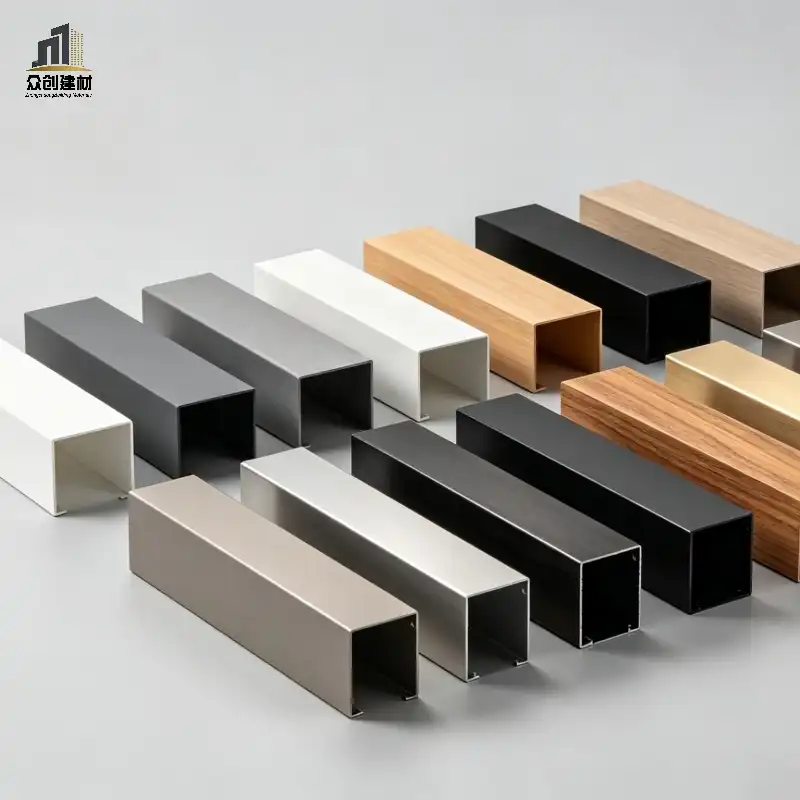
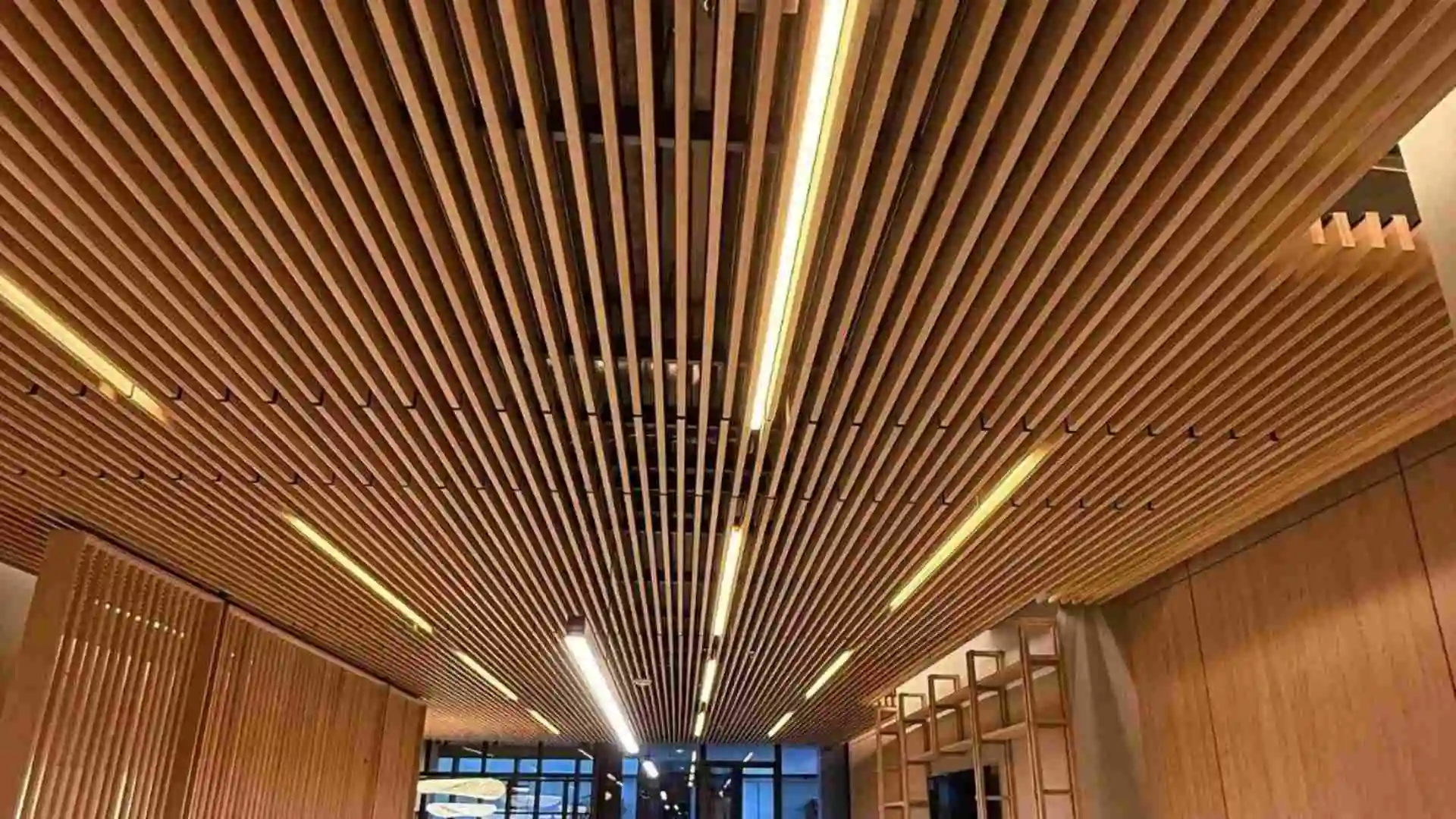
Main sections span more than ten specifications from 30×50mm to 100×150mm, with wall thickness of 0.8–2.0mm. Grain tones cover oak, walnut, cherry, teak, rosewood, ash, and gray wood, and project-specific grains can be developed to create a distinctive product identity. Products are exported steadily to Australia, New Zealand, the United States, Southeast Asia, the Middle East, and Europe.

Market Trends: From Imitating Wood to Redefining How Wood Is Used
A subtle but important shift appeared in 2026 feedback: clients no longer ask "does this look like wood?" but "can this do what wood cannot?" The competitiveness of wood-grain aluminum baffles is moving from resemblance to capability.
Scenario Expansion: Moving from dry areas into pool zones, basements, and semi-outdoor eaves where solid wood fails.
Fire Safety First: Public buildings tighten Class A non-combustible requirements, raising the cost and compliance risk of wood flame treatment.
Long-Length Demand: Large-space design favors continuous unbroken lines, making 6-meter single-pass transfer a hard requirement.
Tone Segmentation: Moving from "brown" toward more restrained contemporary tones such as cool gray wood, white oak, and smoked wood.
Maintenance Economics: Owners now calculate life-cycle cost, making wax-free and pest-free performance a decision factor.
Application Expansion: Five Emerging Demand Directions
2026 project data shows the demand structure is changing. Traditional residential and office use remains the majority, but these five directions are growing notably:
|
Emerging Direction |
Typical Approach |
Growth Driver |
|---|---|---|
|
Pool and spa areas |
Densely arranged U-channels with light coves |
Solid wood fails in humid conditions; a stable alternative is needed |
|
Basement parking and passages |
Wide flat profiles concealing services |
Moisture and mold resistance with easy access |
|
Restaurants and outdoor seating |
Baffle grids with concealed light strips |
Nighttime atmosphere, resistant to grease and easy to clean |
|
Semi-outdoor eaves and corridors |
Winged clip profiles, sealed installation |
Aluminum weatherability supports sheltered exteriors |
|
Brand spaces and exhibitions |
Irregular sections with custom grains |
Reinforces brand identity and a unified visual language |
Technology Upgrade: Treating Color Variation as an Engineering Metric
The industry's technical focus over the past year has moved from "can we make wood grain" to "can we make consistent wood grain." Because transfer is a sublimation-penetration process, it is affected by temperature, vacuum level, film tension, and base-coat flatness, so the same formula can produce visible tone differences between furnace batches.
Our response is to manage color variation as a measurable metric: the same transfer film roll, the same furnace batch, and the same powder batch are used throughout one project, with batch-by-batch comparison against a standard swatch before shipment to hold variation within an acceptable range. Film tension control on long profiles is equally critical — insufficient tension causes wrinkle-like grain distortion, while excessive tension stretches the grain and makes it shallow. Both defects are especially visible at close range.
Another upgrade direction is functionalizing the clear topcoat: moving from simple protection to combined anti-fingerprint, anti-graffiti, and solvent resistance, matching the frequent touching and cleaning typical of commercial spaces.
Global Delivery and Certification
For wood-grain aluminum baffles supplied worldwide, the difficulty lies not in production but in delivery consistency. The company has established a complete flow from swatch approval and batch sealing through staged production to protective packaging, using custom slotted wooden cases to prevent corner compression and surface scratches on long profiles in transit. It supports diversified trade terms including FOB, EXW, CIF, DAP, and DDP, with T/T and letter-of-credit settlement, and provides installation node drawings plus on-site technical guidance.
Certifications cover ISO 9001, CE (EU CPR), ASTM E84 (Class A), AAMA 2605, and SGS test reports, with a 15–20 year warranty, meeting the material requirements of LEED and green building assessment.