_1762768699969.webp)

_1782530506402.webp)
(1)_1783045836766.webp)
_1786157639392.webp)
(1)_1780970038980.webp)
Aluminum Starry Sky Ceiling Design Technology and Immersive Scene Creation
Aluminum starry sky ceiling is a high-end decorative ceiling system that uses aluminum ceiling as a carrier, implants optical fiber light guide points on the panel, and cooperates with LED light source generators to present a starry twinkling effect on the ceiling surface. It breaks through the planar decoration limitations of traditional ceilings, deeply integrates lighting art with spatial aesthetics, and is widely used in home theaters, high-end hotels, private clubs, KTVs, themed restaurants, children's rooms and other spaces pursuing immersive experiences.
From a technical perspective, the aluminum starry sky ceiling system consists of three major components: aluminum panel substrate, optical fiber light guide network, and LED light source generator. The aluminum panel usually adopts 2.0-3.0mm thick aluminum plate, with matte black or dark fluorocarbon coating treatment on the surface to ensure that areas other than optical fiber points do not reflect light in dark environments, maximizing the depth of the starry sky. The optical fiber adopts PMMA (polymethyl methacrylate) plastic optical fiber, with diameters usually φ0.75mm, φ1.0mm, φ1.5mm, φ2.0mm and other specifications. By drilling holes on the panel and fixing optical fiber endpoints at the hole positions, light is emitted uniformly from the panel surface. The LED light source generator is the "heart" of the entire system, usually using high-brightness RGBW four-color LED chips, achieving color transformation, flicker frequency, meteor effects and other dynamic scenes through motor-driven color wheels or DMX512 control systems.
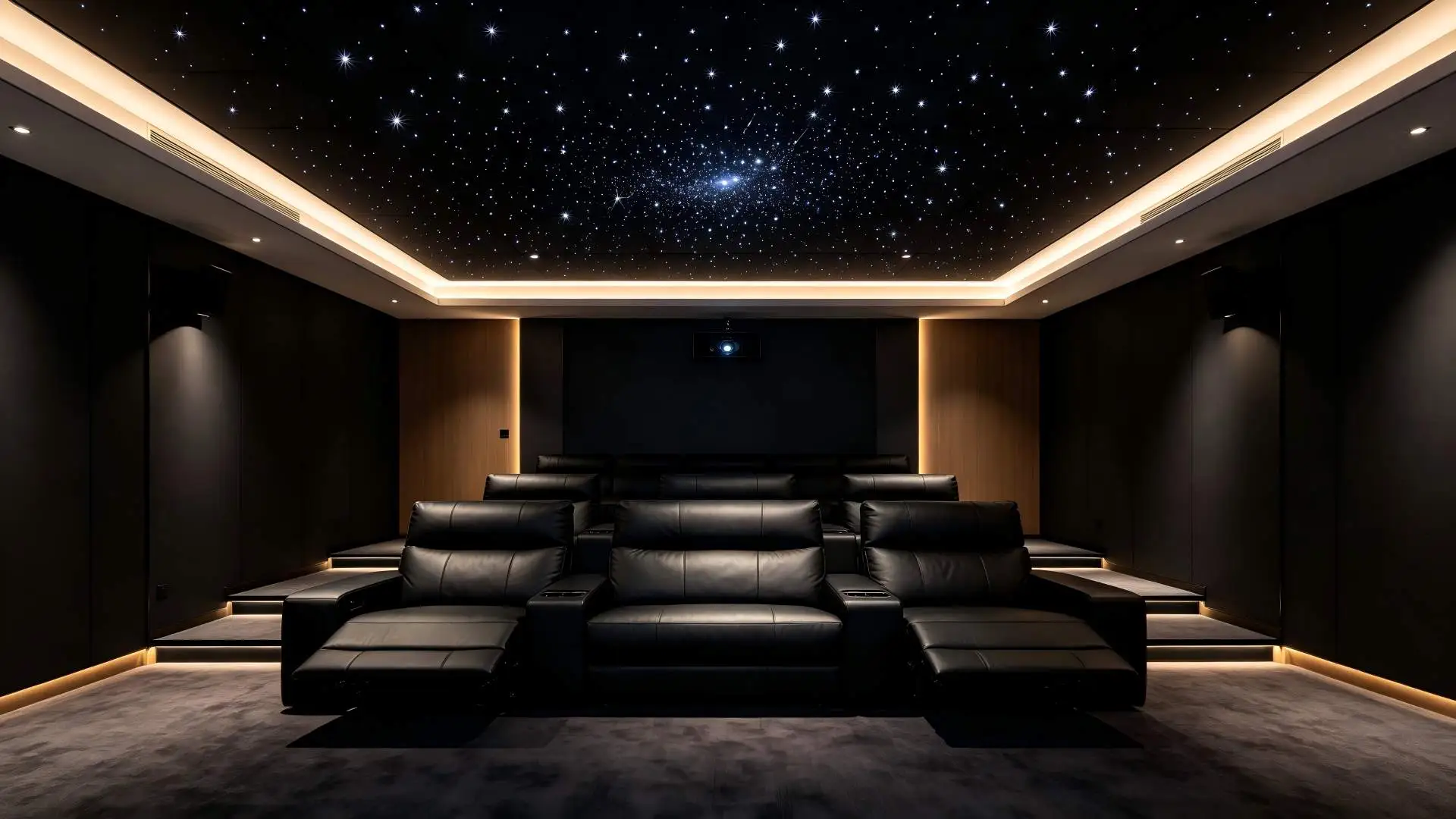
Optical fiber selection and point design are the core links that determine the realism of starry sky ceilings. Professional starry sky ceiling design does not evenly distribute optical fiber points, but simulates the constellation distribution and brightness levels of real starry sky. Optical fibers are usually divided into three brightness levels: first-level bright stars (about 5%) use φ2.0mm optical fiber, corresponding to the brightest stars in the sky such as Sirius and Vega; second-level medium-brightness stars (about 25%) use φ1.5mm optical fiber; third-level dark stars (about 70%) use φ0.75-1.0mm optical fiber, constituting the background density of the starry sky. The optical fiber points per square meter of starry sky ceiling are usually between 80-150. Close viewing spaces such as home theaters can be appropriately encrypted to 200/㎡, while large public spaces can be reduced to 50-80/㎡ to control costs.
In addition to static star points, high-end aluminum starry sky ceilings can also achieve various dynamic effects. The meteor effect arranges series optical fibers on specific paths,配合 the sequential lighting of the light source controller to simulate the visual experience of meteors streaking across the night sky, usually appearing once every 5-10 seconds with random directions. The nebula effect densely arranges blue and purple optical fiber points in specific areas of the panel to simulate the hazy halo of deep sky objects such as the Orion Nebula and Andromeda Galaxy. The twelve constellation effect precisely arranges optical fiber points according to real star maps, and can even add meteor connection animations to present complete constellation patterns in specific festivals or ritual scenes. In recent years, with the development of intelligent control technology, starry sky ceiling systems can be connected to smart home platforms, controlling scene modes, brightness, color and dynamic effects through voice or mobile APP.
In terms of panel technology, the production of aluminum starry sky ceilings requires multiple precision processes. First, CNC drilling is performed on the aluminum plate according to design drawings. The hole diameter is precisely controlled according to optical fiber specifications, with hole position error not exceeding ±0.1mm; then surface treatment is performed on the drilled panel. Black matte fluorocarbon coating must ensure that hole walls are also uniformly covered to prevent light leakage; then optical fiber implantation is performed, threading optical fibers from the back of the panel into the holes, with endpoints flush with or slightly protruding 0.1mm from the panel surface, and fixed with special glue; finally, all optical fibers are grouped and collected by region, connected to the LED light source generator through optical fiber couplers. The entire process has extremely high requirements for cleanliness. Any dust or oil attached to the optical fiber end face will cause light effect attenuation or uneven bright spots.
In terms of installation and maintenance, aluminum starry sky ceilings usually adopt modular design, with each panel size of 600×600mm or 600×1200mm, installed with dedicated concealed keel. The light source generator is usually placed near the access opening above the ceiling for later maintenance. The theoretical service life of optical fiber is more than 20 years, and the LED light source life is about 50,000 hours. Daily maintenance mainly involves regularly cleaning dust on the panel surface and checking the working status of the light source generator. It should be noted that the optical fiber bundle on the back of the starry sky panel should avoid excessive bending (bending radius not less than 20 times the optical fiber diameter), otherwise it will cause optical signal loss or even optical fiber fracture.