_1762768699969.webp)

_1782530506402.webp)
(1)_1783045836766.webp)
_1786157639392.webp)
(1)_1780970038980.webp)
Decorative Aluminum Panel Applications: A Complete Guide from Interior to Exterior Use
Decorative aluminum panels, commonly referred to as architectural aluminum cladding in overseas markets, are categorized by application into aluminum facade panels, aluminum ceiling tiles and baffles, aluminum wall cladding and perforated aluminum screens. Manufactured from aluminum alloy substrates and finished with powder coating, PVDF fluorocarbon coating, wood-grain thermal transfer, anodizing or CNC perforation, these panels combine lightweight construction, fire resistance, corrosion resistance and design versatility. They have become one of the most widely specified metal decorative materials for public buildings, commercial spaces and high-end residential projects worldwide.
Many project stakeholders still associate decorative aluminum panels only with exterior cladding or ceiling systems. In reality, their application scope is far broader. Drawing on real project experience, this article systematically reviews the core applications of decorative aluminum panels from interior to exterior, from decorative to functional, and provides a material-selection framework to help architects and procurement teams specify the right product and finish at the earliest project stage.
1. Interior Ceiling Systems: The Largest Application Segment
Interior ceilings represent the highest-volume application for decorative aluminum panels. The lightweight, non-combustible and easy-to-clean properties of aluminum alloy make it the preferred ceiling material for commercial and public buildings. Based on profile type and installation method, they fall into the following categories:
Clip-in aluminum ceiling tiles. Common sizes include 300x300mm, 600x600mm and 600x1200mm, installed with a clip-in T-bar grid system. The flat, modular surface is widely used in offices, hospitals, schools and metro stations. Finishes range from matte white and light gray powder coating to perforated acoustic tiles.

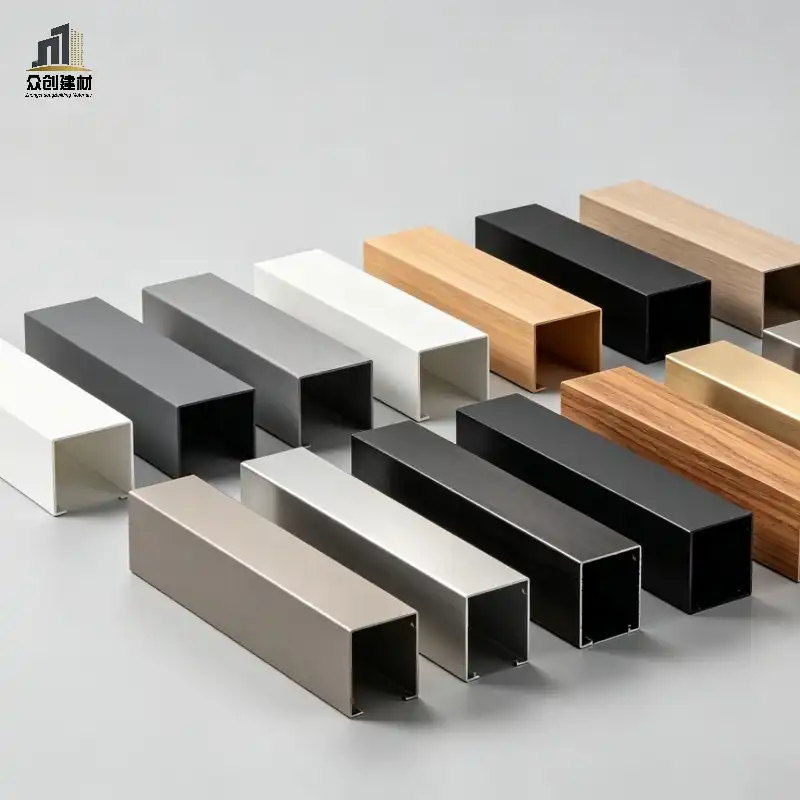
Aluminum baffle ceilings (U-channel ceilings). Linear long profiles suspended from a carrier grid create an open, transparent ceiling that conceals MEP services while preserving perceived ceiling height. Available in wood-grain, solid color and two-tone combinations, they are the most common ceiling form in shopping mall atriums, airport terminals and office lobbies. Baffle height, bottom width and spacing are fully customizable.

Aluminum grid ceilings. Interlocking horizontal and vertical aluminum bars form a square grid pattern with excellent ventilation and light transmission. They are ideal for mechanical rooms, parking areas and supermarkets where air circulation and heat dissipation are critical, and also serve as decorative ceilings in restaurants and creative spaces.
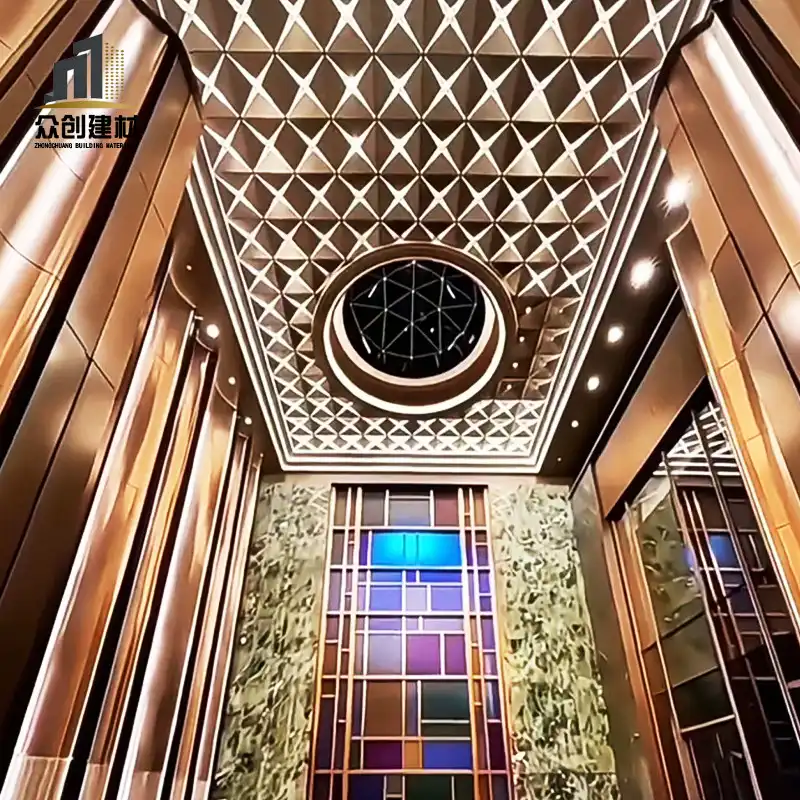
Custom-shaped aluminum ceiling panels. Curved, wavy and irregular ceiling panels are fabricated to order for hotel lobbies, exhibition halls and cultural buildings that require distinctive visual effects. Any color can be achieved with powder or PVDF coating.

2. Interior Wall Cladding: From Feature Walls to Full-Surface Facades
The use of decorative aluminum panels for interior wall cladding is growing rapidly, particularly in commercial spaces and high-end residences, where metal walls are increasingly replacing stone and wood veneer.
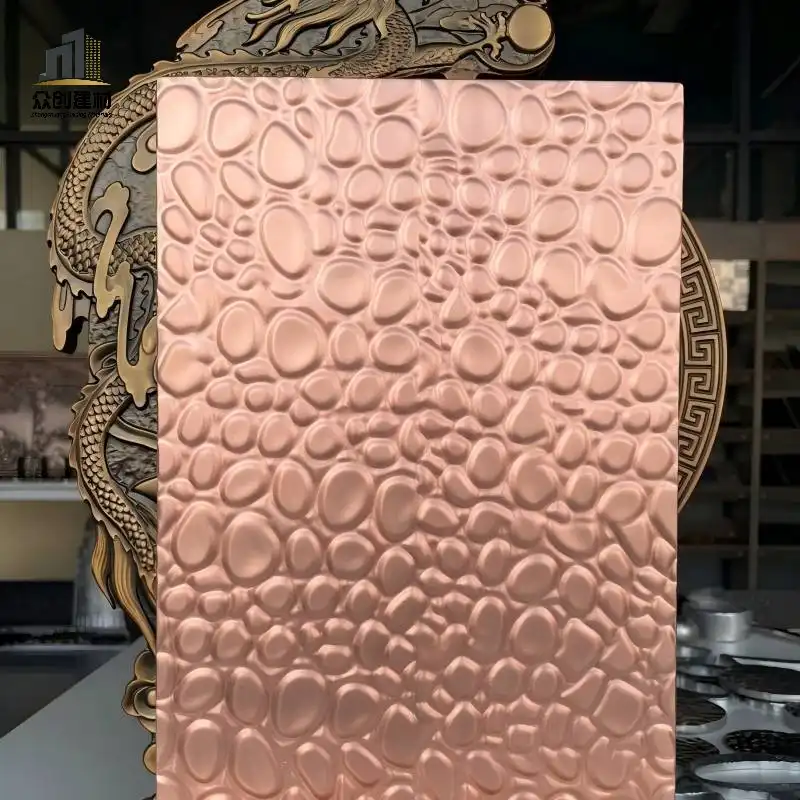
Feature walls and brand walls. Large-format aluminum panels are dry-hung as feature walls in corporate reception areas, hotel lobbies and retail brand stores. Finishes include wood-grain thermal transfer, stone pattern, solid color and artistic perforation, often combined with backlighting to reinforce brand identity. Compared with natural stone, aluminum panels are lighter, faster to install and free of color-batch variation.
Corridor and elevator lobby walls. Corridors and elevator lobbies in hospitals, office buildings and apartments experience high foot traffic and require scratch-resistant, cleanable and impact-resistant wall surfaces. Powder-coated aluminum panels offer high surface hardness, allow stain removal by simple wiping, and enable single-panel replacement when damaged.
Column and beam encasement. Structural columns and beams often disrupt interior aesthetics. Curved or rectangular aluminum panels can be custom-fabricated to wrap these elements, converting structural components into decorative features. Wood-grain aluminum column wraps are especially popular in commercial spaces for adding warmth.
Walls in wet areas. Aluminum does not absorb water or support mold growth. With a waterproof coating, it can be used in restrooms, pool changing rooms and kitchens, replacing tiles and stone with a seamless, grout-free surface that eliminates hygiene gaps.

3. Exterior Curtain Walls: The Most Iconic Outdoor Application
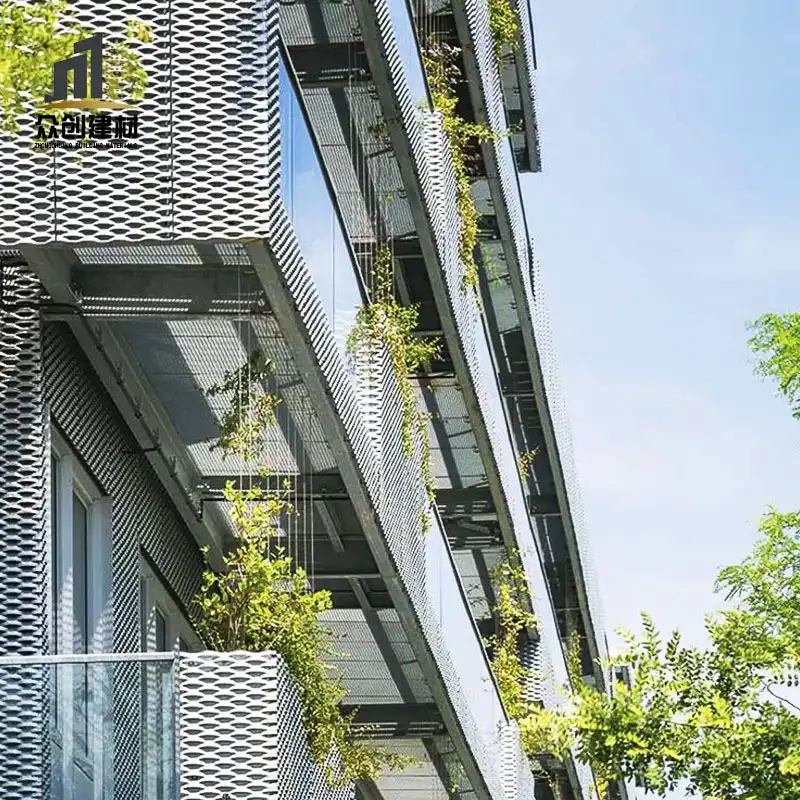
Exterior curtain walls are the most technically demanding and architecturally expressive application of decorative aluminum panels. Known overseas as aluminum curtain wall panels or aluminum facade cladding, they are mounted on a steel sub-frame via a dry-hanging system to form the building's second skin.
Flat aluminum panel curtain walls. The most common and fundamental form, with flat panels joined to create clean, modern facades. PVDF fluorocarbon coating is the standard outdoor specification, guaranteed against fading and chalking for 15 to 20 years. Solid, metallic and pearlescent colors are all achievable, making it the dominant choice for office towers, commercial complexes and industrial parks.
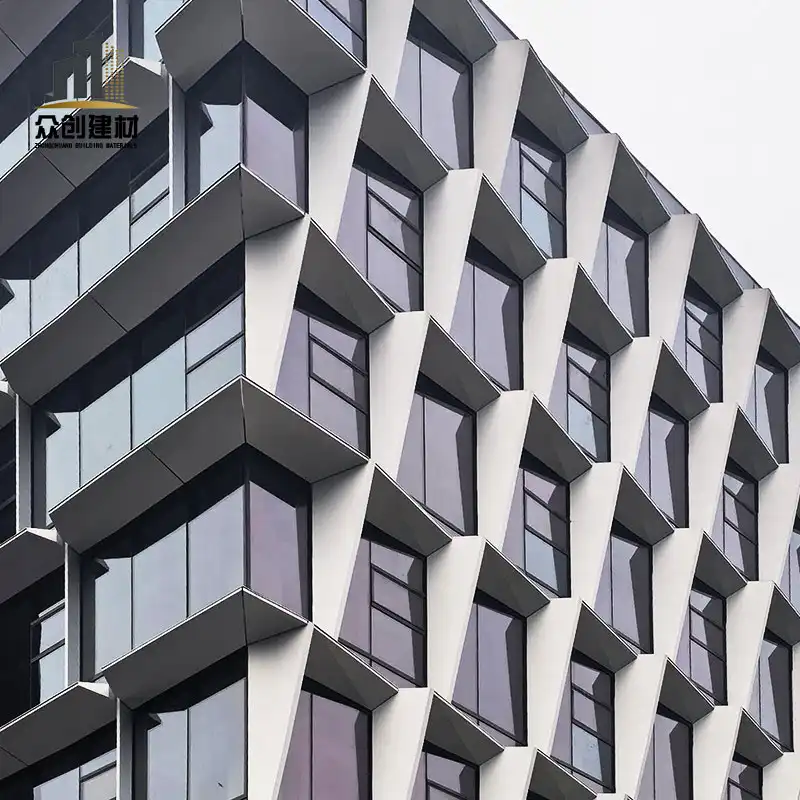
Irregular and double-curved aluminum panel curtain walls. CNC bending, welding and molding produce curved, wavy and hyperbolic panels for landmark buildings and cultural venues. These products demand extreme fabrication precision, requiring 3D modeling and digital manufacturing, and serve as the primary vehicle for architectural form expression.
Perforated aluminum panel curtain walls. CNC punching creates patterns, text or gradient effects on the panel surface. By day, the facade displays a textured play of solid and void; by night, integrated backlighting transforms the wall into a luminous surface. This is the most popular creative facade solution for commercial buildings, cultural venues and flagship stores. Perforation ratio also allows tuning of ventilation and solar shading performance.
Aluminum honeycomb panel curtain walls. Two aluminum skins bonded to an aluminum honeycomb core deliver exceptional flatness and wind-load resistance, suitable for large-format and high-rise exterior projects. At one-third the weight of a solid aluminum panel of equivalent thickness, they offer superior rigidity, sound insulation and thermal performance.

4. Commercial Storefronts and Signage: The First Visual Touchpoint for Brands
Commercial storefronts represent the fastest-growing segment for decorative aluminum panels. Conventional storefronts rely on acrylic, printed vinyl and aluminum composite panels, which offer short service life and low perceived quality. Artistic perforated aluminum storefronts are becoming the standard for chain brands and trend-driven retail.
Back-lit perforated storefronts. Brand logos, text and geometric patterns are CNC-punched directly into aluminum panels, with LED fixtures mounted behind. At night, light shines through the perforations to create a glowing effect. The seamless, highly recognizable design eliminates the need for separate sign letters, making it a top choice for restaurants, retail stores and experience centers.
Gradient perforated storefronts. Hole diameter transitions from dense to sparse or vice versa, creating a subtle solid-to-void gradient. By day, the surface exhibits a refined metallic texture; by night, backlighting produces rich layers of light and shadow. This finish suits brands pursuing a minimalist, light-luxury aesthetic.
Wood-grain and stone-pattern storefronts. Thermal transfer technology reproduces wood, stone and concrete textures on aluminum, delivering a natural, premium brand atmosphere while retaining the weather resistance and fire safety of metal. This solves the decay and flammability problems associated with solid-wood storefronts in outdoor environments.
5. Public Buildings and Transportation Hubs: Functional Decoration for Large Spaces
Airports, high-speed rail stations, metro stations, exhibition centers and stadiums are concentrated application scenarios for decorative aluminum panels. These projects impose strict requirements on fire rating, acoustic performance, wind resistance and durability, where aluminum alloy is virtually irreplaceable.
Long-span ceiling systems. Airport terminals and railway station halls often exceed 10 meters in clear height. Aluminum baffles, grid ceilings and large-format panels are suspended from steel structures to cover vast spans. The open configuration simplifies integration of fire sprinklers, HVAC diffusers and lighting fixtures, and facilitates ongoing maintenance access.
Acoustic wall and ceiling panels. Perforated aluminum panels backed with acoustic mineral wool effectively reduce reverberation time and improve speech intelligibility in large volumes. Platform walls, airport waiting areas and stadium seating zones extensively use perforated acoustic aluminum panels that combine decoration with sound absorption.
Integrated wayfinding and signage. Directional signs, floor numbers and brand information can be directly integrated into aluminum panels via perforation, screen printing or laser engraving, reducing the need for separate sign elements and creating a cleaner, more unified spatial interface.
6. Functional Decoration: Combined Uses for Shading, Weather Protection and Safety
The value of decorative aluminum panels extends beyond aesthetics. In many scenarios, they simultaneously serve a functional role.
Sun-shading louvers and grilles. Aluminum louvers and grilles installed on building facades or outside windows adjust solar heat gain and reduce cooling energy consumption, while creating a rhythmic architectural expression. Known overseas as aluminum louvers or brise-soleil, they are a common energy-efficient component in green buildings.
Canopy and walkway roofing. Aluminum panels used for entrance canopies and covered walkway roofs are waterproof, rust-resistant and lightweight, and can be integrated with drainage systems. Curved canopies are achieved with custom-formed panels, combining weather protection with decorative effect.
Balustrade and guardrail decoration. Perforated or laser-cut aluminum panels serve as balcony railings, stair guards and platform enclosures, meeting safety requirements while adding patterned decorative elements to the space.
Equipment and duct screening. Exterior air-conditioning units, ventilation ducts and mechanical rooms are commonly screened with perforated aluminum panels or grilles, ensuring airflow and heat dissipation while concealing unsightly equipment behind a unified metal facade.
7. Matching Surface Finishes to Applications
Selecting decorative aluminum panels is fundamentally a matter of matching the service environment to the surface finish. The table below maps common finishes to their recommended applications:
|
Surface Finish |
Key Characteristics |
Recommended Applications |
|---|---|---|
|
Powder Coating |
Rich colors, strong adhesion, cost-effective |
Interior ceilings, walls, storefronts; semi-outdoor canopies |
|
PVDF Fluorocarbon Coating |
Extreme weather resistance, UV-stable, 15-20 year color retention |
Exterior curtain walls, outdoor storefronts, coastal buildings |
|
Wood-grain / Stone-pattern Thermal Transfer |
Natural texture reproduction, fireproof and dimensionally stable metal substrate |
Interior walls / column wraps, commercial storefronts, cultural buildings |
|
Anodizing |
Strong metallic appearance, abrasion-resistant, high surface hardness |
High-end interior walls, elevator lobbies, flagship retail |
|
Perforation / Laser Cutting |
Light-and-shadow effects, custom patterns, ventilation and acoustic benefits |
Commercial storefronts, exterior facades, acoustic ceilings, balustrades |
|
Aluminum Honeycomb Composite |
Exceptional flatness, high rigidity, sound and thermal insulation |
Large-format exteriors, high-rise curtain walls, premium interiors |
8. Common Selection Pitfalls and How to Avoid Them
Despite their wide applicability, specifying the wrong finish or thickness for decorative aluminum panels can lead to spiraling maintenance costs. The following are the most common pitfalls in project specification:
Pitfall 1: Using interior powder coating outdoors. Powder coating offers far less UV resistance than PVDF. Applied to exterior walls, it will fade and chalk within one to two years. Outdoor projects must explicitly specify PVDF fluorocarbon coating and request weather-resistance test reports.
Pitfall 2: Mismatching panel thickness to module size. Large-format exterior panels with insufficient thickness will warp and buckle under thermal expansion and contraction. As a rule, exterior solid panels should be no thinner than 2.0mm; for large modules, 2.5 to 3.0mm or aluminum honeycomb panels are recommended.
Pitfall 3: Excessive perforation ratio compromising structural integrity. When the perforation ratio of artistic storefront or facade panels exceeds 40%, panel rigidity drops significantly, requiring thicker substrates or smaller module sizes. High perforation ratios also reduce waterproofing performance, so exterior applications require proper backing waterproofing.
Pitfall 4: Judging color from small swatches only. Wood-grain, stone-pattern and metallic finishes look very different on a small sample versus a large installed surface. Always request a full-size sample of at least one square meter and evaluate it under actual site lighting conditions before final confirmation.
Pitfall 5: Overlooking the installation system. Decorative aluminum panels rely on the subframe for long-term performance. The material, corrosion protection and expansion-joint detailing of the dry-hanging subframe directly affect service life. Outdoor projects must use hot-dip galvanized or stainless steel subframes with adequate thermal movement gaps.
Conclusion
The true value of decorative aluminum panels lies in their ability to cover virtually every building envelope need, from interior to exterior and from decoration to function, all from a single metal substrate through finishing innovation. Whether a ceiling tile in an office, a perforated wall in a shopping mall, a long-span ceiling in an airport, or a curved facade on a landmark building, decorative aluminum panels deliver lightweight, modular and customizable solutions. For project teams, understanding the finish and structural requirements corresponding to each application is the key to achieving both design intent and engineering quality.