_1762768699969.webp)

_1782530506402.webp)
(1)_1783045836766.webp)
_1786157639392.webp)
(1)_1780970038980.webp)
Perforated Aluminum Panels: High-Appearance Decorative Cladding for Interior & Exterior Walls
Perforated aluminum panels, widely known in overseas construction markets as perforated aluminum cladding, perforated metal facade or CNC punched aluminum sheets, are manufactured from aluminum alloy substrates. Holes of various shapes and patterns are created by CNC punching machines or laser cutting, followed by powder coating, PVDF fluorocarbon coating or thermal transfer finishing. The result is a high-appearance decorative panel that combines aesthetic expression with functional performance.
What sets perforated aluminum panels apart from solid aluminum sheets is the interplay of solid and void. The solid areas provide structural support and color, while the perforations introduce light, air and visual transparency. This transforms a flat metal sheet into an interactive building envelope that responds to light, wind and sound. In recent years, advances in CNC precision and evolving design aesthetics have elevated perforated aluminum panels from utilitarian ventilation panels and noise barriers to one of the most sought-after creative materials for commercial buildings, cultural venues and flagship retail stores.

1. Perforation Technology: From Regular Arrays to Artistic Digital Patterns
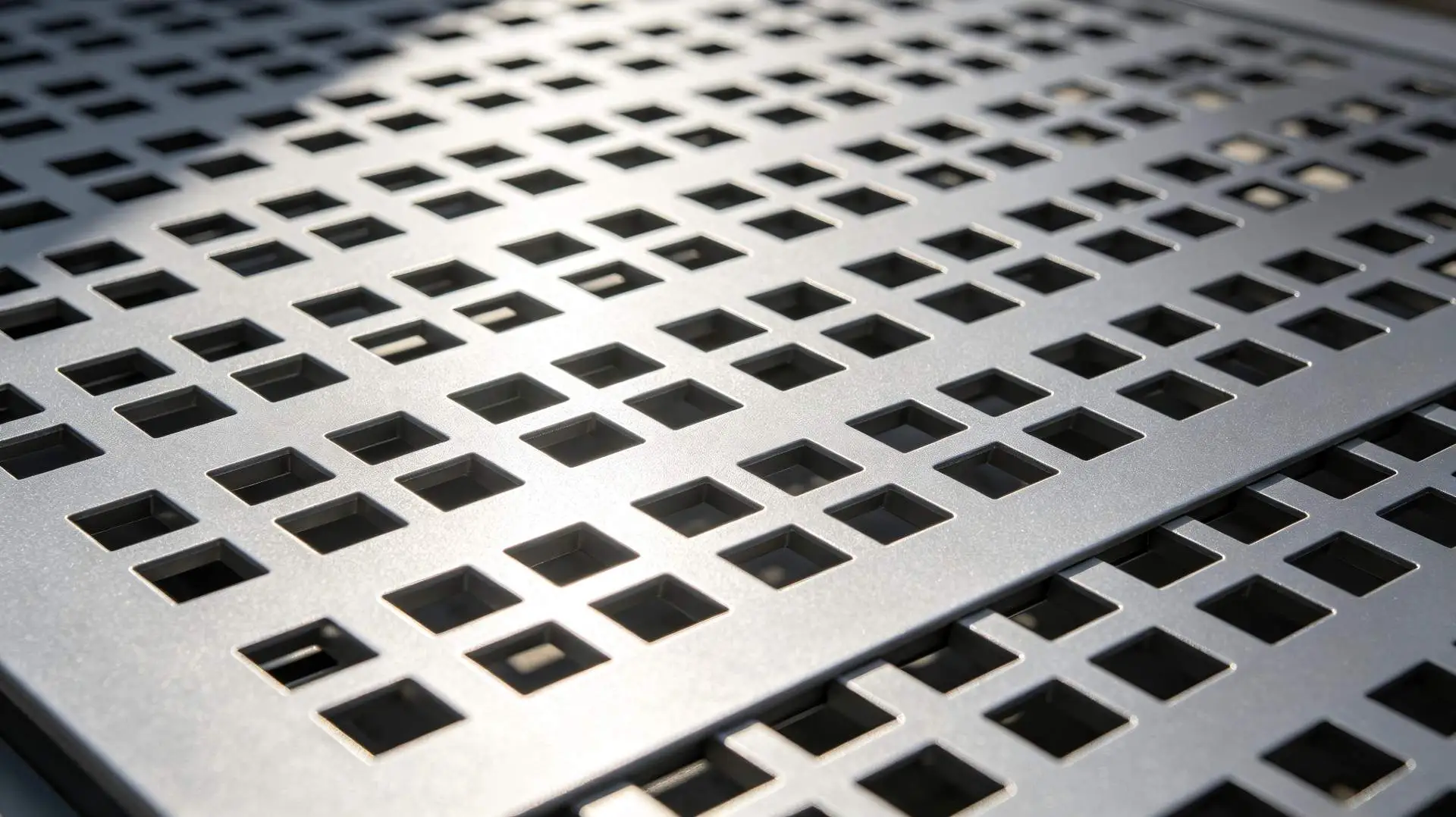
The essence of a perforated aluminum panel lies in its holes, and hole design directly determines both visual impact and structural performance. Two dominant manufacturing methods are used today: CNC punching and laser cutting. CNC punching is ideal for high-volume regular hole patterns with high efficiency and competitive cost. Laser cutting handles complex artistic patterns, irregular hole shapes and small-batch customization with precision down to 0.1mm, though at a higher unit cost.
Regular hole patterns. The most fundamental and widely used form, including round, square, slotted and diamond holes arranged in triangular or square matrices. Regular patterns offer visual consistency and structural stability, suitable for large-area facades, ceilings and acoustic barriers. Hole diameters typically range from 1mm to 50mm, with spacing adjusted to achieve the target open-area ratio.
Gradient perforation. Hole diameter or density transitions gradually from dense to sparse or from large to small, creating a subtle solid-to-void transition. Gradient perforation can simulate light-shadow gradation, guide visual flow, and even reproduce grayscale images such as portraits or brand logos through density variation. This "pixelated facade" technique has become increasingly popular in cultural buildings and brand flagship stores.
Artistic pattern perforation. Geometric motifs, abstract lines and botanical patterns are directly converted into perforation toolpaths, turning the aluminum panel into a metal open-work artwork. These panels are typically used with backlighting. At night, light shines through the perforations to produce dramatic visual effects, making them ideal for commercial storefronts, exhibition feature walls and hotel lobby decor.
Text and logo perforation. Brand names, slogans and logos are perforated directly into the panel, replacing traditional sign letters. Combined with backlighting, the text glows naturally with a seamless integrated appearance, avoiding the yellowing and detachment problems common with acrylic sign letters.

2. Interior Wall Applications: Reimagining Light, Transparency and Spatial Layers
In interior spaces, the value of perforated aluminum panels extends far beyond aesthetics. By modulating light and sightlines through perforations, they create spatial depth and atmosphere that solid walls simply cannot achieve.
Feature walls and brand walls. Perforated aluminum panels are dry-hung as feature walls in corporate reception areas, hotel lobbies and retail brand stores, with LED strip lights or wall washers mounted behind. Light filters through the holes to cast dappled patterns on walls and floors. By day, the surface exhibits a refined metallic texture; by night, it transforms into a luminous feature wall. Compared with stone and wood veneer, perforated walls offer a more contemporary, tech-forward aesthetic with the added benefit of single-panel replacement for easy maintenance.
Space dividers and semi-transparent partitions. Perforated aluminum panels serve as spatial dividers in offices, restaurants and exhibition halls, defining functional zones while preserving sightlines and light penetration. The hole diameter and density can be tuned to privacy requirements: smaller holes and lower open-area ratios for greater privacy, larger holes and higher ratios for openness.
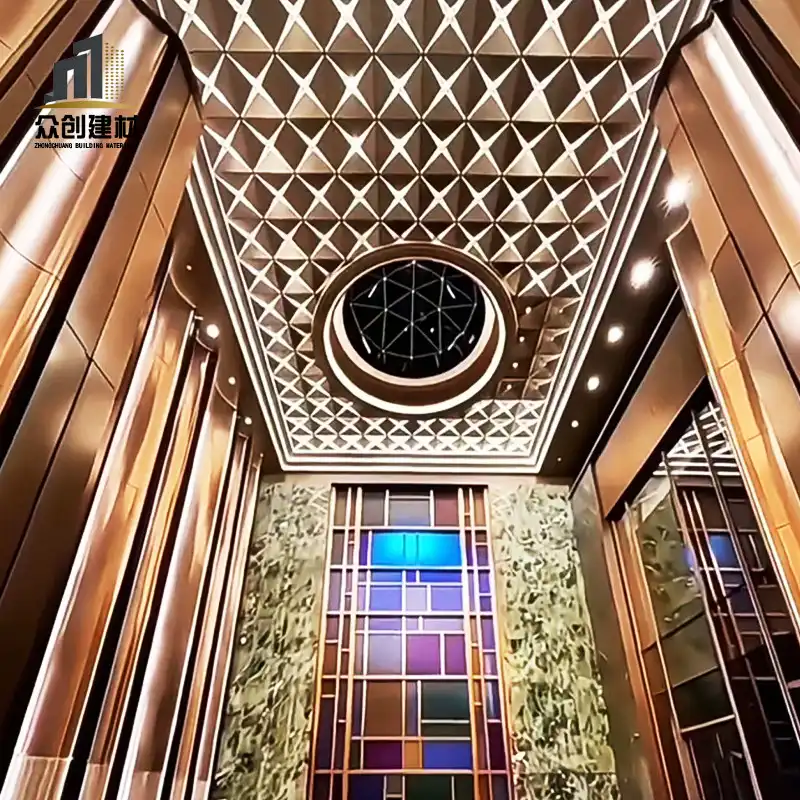
Column wraps and elevator lobby decor. Structural columns and elevator lobbies in shopping malls and office buildings can be wrapped with curved perforated aluminum panels with integrated lighting, converting cold structural elements into visual focal points. Wood-grain perforated column wraps are particularly popular in commercial spaces, injecting natural warmth while retaining the durability of metal.
Walls in wet areas. Aluminum does not absorb water or support mold growth, and perforation improves ventilation to reduce odor and moisture accumulation. With waterproof powder coating, perforated panels are suitable for public restrooms, pool changing rooms and SPA areas where traditional materials struggle.
3. Interior Ceiling Applications: The Preferred Solution for Open Acoustic Ceilings
In ceiling systems, the core advantage of perforated aluminum panels is the combination of acoustic absorption and visual transparency. In open ceiling configurations, perforated panels backed with acoustic mineral wool effectively reduce reverberation, while the perforations allow MEP services above the ceiling to remain partially visible, creating an industrial or tech-inspired spatial atmosphere.
Perforated clip-in ceiling tiles. Standard 600x600mm or 600x1200mm perforated aluminum tiles with non-woven fabric or acoustic wool backing achieve a Noise Reduction Coefficient (NRC) of 0.6 or higher. They are widely used in offices, meeting rooms, classrooms and hospitals with acoustic requirements. Matte white powder coating is the standard finish, and the tiles are compatible with conventional T-bar grid systems for easy installation.
Perforated aluminum baffle ceilings. Perforations on the bottom or side faces of U-channel aluminum baffles retain the transparency of linear ceilings while adding acoustic function. Large-space ceilings in shopping mall atriums, airport terminals and railway station halls extensively use perforated aluminum baffles, balancing decoration, acoustics and maintenance access.
Custom-shaped perforated ceilings. Curved, wavy and irregular perforated aluminum ceiling panels are used in hotel lobbies, exhibition halls and cultural buildings that require distinctive ceiling designs. The perforation ratio can be zoned according to acoustic needs: higher ratios in high-traffic zones for enhanced absorption, lower ratios in quiet areas for a more solid appearance.
4. Exterior Facade Applications: An Innovative Medium for Transparent Envelopes and Solar Shading
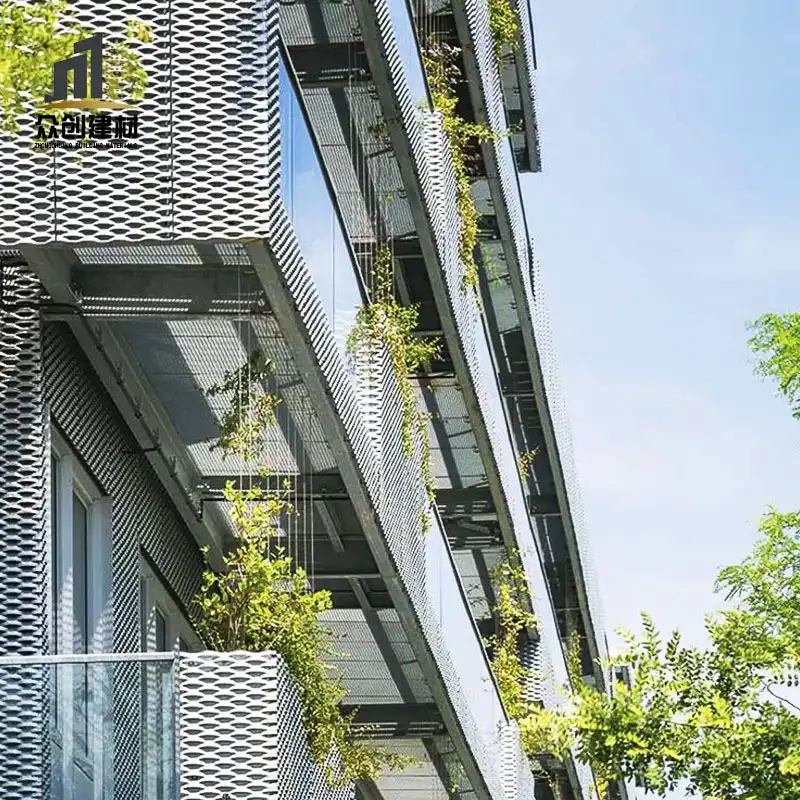
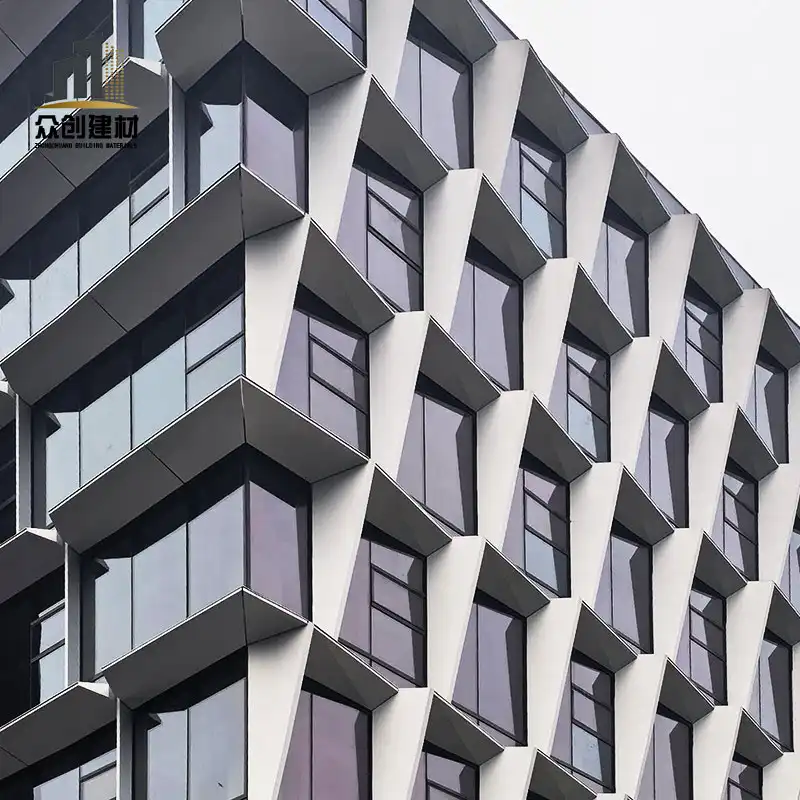
Exterior walls represent the most expressive application for perforated aluminum panels. Known overseas as perforated aluminum facades, they break away from the closed, heavy image of traditional curtain walls, offering a lightweight, transparent and light-responsive alternative that has become a major direction in contemporary facade design.
Gradient perforated facades. The solid-to-void ratio is varied across the facade to control shading. Denser perforation on west and south elevations reduces solar gain, while sparser perforation on north elevations maximizes daylight. This creates a "breathing building skin" that is not only visually rhythmic but also measurably reduces cooling energy demand, making it a common strategy in green building design.
Patterned perforated curtain walls. Architectural themes, regional cultural elements and brand symbols are converted into perforation patterns covering entire building elevations. By day, the patterns appear through light and shadow; by night, interior lighting transforms the whole building into a luminous art installation. Such projects often become urban landmarks, including museums, cultural centers and brand headquarters.
Double-skin facades. Perforated aluminum panels serve as the outer shading skin, with a glass curtain wall as the inner layer and a ventilated cavity between them. In summer, the outer panels block direct sunlight and the cavity dissipates heat through stack ventilation. In winter, ventilation openings are closed to form an insulating air layer. This construction is well established in Europe and is gaining rapid adoption in other markets.
Balcony and facade screening. Perforated aluminum panels are used as balcony enclosures and decorative facade screens, ensuring resident privacy and safety without compromising ventilation or daylight. Compared with traditional iron railings, perforated panels offer a more modern, monolithic appearance and require no periodic repainting.
5. Commercial Storefronts and Brand Facades: The Visual Revolution of Back-Lit Perforation
Commercial storefronts represent the fastest-growing segment for perforated aluminum panels. Conventional storefronts rely on acrylic illuminated letters, printed vinyl and aluminum composite panels, which suffer from short service life, low perceived quality and frequent maintenance. Perforated back-lit storefronts, with whole-panel illumination, unlimited pattern freedom and exceptional durability, are redefining the visual standard for commercial entrances.
Whole-panel back-lit storefronts. LED light sources are mounted behind an entire perforated aluminum panel, and light shines through uniformly distributed holes to create a soft glowing surface. Brand logos and text are naturally expressed through varying hole diameters or solid zones. Compared with traditional illuminated letters, whole-panel storefronts deliver uniform brightness without dark spots, and the LED fixtures are enclosed behind the panel for superior waterproof and dust-proof performance.
Partial perforation combined with solid panels. The brand logo area is perforated for illumination, while the remaining area retains solid aluminum panels in solid color or wood-grain finish. This creates strong solid-void contrast at a lower cost than full perforation. It is currently the most popular cost-effective solution for chain brands, highlighting brand identity while controlling the overall budget.
Dynamic lighting perforated storefronts. Programmable RGB LED strips are installed behind perforated panels, enabling dynamic changes in color, brightness and flowing effects via a control system. This is ideal for bars, nightclubs and trend-driven flagship stores. The perforated panel functions as a "pixel screen" for light, with effects far exceeding those of conventional LED displays, while remaining an attractive metal facade during the day.
6. Key Parameter Selection: Open-Area Ratio, Hole Size, Panel Thickness and Structural Safety
Selecting perforated aluminum panels is not simply a matter of aesthetics. The open-area ratio, hole diameter and panel thickness directly affect structural safety and in-service performance, and must be scientifically matched to the application scenario.
Open-area ratio. This is the percentage of total hole area relative to total panel area. Interior acoustic ceilings typically require 20% to 40%; exterior shading generally ranges from 30% to 60%; purely decorative pattern perforation may reach 50% to 70%. Note that panel rigidity drops significantly above 40% open area, which must be compensated by increasing substrate thickness, reducing module size or adding back stiffeners. Panels exceeding 60% open area are not recommended for load-bearing exterior applications.
Hole diameter and spacing. Smaller holes mean more holes per unit area and better acoustic performance, but higher fabrication cost. Interior acoustic ceilings commonly use 2mm to 5mm hole diameters; exterior decoration and shading typically use 10mm to 30mm; artistic pattern perforation ranges from 0.5mm to 50mm depending on pattern detail. Hole spacing should generally be no less than 0.8 times the hole diameter to avoid tearing between adjacent holes.
Panel thickness. Interior walls and ceilings commonly use 1.0mm to 1.5mm. Exterior solid panels should be no thinner than 2.0mm, with 2.5mm to 3.0mm recommended for large modules or high open-area ratios. Overhanging storefront structures require 2.0mm or thicker, or aluminum honeycomb composite panels for enhanced rigidity. Perforated panels with insufficient thickness are highly prone to warping and buckling under outdoor thermal cycling.
Back stiffeners. Large-format or high open-area panels must have reinforcing ribs (typically aluminum rectangular tubes) installed on the back to prevent panel deformation. Stiffener spacing should generally not exceed 600mm, with exact dimensions determined by structural calculation. Many low-cost perforated panels omit stiffeners, resulting in wavy panel deformation shortly after installation.
7. Surface Finishes and Weather Resistance: The Fundamental Difference Between Indoor and Outdoor Grades
The surface finish of perforated aluminum panels determines not only color and texture but also service life. Indoor and outdoor projects have fundamentally different coating requirements, and specifying the wrong finish is the most common cause of perforated panel project failures.
Indoor projects: Powder coating. Electrostatic powder coating offers rich colors, strong adhesion and competitive cost, making it the standard for interior perforated panels. Matte white, light gray and black are the most common colors, while wood-grain thermal transfer is used for spaces requiring natural texture. Powder coating has limited UV resistance and is suitable only for indoor or fully sheltered semi-outdoor areas.
Outdoor projects: PVDF fluorocarbon coating. Polyvinylidene fluoride (PVDF) fluorocarbon coating provides exceptional weather resistance, guaranteed against fading, chalking and cracking for 15 to 20 years. It is mandatory for exterior perforated panels. In coastal high-salt-spray regions, increased primer thickness or super-weatherable PVDF formulations are recommended. Outdoor projects must explicitly specify "PVDF fluorocarbon coating" in the procurement contract and require coating test reports from the supplier.
Special effects: Anodizing and thermal transfer. Anodizing produces a natural metallic appearance with high surface hardness and abrasion resistance, but limited color options, making it suitable for high-end interior projects. Thermal transfer reproduces wood, stone and concrete textures on perforated panels, but its outdoor weatherability is inferior to PVDF, limiting it to indoor or sheltered applications.
Perforation edge treatment. After punching, the cut edges expose the bare substrate. Without proper sealing, these edges are vulnerable to oxidation and corrosion in outdoor environments. Quality suppliers perform full pre-treatment and coating after perforation to ensure complete coating coverage inside the holes. Low-cost products often coat only the front face, leaving cut edges exposed and causing rust spots within a short period.
8. Engineering Pitfalls: The Five Most Common Failure Points for Perforated Aluminum Panels
Perforated aluminum panels may appear simple, but every stage from design to installation can introduce hidden problems. The following are the five most frequently encountered issues in real projects:
Pitfall 1: Relying on renderings without structural verification. High open-area, large-module perforated panels that are not structurally calculated may deform or even detach under wind loads or self-weight after installation. Exterior projects must have wind loads calculated by a structural engineer to determine panel thickness, module size and stiffener layout.
Pitfall 2: Poor back-light design causing uneven bright spots. The most common problem with perforated illuminated storefronts is a "spotty" appearance, where each hole corresponds to a bright point with uneven overall brightness. This is caused by light sources placed too close to the panel (typically should be no less than 150mm) or by excessive spacing between light sources. The correct approach is to install a reflective light trough behind the panel so that light is reflected and diffused before passing through the perforations, producing a soft, uniform glow.
Pitfall 3: Using interior powder coating outdoors. This is the most critical and most common mistake. Powder coating applied outdoors will severely fade and chalk within one to two years, and cannot be locally repaired, requiring full panel replacement. Outdoor projects must specify PVDF fluorocarbon coating in the contract and require test reports conforming to AAMA 2605 or equivalent standards.
Pitfall 4: Neglecting drainage and waterproofing details. Although exterior perforated panels drain water through holes, improper treatment at panel joints and trim edges can allow rainwater to penetrate the back sub-frame system, causing steel corrosion. The correct approach is to use a dry-hanging system, reserve drainage holes and install a waterproof breathable membrane on the back to ensure water that enters can also exit.
Pitfall 5: Improper installation sequence causing surface scratches. Perforated panel coatings are relatively soft. Panels should be installed last, after scaffolding removal and completion of other trades, and installers must wear gloves and use rubber suction cups. Many projects, rushing to meet deadlines, install panels early, only to have them contaminated by mortar and paint or scratched by tools, with no viable repair solution afterward.
Conclusion
The appeal of perforated aluminum panels lies in how the simplest act of punching holes unlocks unlimited design possibilities for metal cladding. From a luminous feature wall indoors to a pixelated facade on an entire building, from an acoustic ceiling to an energy-saving shading skin, perforated aluminum panels are redefining the boundaries of decorative cladding. For designers and project teams, understanding the matching logic among open-area ratio, hole diameter, panel thickness and coating, while avoiding common engineering pitfalls, is essential to ensuring that this high-appearance material delivers on its promise of beauty and durability.