_1782530506402.webp)
(1)_1783045836766.webp)
_1786157639392.webp)
(1)_1780970038980.webp)
Double-Layer Aluminum Ceiling Selection Guide
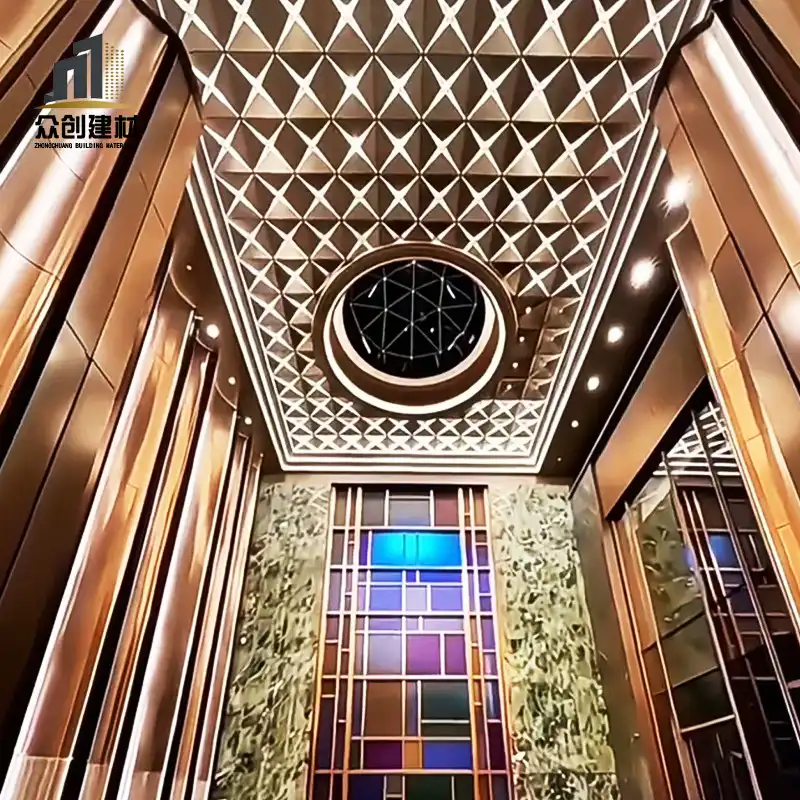
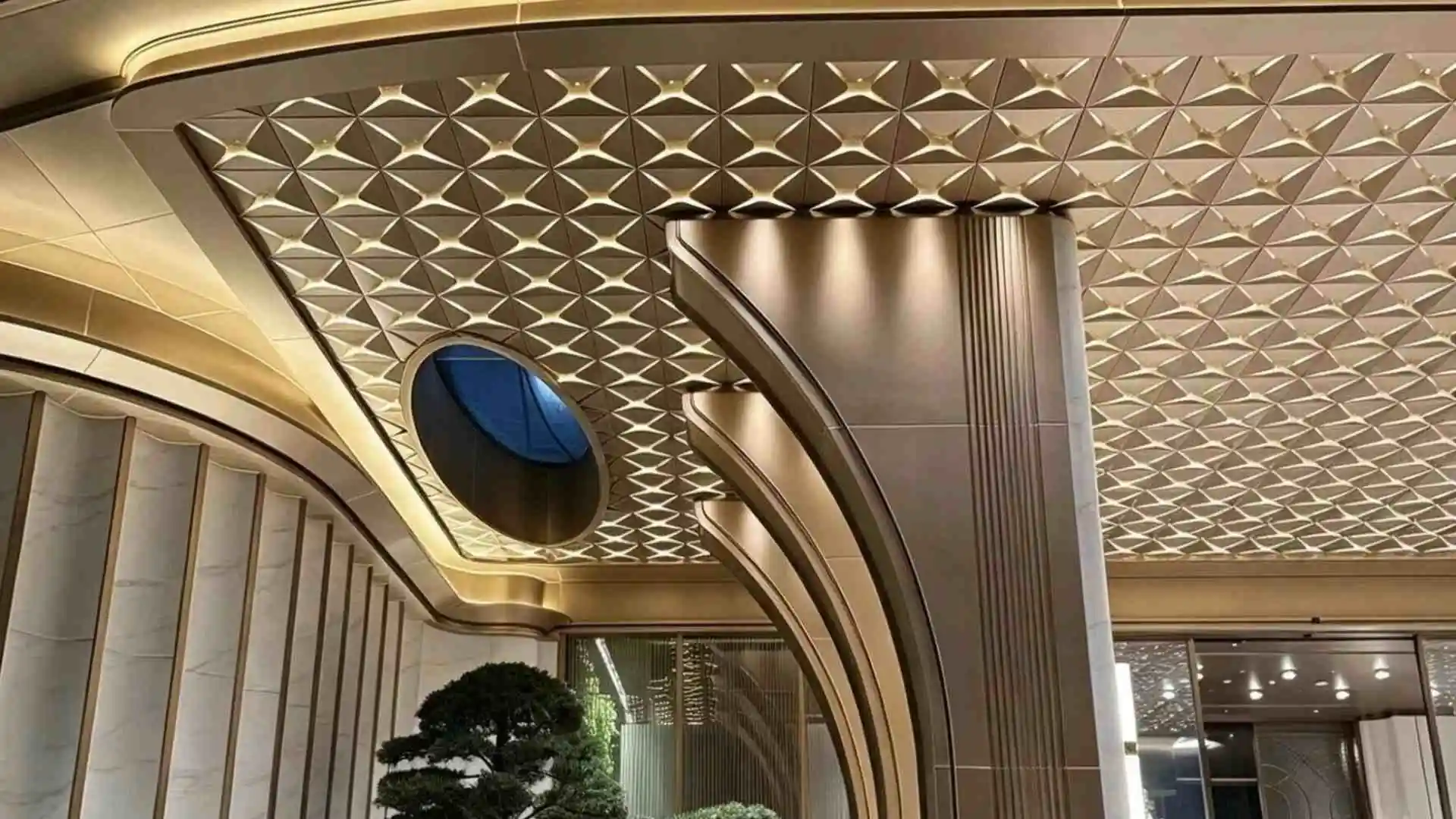
Shaped Types and Suitable Spaces
Form determines light character and should be chosen by spatial scale and viewing distance. Small spaces benefit from fine, dense units that create rhythm; large spaces need bigger units to build presence. Close viewing demands detail; distant viewing demands silhouette.
|
Shaped Type |
Forming Method |
Light Effect |
Application |
|---|---|---|---|
|
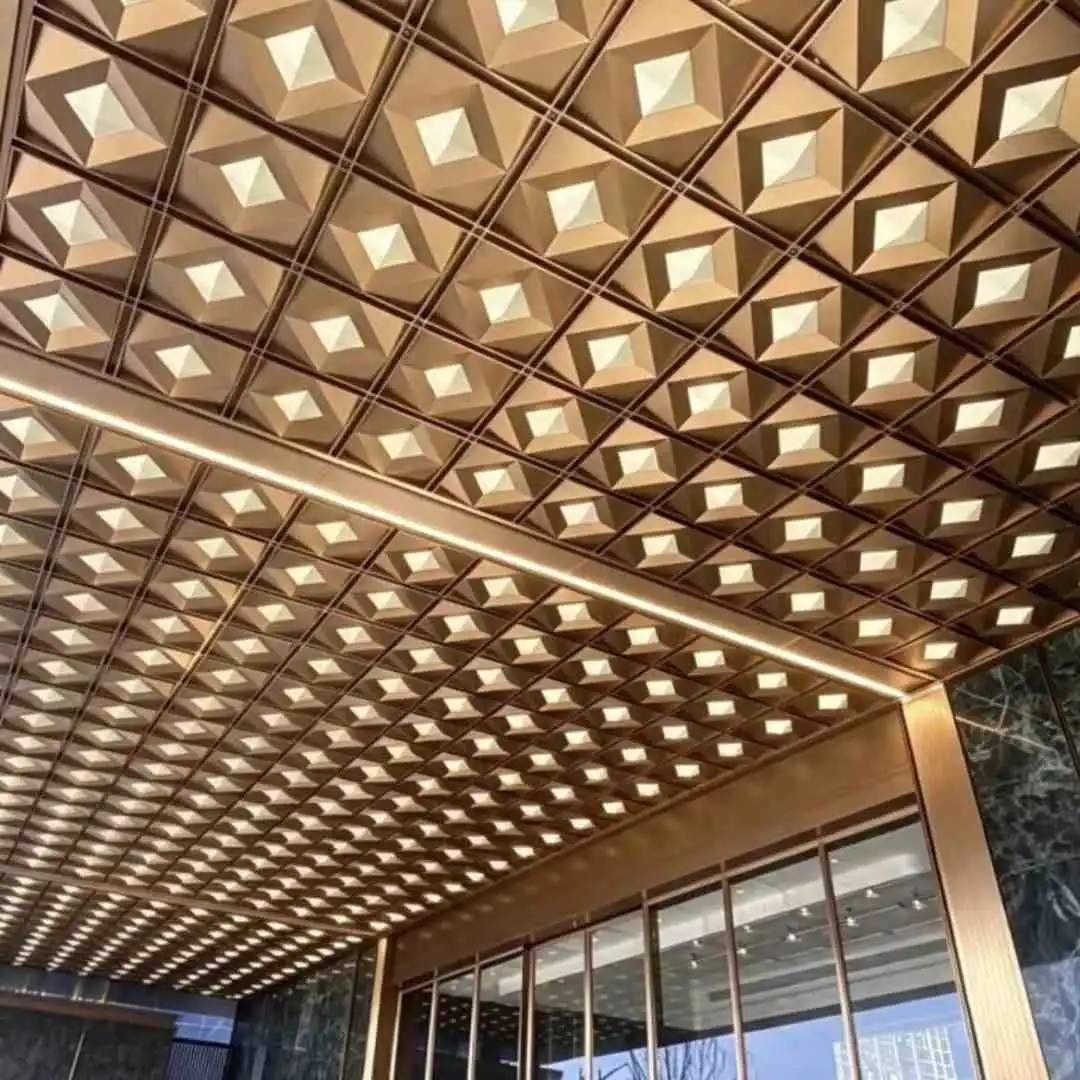
Pyramid relief |
Four-side bending and pressing |
Distinct faces, light concentrated at center |
Hotel lobbies, commercial atriums |
|
Four-point star |
Irregular bending with center hole |
Radiating light, star-like spots |
Ballrooms, brand spaces |
|
Diamond facets |
Multi-angle bending |
Geometric facets, crisp and modern |
Office foyers, exhibition halls |
|
Petal curves |
Curved forming |
Soft curves, flowing rhythm |
Clubs, sales centers |
|
Wave undulation |
Roll corrugating |
Continuous waves, gentle rhythm |
Large atriums |
|
Free-form surface |
CNC double-curvature forming |
Sculptural, strong artistic tension |
Cultural buildings, art spaces |

Comparison with Single-Layer Ceiling Options
When a project hesitates between single-layer and double-layer, the real dividing line is not cost but whether light must be part of the form itself.
|
Dimension |
Double-Layer Formed |
Single-Layer Tiles |
Mineral Wool |
Gypsum Forms |
|---|---|---|---|---|
|
Dimensional depth |
Strong (interlayer cavity) |
None |
None |
Medium (stepped) |
|
Light performance |
Excellent (hidden sources) |
Fair (surface fixtures) |
Fair |
Fair (needs coves) |
|
Installation time |
Short (factory units) |
Short |
Short |
Long (on-site plastering) |
|
Moisture and mold resistance |
Excellent |
Excellent |
Poor (absorbs moisture) |
Poor (cracks and molds) |
|
Maintenance |
Single-panel source replacement |
Removable |
Removable |
Not removable without damage |
|
Weight |
Light (8–15kg/m²) |
Light |
Medium |
Heavy |
|
Cost |
Medium-high |
Low |
Low |
Medium |
Matching Interlayer Cavity to Light Source
The cavity is neither better when larger nor cheaper when smaller. It must match fixture height, beam angle, and target spot diameter to reach the intended effect:
-
Spot diameter: A taller cavity spreads the spot wider and softer; a shallower one keeps the spot sharp with harder edges.
-
Glare control: If the source sits less than 40mm deep, the fixture body may still be visible from directly below and requires a diffuser.
-
Thermal headroom: Continuously operating LEDs need airflow; a sealed cavity should be at least 30mm with a reserved heat path.
-
Form depth: The pyramid or star relief must be taller than the cavity, otherwise the form gets flattened and loses depth.
-
Practical values: 30–50mm for general decoration; 50–70mm for a pronounced star matrix; 70–80mm for large-space wall-washing.
Process Comparison and Quality Control Points
|
Process |
Method |
Key Control Point |
|---|---|---|
|
Bending and pressing |
CNC bending plus four-side pressing |
Symmetrical faces, consistent angles, springback compensation |
|
Center perforation |
Punching or laser cutting |
Centered hole, diameter matched to fixture |
|
Interlayer assembly |
Limiters fixing both panels |
Uniform cavity depth, no local compression |
|
Coating |
Electrostatic spraying after forming |
Continuous coating on facets and hole rims, no exposed substrate |
|
Light pre-installation |
Factory pre-install and test-lighting |
Consistent color temperature, flicker-free, compliant wiring |
|
Packaging |
Custom slotted wooden cases |
Facets not compressed, interlayer not deformed |
The easily overlooked point is coating sequence. The formed panel must be coated only after bending, pressing, and perforation are all complete; otherwise coating thickness drops at fold corners and hole rims, exposing substrate and causing color variation and early oxidation. This looks like a process detail but effectively decides how the ceiling looks five years later.
Common Installation Issues and Solutions
-
Misaligned Dual-Layer Setting Out: Outer and inner layers must be marked out separately; a single line causes center holes to miss the light sources and produces off-center glow.
-
Hangers Estimated as Single Layer: A double-layer panel plus fixtures weighs about 1.6–2 times a single layer; estimating as single layer causes the ceiling to sag.
-
Uneven Joints: Joints should be designed uniformly as reveal gaps with consistent width to prevent compression or misalignment from thermal movement.
-
Drilling for Fixtures After Installation: On-site drilling damages the coating and leaves corrosion risks; light positions must be fixed at the factory stage.
-
Missing Access Hatches: Without hatches, replacing a light source requires removing an entire ceiling area, sharply raising maintenance costs.
-
Batch Color Variation: Order all panels for one ceiling in a single batch; separate production runs cause slight color differences.
Supplier Evaluation Checklist
To judge whether a double-layer ceiling supplier is reliable, check the following six items:
-
Forming and Perforation Capability: Can the supplier produce unit fabrication drawings from renderings and guarantee alignment between center holes and fixtures?
-
Double-Layer Assembly Process: Does the supplier have a proven limiter and cavity-control solution, and can it provide an interlayer section drawing?
-
Coating Sequence Control: Does the supplier insist on coating after forming, and can it provide coating inspection notes for fold corners and hole rims?
-
Light Integration Capability: Can the supplier pre-install and test-light in the factory, and provide color temperature and luminous flux data?
-
Certification Completeness: Are AAMA 2605, CE, ISO 9001, ASTM E84, and SGS reports all in place?
-
Export and After-Sales: Packaging solutions, customs experience, 15–20 year warranty, and replacement-panel response mechanism.