
_1782530506402.webp)
(1)_1783045836766.webp)
_1786157639392.webp)
(1)_1780970038980.webp)
Wood-Grain Aluminum Baffle Selection Guide
Process First: Layers Determine Life, Tension Determines Grain
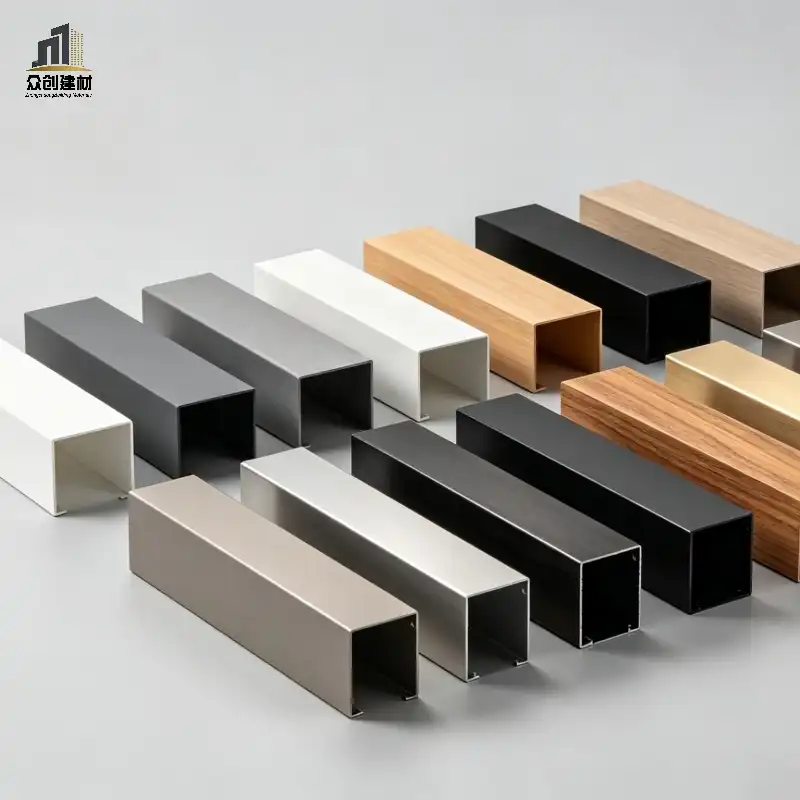
The first step in judging a wood-grain aluminum baffle is not color but structure. Two practices exist in the market: two-layer and three-layer.
-
Two-layer (low-cost): Base color sprayed, grain transferred directly, then topcoat. Without the powder base, grain adhesion is weak and fading or peeling appears within two to three years.
-
Three-layer (proper): Powder base 40–60μm → vacuum heat transfer 5–15μm → clear topcoat 15–25μm.
In the three-layer structure, the powder base does more than prime the surface: it provides the microporous structure into which transfer ink diffuses. The grain penetrates rather than sitting on top, and that is the root cause of durability. A simple test: scratch repeatedly at one spot with a fingernail. Two-layer products quickly expose the base color; three-layer products only leave light marks in the clearcoat.
The second process key is transfer film tension. Insufficient tension causes wrinkle-like distortion, while excessive tension stretches the grain and makes it shallow. Both defects are obvious within one meter but nearly invisible from afar — so inspection must be done at close range.

Section Selection: Driven by Space and Visual Goal, Not Habit
|
Section Type |
Structural Feature |
Visual Feature |
Application |
Note |
|---|---|---|---|---|
|
Square tube |
Fully closed four-sided |
Crisp lines, strong order |
Offices, commercial corridors |
Sides are also visible; grain must be continuous on all faces |
|
U-channel |
Closed on three sides, open on one |
Light, transparent, layered |
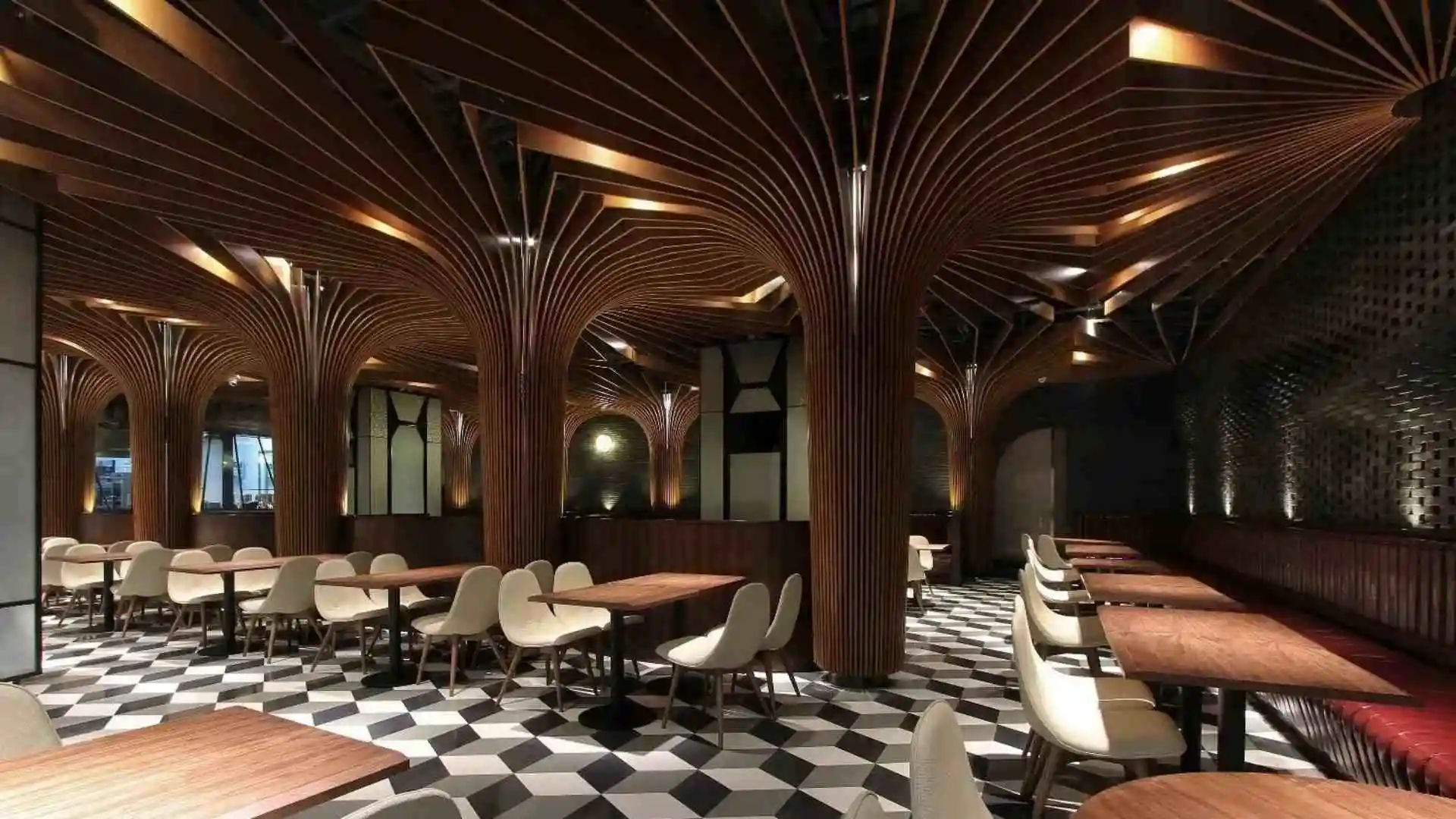
Restaurants, hotel lobbies |
Opening direction determines shadow effect |
|
Winged clip |
Wings on both sides, clip-mounted |
Tight joints, integrated |
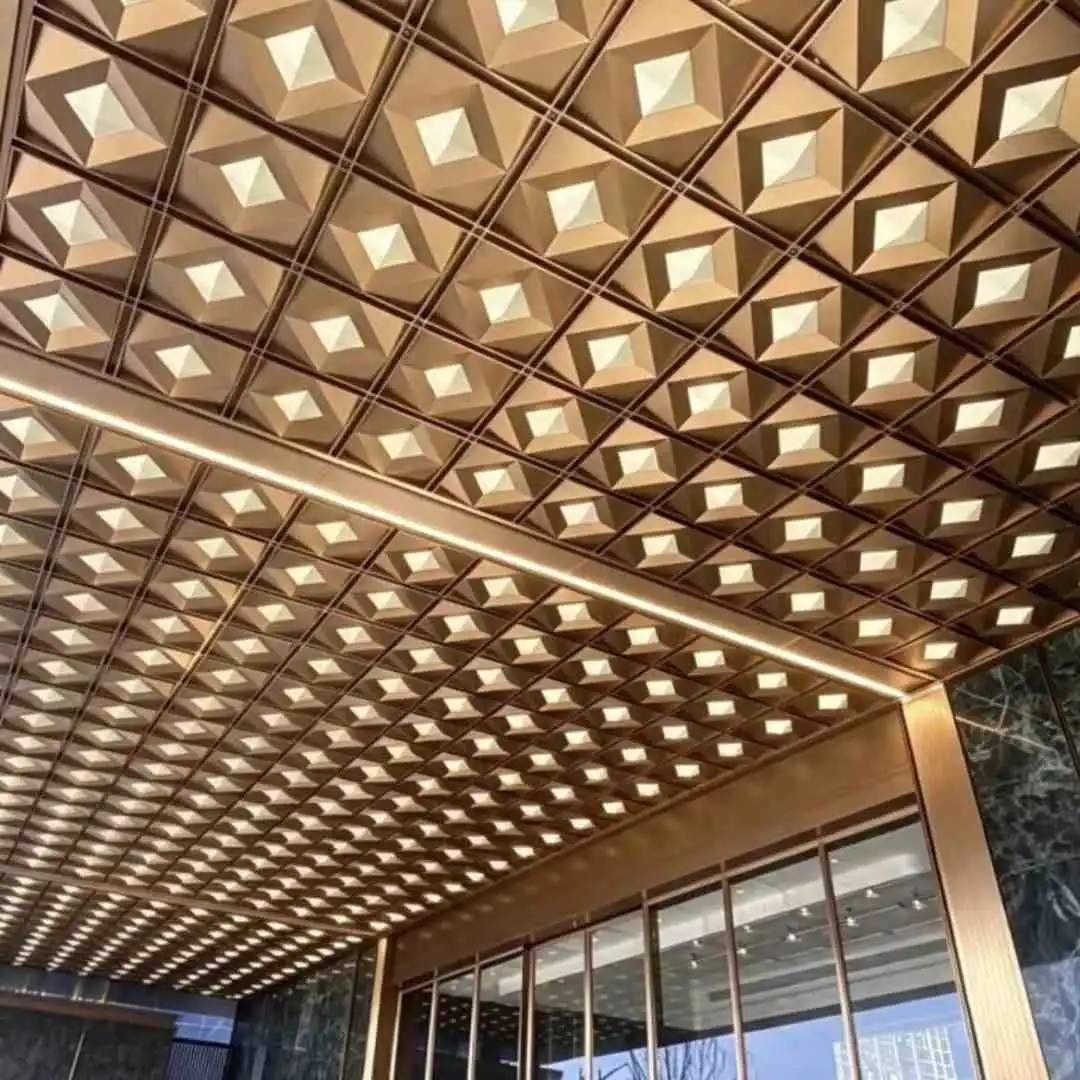
Large ceiling areas |
Highest demand on carrier precision |
|
Rounded tube |
Rounded corners |
Soft and approachable |
Residences, clubs |
Grain may shift tone at rounded corners; check closely |
|
Wide flat profile |
Width-to-height above 2:1 |
Sheet-like, strong concealment |
High spaces, service concealment |
Wide faces may show visual waviness; needs high straightness |
|
Irregular section |
Trapezoid, polygon, etc. |
High recognition |
Brand spaces |
Requires tooling; higher minimum order |
One commonly overlooked judgment: whether the baffle is "three-face visible" or "single-face visible." Seen from below, a ceiling baffle shows at least the bottom plus two sides; in high spaces or at oblique angles, the top may also be seen. If only the bottom is transferred and the sides remain bare aluminum, silver edges appear when viewed obliquely and break the overall impression. Proper practice is therefore full four-face transfer — a cost difference of roughly 10–15% but a completely different visual result.
Spacing and Visual Density: The Threshold Between Sparse and Dense
Baffle spacing is not arbitrary; three factors determine it: baffle width, space height, and viewing distance.
-
Dense (spacing less than baffle width): Reads close to a continuous wood finish, strong service concealment, but weaker transparency and higher cost.
-
Standard (spacing 1–2 times baffle width): Balances slat character and transparency; the most common choice.
-
Sparse (spacing more than 3 times baffle width): Emphasizes linearity and lightness, but poor service concealment.
-
Rule of thumb: Spacing around 1/20 to 1/10 of clear height reads most comfortably; 150–300mm for a 3-meter ceiling.
-
Oblique-view compensation: If the main viewing angle is oblique (such as looking up from under a stair), perspective compresses the apparent spacing and it should be increased.
Another easily missed point is perceived depth. The vertical dimension of a square tube determines the slat's dimensional depth: the taller the profile, the deeper the shadow and the stronger the layering. A 50mm-high baffle and a 100mm-high baffle feel completely different at the same spacing. Adjusting spacing should therefore always be considered together with section height.
Grain Direction and Color Variation Control
Wood grain has direction. If two adjacent baffles run in opposite grain directions, the result looks like mismatched planks and causes clear visual discomfort. Proper practice is to align all baffles in the same direction and, within one area, to align grain starting positions as closely as possible.
Color variation control is an engineering metric. Transfer is affected by temperature, vacuum level, film tension, and base-coat flatness, so slight but visible differences can appear between furnace batches. Three control measures apply:
-
Single-Batch Principle: Order all panels for one ceiling or one elevation at once — same film roll, same furnace batch, same powder batch.
-
Sealed Sample First: Approve and seal a standard swatch before mass production, and use it as the acceptance benchmark.
-
Zoned Acceptance: Accept by sight-line zone, applying the strictest standard to primary viewing areas and allowing reasonable tolerance in secondary areas.
Comparison with Other Wood-Look Finishes
|
Dimension |
Wood-Grain Aluminum Baffle |
Solid Wood Battens |
Wood Veneer Panel |
PVC Wood Board |
Aluminum Honeycomb Wood Panel |
|---|---|---|---|---|---|
|
Moisture and mold resistance |
Excellent |
Poor |
Poor |
Fair |
Excellent |
|
Fire rating |
Class A non-combustible |
Requires treatment |
Requires treatment |
Mostly Class B |
Class A non-combustible |
|
Cracking resistance |
Excellent |
Poor |
Fair |
Fair |
Excellent |
|
Grain realism |
High |
Highest |
High |
Low |
High |
|
Weight |
Light |
Medium-heavy |
Medium |
Light |
Medium |
|
Transparency |
Good (slatted) |
Good |
None (closed surface) |
None |
None |
|
Maintenance cost |
Low |
High |
Medium |
Low |
Low |
|
Cost |
Medium |
High |
Medium-high |
Low |
High |
The key conclusion from this table: the irreplaceability of wood-grain aluminum baffles comes from the combination of slatted transparency plus aluminum's stability. If a project needs no transparency and only a flat wood-look surface, aluminum honeycomb wood panels or veneer panels may suit better; if it needs transparency and fire safety, wood-grain aluminum baffles have almost no competitor.
Technical Parameters and Selection Guidance
|
Parameter |
Standard |
Selection Guidance |
|---|---|---|
|
Base alloy |
6063-T5 |
Use 6061 or a higher coating grade in coastal or corrosive environments |
|
Wall thickness |
1.0mm |
Use 1.2–1.5mm for spans over 1.5m or wide flat sections |
|
Section size |
50×50mm |
Choose by clear height; avoid heavy sections below 3m |
|
Cut length |
3000mm |
Prefer 6m for large spaces to reduce splices |
|
Powder base thickness |
50μm |
Not less than 55μm for outdoor use |
|
Topcoat gloss |
5–15GU |
Matte is preferred for large ceilings to reduce reflection |
|
Fire rating |
Class A |
Mandatory for public buildings; test reports required |
Common Installation Issues and Solutions
-
Carrier Spacing Exceeded: If carrier spacing exceeds the manufacturer's requirement, long profiles sag at mid-span with visible straightness loss; follow the specified layout strictly.
-
Uneven Spacing: Without fixed-distance jigs, spacing becomes uneven and reads as disorder from a distance; position each baffle with a jig.
-
Reversed Grain: Adjacent baffles with opposite grain directions are visually disturbing; unify orientation using grain markings before installation.
-
Bare Silver Sides: Products transferred only on the bottom show bare aluminum at oblique angles; specify full four-face transfer.
-
White Edges at Borders: Without matching edge trims or corner pieces, white aluminum substrate shows at the perimeter; produce accessories in the same batch.
-
Transit Damage on Long Profiles: Six-meter profiles without slotted wooden cases suffer corner compression; packaging must be specifically designed.
-
No Reserved Access: Without openable units above equipment, maintenance requires removing an entire baffle field.
Supplier Evaluation Checklist
-
Layer Count Clarity: Can the supplier state whether the product is two-layer or three-layer, and provide a coating section description?
-
Long-Profile Transfer Capability: Can it wrap a 6-meter profile in a single pass to avoid grain breaks?
-
Tension Control Level: Can it supply a close-range sample for scratch and grain-continuity inspection?
-
Color Variation Management: Does it have a defined process for same-batch production, same film roll, and sealed-sample acceptance?
-
Certification Completeness: Are ISO 9001, CE, ASTM E84, AAMA 2605, and SGS reports all in place?
-
Accessory Capability: Can edge trims and corner pieces be produced in the same batch to avoid color mismatch?
-
Delivery and After-Sales: Packaging solutions, customs experience, 15–20 year warranty, and replacement-material response.