_1762768699969.webp)

_1782530506402.webp)
(1)_1783045836766.webp)
_1786157639392.webp)
(1)_1780970038980.webp)
Where Art Meets Function: How Perforated Aluminum Panels Redefine Architectural Decoration
Few building materials manage to integrate "looking beautiful" and "working well" as naturally as perforated aluminum panels. Known in overseas markets as perforated aluminum panels or perforated metal cladding, these products are manufactured from aluminum alloy sheets. Precise hole arrays are created by CNC punching machines or laser cutting, followed by powder coating, PVDF fluorocarbon coating or thermal transfer finishing. The result is a unique building material that functions both as a "canvas" and as a "filter."
Traditional building materials often force a trade-off between aesthetics and performance: stone is elegant but heavy, wood is warm but flammable, glass is transparent but energy-inefficient, concrete is durable but cold. Perforated aluminum panels break this dilemma. The holes serve simultaneously as brushstrokes for artistic expression and channels for functional performance. Light passing through holes becomes pattern; air passing through holes achieves ventilation; sound passing through holes is absorbed and dissipated; sight passing through holes gains depth. This article systematically examines how perforated aluminum panels achieve "beauty and substance in one" in contemporary architecture, from both artistic and functional perspectives.

1. The Artistic Dimension: When Metal Sheets Meet Light and Pattern
The artistic value of perforated aluminum panels lies in their ability to transform "light" into a designable building material. Solid panels can only reflect light, but perforated aluminum panels can "filter" and "sculpt" light, allowing building facades to display changing light-and-shadow expressions throughout the day as the sun moves.
Light-and-shadow painting. This is the most distinctive artistic technique of perforated aluminum panels. By controlling hole diameter and density, designers can "paint" gradients, stripes and even representational patterns on walls or floors. In strong sunlight, shadows are sharp and crisp; on overcast days or at dusk, they become soft and diffuse. The same perforated wall presents completely different visual effects at different times, a dynamic aesthetic that no solid panel can achieve.
Pattern-based storytelling. CNC fabrication technology enables perforated aluminum panels to carry complex artistic patterns, from geometric motifs and botanical textures to human portraits and city maps. An even more creative approach is to translate a building's history, regional culture or brand story into perforation patterns, turning the building facade into a "storytelling interface." For example, a museum facade may reproduce traditional local textile patterns through perforation, while a brand headquarters may use gradient perforation to create a pixelated image of its logo.
Nighttime luminous art. When LED light sources are installed behind perforated aluminum panels, the material transforms into a "luminous canvas" after dark. Light shines evenly through the holes, producing either a soft surface glow or patterned projection. Compared with traditional LED display screens, perforated luminous facades remain attractive metal walls during the day, avoiding the "black screen" or "grid" appearance. They achieve a dual identity: "architecture by day, art by night."
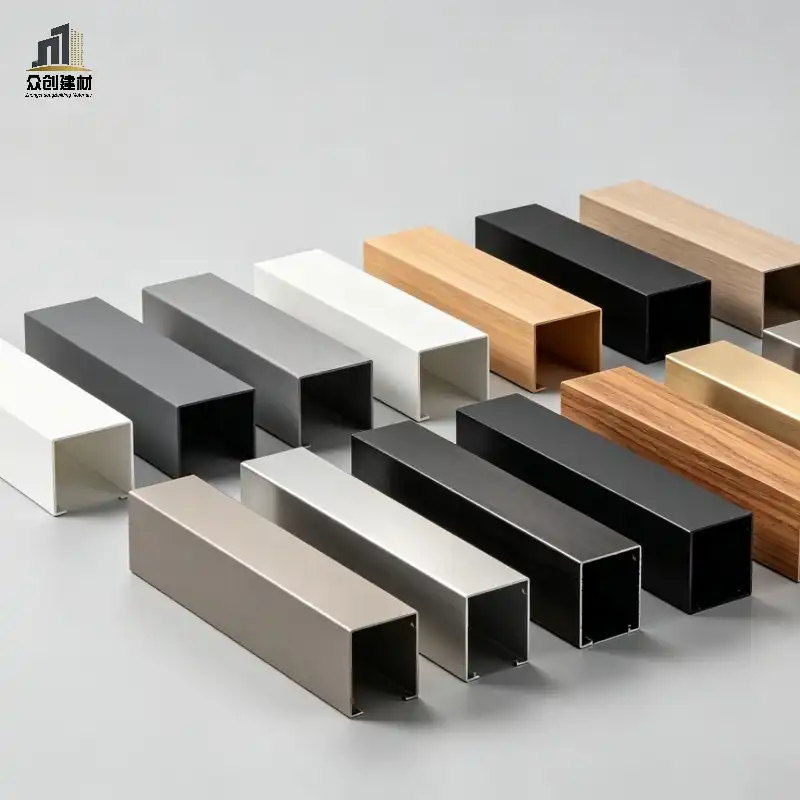
Layering color and texture. Perforation itself is a form of "texture," while surface finishing adds a second "skin." Matte powder coating delivers a soft, contemporary look; PVDF metallic paint shimmers with subtle luster in sunlight; thermal transfer wood grain brings natural warmth; anodizing preserves the cool austerity of bare metal. The same hole pattern, paired with different surface finishes, can produce entirely different moods, from industrial to light-luxury, from tech-forward to natural.
2. The Functional Dimension: The Underestimated Engineering Value
If art is the "face" of perforated aluminum panels, then functional performance is their "backbone." Many people see only the appearance of perforated panels while overlooking the powerful engineering properties behind the holes. In fact, it is these functional values that elevate perforated aluminum panels from mere decorative materials to essential components of building systems.
Acoustic control. This is the core functional benefit of perforated aluminum panels. When backed with acoustic mineral wool or non-woven fabric, sound waves pass through the holes into the absorbing material, where friction converts sound energy into heat, effectively reducing reverberation time. Perforated aluminum ceiling tiles can achieve a Noise Reduction Coefficient (NRC) of 0.6 or higher, and perforated aluminum baffle ceilings deliver even more significant acoustic performance in large spaces. For offices, meeting rooms, classrooms and hospitals where clear speech communication is essential, perforated ceilings are almost a standard acoustic design solution.
Ventilation and heat dissipation. The holes allow free air circulation, which is particularly important in mechanical rooms, parking areas, kitchens and substations that require forced ventilation. Perforated aluminum panels used as equipment enclosures or mechanical room walls ensure heat dissipation while concealing unsightly equipment behind a unified metal facade. On building exteriors, perforated panels can also serve as an alternative to ventilation louvers, achieving the same airflow function with a more monolithic visual appearance.
Solar shading and energy efficiency. When used as external solar shading, perforated aluminum panels filter a portion of direct sunlight, reducing solar heat gain entering the building while preserving natural daylight and exterior views. Studies show that properly designed perforated shading facades can reduce building cooling energy consumption by 15% to 30%. Compared with solid shading panels, perforated shading does not completely block light and views, creating a lighter, more transparent spatial experience; compared with glass curtain walls, it effectively controls glare and thermal radiation.
Safety and protection. When used as balcony enclosures, stair guards or platform railings, perforated aluminum panels meet safety code requirements while avoiding the closed feeling of solid walls. Panels with hole diameters smaller than 20mm effectively prevent children from climbing and objects from falling, while maintaining ventilation and visual transparency. In some projects, perforated aluminum panels are also used as the exterior finish of blast-resistant walls, improving aesthetics without compromising blast performance.
Lightweight and recyclable. Aluminum alloy is inherently lightweight and high-strength, and perforation further reduces weight, minimizing load on building structures. At the same time, aluminum is 100% recyclable; discarded perforated panels can be melted down and reused, aligning with green building and circular economy requirements. This is a key reason why perforated aluminum panels are widely specified in LEED, BREEAM and other green building certification projects.
3. Interior Spaces: Merging Artistic Atmosphere with Acoustic Comfort
In interior design, the most compelling application of perforated aluminum panels is the perfect integration of artistic atmosphere creation with acoustic functional requirements. A space needs both to "look good" and to "sound good," and perforated aluminum panels satisfy both demands simultaneously.
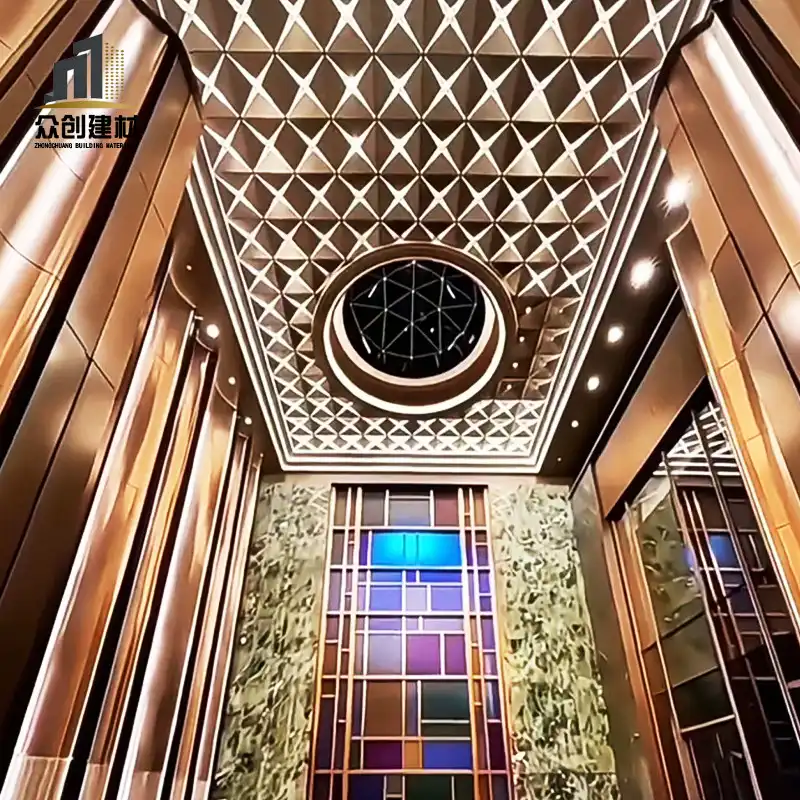
Office spaces. The biggest pain point in open-plan offices is noise interference, where conversation, phone calls and keyboard sounds combine to severely reduce productivity. Perforated aluminum tile ceilings with acoustic backing can control reverberation time to within 0.5 seconds, significantly improving speech intelligibility and work focus. At the same time, the perforated texture itself conveys a modern, tech-forward aesthetic that aligns well with office environments. Innovative projects also integrate lighting, HVAC diffusers and fire sprinklers into perforated ceilings, creating a "unified ceiling system" with a cleaner visual appearance.
Commercial spaces. Shopping malls, restaurants and cafes extensively use perforated aluminum panels for ceilings and walls. On one hand, acoustic absorption reduces spatial noise and improves customer comfort; on the other hand, perforation patterns, gradient effects and backlighting create brand atmosphere. For example, a coffee chain may use perforated panels to simulate the bubble texture of coffee extraction, while a fashion retailer may use gradient perforated walls to create privacy in fitting-room areas, both typical cases of art meeting function.
Cultural and exhibition spaces. Museums, art galleries and exhibition halls impose strict requirements on both acoustics and lighting. Perforated aluminum wall panels control echo and avoid sound interference near exhibits; perforated ceilings diffuse light and prevent direct light damage to artifacts. At the same time, the perforated texture itself is restrained and understated, never competing with exhibits for visual focus, making it an ideal "unobtrusive background" material.
Transportation and public spaces. Metro stations, airports and railway stations have high foot traffic and high noise levels, where perforated aluminum ceilings and walls are standard specifications. They not only effectively absorb noise but also enable rapid installation and single-panel replacement through standardized modules, reducing long-term maintenance costs. Some projects also integrate wayfinding signage and advertising light boxes into perforated panels, combining decoration, function and information in one.

4. Building Exteriors: Unifying Aesthetic Expression with Climate Adaptation
In exterior applications, perforated aluminum panels face greater challenges: they must look good while enduring long-term exposure to wind, sun, rain and temperature fluctuations. Excellent perforated facade designs achieve a high degree of unity between artistic creativity and climate adaptation.
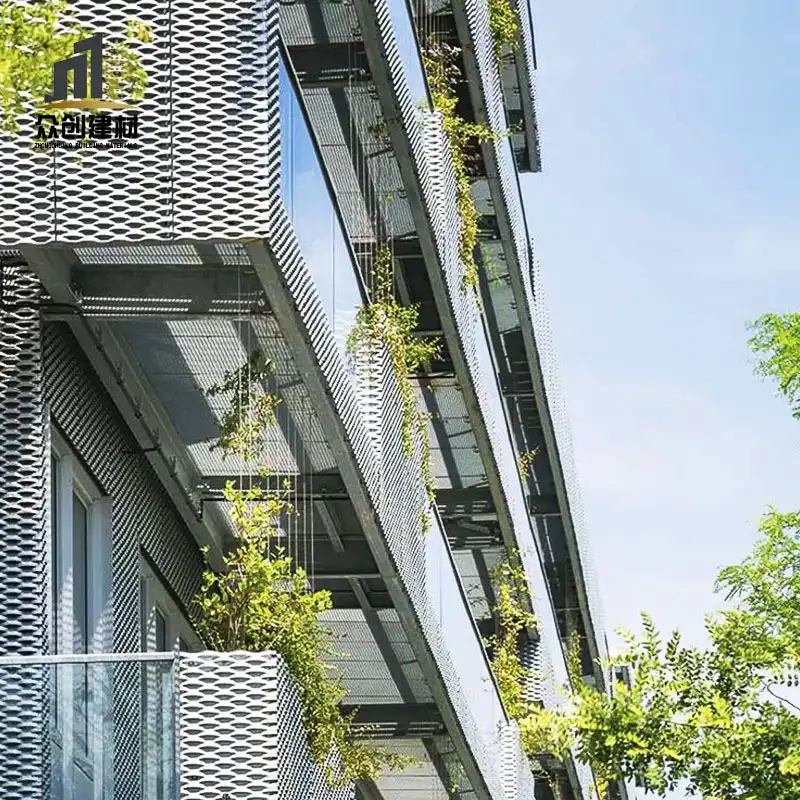
Shading facades. In regions with hot summers and strong solar radiation, perforated aluminum panels serve as a building's "second skin," effectively blocking west-facing and south-facing direct sunlight. Designers typically adjust the open-area ratio according to solar conditions on each orientation: high-density perforation for strong shading on the west, low-density perforation for more daylight on the north, and gradient perforation for transition on the east and west. This "passive energy-efficient design" requires no mechanical equipment and reduces building energy consumption through the material alone, making it one of the most cost-effective strategies in green building.
Ventilated facades. In buildings requiring natural ventilation, such as parking structures, equipment buildings and industrial facilities, perforated aluminum panel facades can replace traditional louvers, achieving ventilation with a more monolithic and attractive appearance. The open-area ratio is typically between 40% and 60%, ensuring airflow while concealing views of internal equipment. Some innovative projects also install vertical greenery behind perforated facades, with plants growing through the holes to create a "breathing green metal wall."
Rainscreen and drainage. When perforated aluminum panels are used in a dry-hung facade system, a ventilated cavity forms between the panels and the wall, allowing rainwater to drain quickly through holes and the cavity without pooling on the surface. This "open rainscreen system" is well established in Europe. Compared with traditional sealed curtain walls, it offers better drainage performance, easier maintenance and longer service life.
Wind resistance and structural safety. Perforated facades on high-rise buildings must undergo rigorous wind load calculation. Higher open-area ratios reduce the wind-exposed area and thus the wind load, but they also reduce the panel's own rigidity. Therefore, high open-area exterior panels typically require thicker substrates or back stiffeners. A well-designed perforated aluminum facade system can withstand typhoons of Category 12 or above, and each panel can be replaced independently without local damage affecting the overall structure.
5. Commercial Spaces: A Win-Win for Brand Art and Customer Attraction
For commercial brands, storefronts and facades are not merely decoration but "silent salespeople." The application of perforated aluminum panels in commercial spaces perfectly achieves a win-win between brand artistic expression and practical customer-drawing function.
Luminous storefronts. With LED light sources installed behind perforated aluminum panels, a uniform, soft glow is produced at night, with brand logos and text naturally expressed through varying hole diameters or solid zones. Compared with traditional acrylic illuminated letters, perforated luminous storefronts offer more uniform brightness, a more integrated visual appearance and better waterproof performance. During the day, they remain attractive metal walls, avoiding the embarrassment of "letters still there but not lit." For chain brands, standardized perforated storefronts also enable rapid rollout and consistent brand identity across multiple locations.
Interactive facades. Some cutting-edge projects combine perforated aluminum panels with sensors and dynamic lighting to create interactive building facades. For example, lights behind the perforated wall may follow pedestrians as they pass, or the facade color and brightness may automatically adjust with weather changes. Here, the perforated panel acts as an "interactive interface," transforming the building from a static display into a dynamic experience, greatly enhancing the brand's tech image and social media appeal.
Balancing privacy and openness. Commercial spaces such as restaurants, bars and gyms require a degree of privacy without wanting to be completely cut off from the street. Perforated aluminum panels used as storefront windows or partitions can control sightlines through hole diameter. By day, the exterior view is a semi-transparent metal surface; by night, with interior lights on, activities inside are partially visible, creating an "intriguingly transparent" effect that is precisely the customer-drawing atmosphere commercial spaces need.
6. Public Buildings: Balancing Large-Space Art with Safety Codes
Public buildings, including airports, stadiums, exhibition centers and cultural venues, typically feature large volumes, high occupant density and stringent code requirements. In these projects, perforated aluminum panels must simultaneously satisfy artistic expression, acoustic performance, fire safety and structural integrity.
Long-span ceilings. Airport terminals and stadiums often exceed 15 meters in clear height, with ceiling areas reaching tens of thousands of square meters. Perforated aluminum baffles or perforated aluminum grids are suspended from steel structures to cover vast spans. The open configuration simplifies integration of fire sprinklers, HVAC diffusers, lighting and sound systems. The perforated design also effectively absorbs echo in large spaces, improving broadcast clarity and audience auditory experience.
Fire safety. Aluminum alloy is a non-combustible material (Class A fire rating), and the powder or PVDF coatings on perforated aluminum panels are also flame-retardant treated, fully meeting fire code requirements for public buildings. Compared with combustible materials such as wood veneer and plastic panels, perforated aluminum panels offer an irreplaceable safety advantage in densely occupied public buildings.
Integrated wayfinding and signage. In large public buildings, wayfinding systems are critical. Perforated aluminum panels can directly integrate floor numbers, directional arrows and functional zone identifiers into walls or ceilings through varying hole diameters, colors or backlighting, reducing the need for separate sign elements. This creates a cleaner, more unified spatial interface and also lowers maintenance costs for the signage system.
7. Design Implementation: Coordinating Artistic Creativity with Engineering Feasibility
Perforated aluminum panels offer high design freedom, but "being able to draw it" does not mean "being able to build it." From concept to construction, several key points must be coordinated:
Balancing open-area ratio with structural safety. Artistic effects often require high open-area ratios to achieve transparency and light-shadow drama, but panel rigidity drops significantly above 40% open area. Solutions include increasing substrate thickness (no less than 2.5mm for exteriors), reducing individual panel size, and adding back stiffeners. Designers should communicate with structural engineers at the concept stage, avoiding the embarrassment of "beautiful renderings but deformed panels after installation."
Matching hole diameter with fabrication precision. Smaller holes mean greater fabrication difficulty and higher cost. CNC punching machines can produce holes as small as 0.8mm, and laser cutting can reach 0.5mm, but very small holes are prone to clogging during coating. For detail lines in artistic patterns, a minimum hole diameter of 1.5mm is recommended to ensure the finished product matches the design intent.
Back-light effect and light source distance. The most common problem with perforated luminous effects is "uneven bright spots," where each hole corresponds to a distinct point of light. The solution is to install a reflective light trough behind the panel so that light is reflected and diffused before reaching the perforated surface, with a recommended distance of no less than 150mm between the light source and the panel. Sufficient access space for light source maintenance should also be reserved, avoiding the need to dismantle an entire wall for lamp replacement.
Coating selection and service environment. Powder coating is sufficient for interior projects, while exterior projects must use PVDF fluorocarbon coating, with additional coating thickness required in coastal high-salt-spray regions. This must be specified at the design stage. Coating grade should never be reduced to cut costs, as exterior panels will fade and chalk within one to two years, with remediation costs far exceeding the initial savings.
Installation sequence and product protection. Perforated aluminum panel coatings are relatively soft. Panels should be installed last, after completion of other trades and removal of scaffolding, and installers must wear gloves and use rubber suction cups. Many projects, rushing to meet deadlines, install panels early only to have them contaminated by mortar and paint or scratched by tools, with no viable repair solution other than full panel replacement.
8. Future Trends: New Frontiers in Parametric Design and Intelligent Perforation
With advances in digital design and intelligent manufacturing, the artistic and functional value of perforated aluminum panels is being further expanded. Several trends are worth noting:
Parametric perforation design. Using parametric design tools such as Grasshopper and Rhino, designers can automatically generate optimal perforation patterns and density distributions based on solar analysis, acoustic simulation and view analysis. Each panel may have a unique hole configuration, yet the whole presents an organic aesthetic driven by functional logic. This "data-driven design" transforms perforated aluminum panels from passive decorative materials into building interfaces that actively respond to their environment.
Intelligent luminous perforated facades. Combining perforated aluminum panels with intelligent LED control systems enables dynamic light shows across entire building facades, while the panels remain attractive metal walls during the day. Compared with traditional LED large screens, perforated luminous facades have lower resolution but also lower cost, and they do not compromise building ventilation or daylighting, making them suitable for large-area commercial buildings and cultural venues.
Multi-functional integrated perforated panels. Future perforated aluminum panels may integrate even more functions. Photovoltaic cells embedded in holes generate electricity; photocatalytic coatings purify air; sensors integrated on the back monitor environmental conditions. A single panel simultaneously serves as decorative surface, power generation layer, air purifier and sensor, truly achieving "one panel, multiple functions."
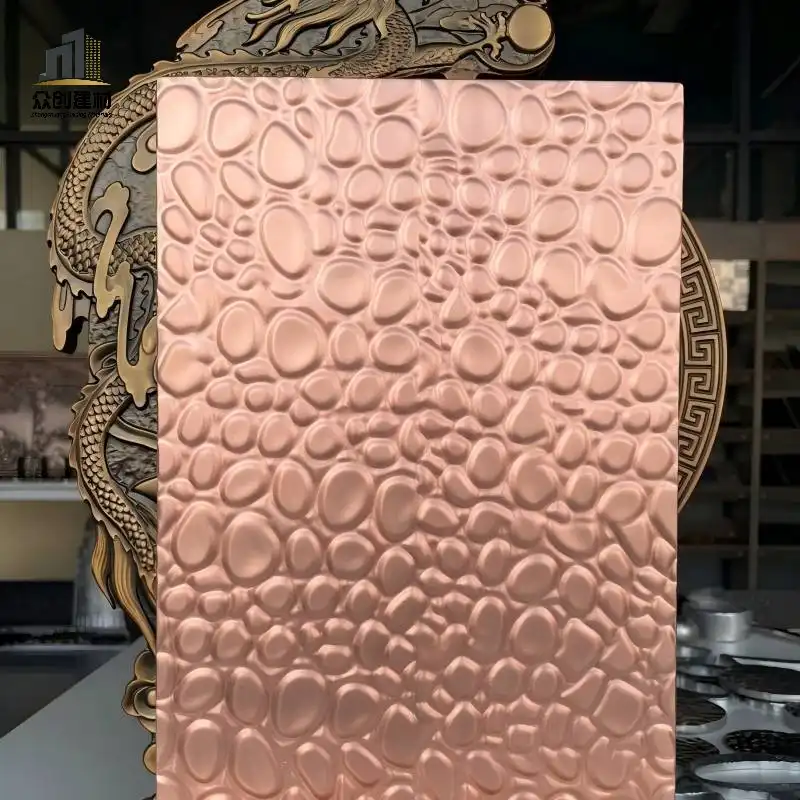
3D perforation and three-dimensional texture. Traditional perforation is planar, but new fabrication technologies enable three-dimensional perforation, where parts of the panel surface are raised or recessed to form three-dimensional texture. This "semi-perforation" technique gives panels both the transparency of holes and the light-shadow variation of three-dimensional form, offering even greater artistic expression.
Conclusion
The unique value of perforated aluminum panels lies in the fact that they never force designers to choose between "looking good" and "working well." The holes are both artistic brushstrokes and functional channels; the metal substrate is both a decorative skin and a structural support. From a luminous brand wall to an entire energy-efficient breathing building, from an acoustic office ceiling to a storytelling cultural venue, perforated aluminum panels are achieving the richest architectural possibilities through the simplest act of punching holes. For designers and project teams, understanding the logic of combining art with function is essential to unlocking the full potential of this material and creating architectural works that are both visually pleasing and durably functional.