_1762768699969.webp)


_1782530506402.webp)
(1)_1783045836766.webp)
_1786157639392.webp)
(1)_1780970038980.webp)
Radian Customization of Curved Aluminum Baffles: Curvature Radius Calculation and Error Control
Radian customization of curved aluminum baffles is a difficult point in many projects. Problems such as wrong radian, impossible installation, unsmooth lines, folded angles at splicing often occur, mainly due to wrong curvature radius calculation, inadequate processing technology, and lax error control. The radian of curved aluminum baffles cannot be bent casually, it requires precise calculation and professional processing equipment to make a perfect arc.
First, understand several radian-related concepts. Curvature radius R refers to the radius of the circle where the arc is located. The smaller the radius, the larger the radian, the more severe the bend; the larger the radius, the smaller the radian, the closer to a straight line. Chord length L refers to the straight-line distance between the two endpoints of the arc, and arch height H refers to the vertical distance from the highest point of the arc to the chord length. There is a fixed mathematical relationship between these three parameters: R = (L² + 4H²)/(8H), as long as two parameters are known, the third can be calculated. When designers provide radian, it is best to provide chord length and arch height at the same time, or provide curvature radius and chord length, don't just say "bend a big arc" or "bend an S shape", processing factories cannot process accurately.

There are three common arc types. The first is single arc, that is, the baffle is bent into a standard arc with fixed curvature radius, which is the most common and easiest to process arc, suitable for circular ceilings, curved corridors, arched shapes, etc. The second is multi-segment arc, the baffle consists of multiple arcs with different radii, common S-shape and wave shape consist of two positive and negative arcs. When processing, it needs to be stretched and bent in sections, pay attention to smooth transition at the tangent point of the two arcs, no folded angles. The third is variable curvature arc, that is, arc with constantly changing curvature radius, such as elliptical arc, parabola, free curve, etc. This arc is the most difficult to process, requiring CNC stretch bender to program in sections and control radian point by point, usually used for artistic modeling.
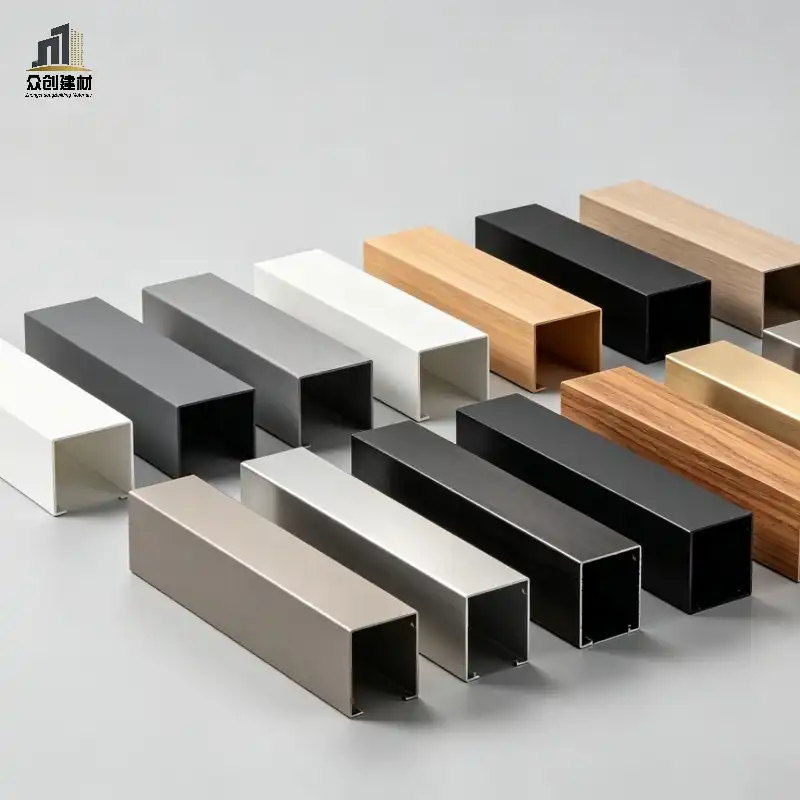
The selection of curvature radius should consider the specification and material characteristics of aluminum baffles, not the smaller the better. Aluminum baffle stretch bending has minimum curvature radius limit, below which section deformation, wrinkling, cracking and other problems will occur. Generally speaking, the minimum curvature radius of U-shaped aluminum baffles is 15-20 times the baffle height. For example, U-shaped baffles with height of 50mm have minimum curvature radius of about 750-1000mm; U-shaped baffles with height of 100mm have minimum curvature radius of about 1500-2000mm. Groove-shaped aluminum baffles have higher structural strength, so minimum curvature radius can be smaller, 10-15 times the baffle height. The thicker the thickness, the larger the minimum curvature radius; the higher the baffle, the larger the minimum curvature radius. If the required radian is smaller than the minimum curvature radius, stretch bending process cannot be used, roll bending or segmented welding is needed, or change baffle specifications. When designing, it is best to communicate with the processing factory in advance to confirm the minimum processable radius to avoid unprocessable radian design.

There are three main processing technologies for curved aluminum baffles. The first is CNC stretch bending, which is the most commonly used process. Fix both ends of the cut straight baffle on the chucks of CNC stretch bender, bend through the die while stretching, control the stretch amount according to the set curvature radius, and perform shaping treatment after stretch bending. CNC stretch bending has advantages of accurate radian, flat surface, no wrinkling, suitable for processing arcs with large curvature radius, the disadvantage is that small radius arcs are easy to deform. When stretch bending, pay attention to stretch amount control, too small stretch amount leads to large springback and inaccuracy; too large stretch amount leads to section deformation, generally stretch amount is controlled between 0.5%-2%. The second is roll bending, repeatedly rolling the baffle through three-wheel roll bender, gradually bending to the required radian, suitable for processing arcs with small curvature radius and large length, the disadvantage is that radian accuracy is not as good as stretch bending, and the surface is easy to have roll marks. The third is die pressing, for small radius and large batch arcs, special dies can be made, die forming on press, accurate radian, good consistency, but die cost is high, suitable for standard arcs with large batch.
There will be springback after arc processing, which is caused by the elasticity of aluminum alloy. When stretch bending, the bent radian should be slightly larger than the required radian to offset the springback. Springback amount is related to aluminum alloy grade, state, thickness, curvature radius, generally springback amount is between 5%-15%, the larger the curvature radius, the larger the springback amount, which requires experienced masters to adjust according to actual conditions. This is also the reason why small factories cannot make good curved baffles, they do not master springback amount, so the radian made is always wrong.
Error control is the key to the quality of curved aluminum baffles. Industry standards stipulate that curvature radius error of curved aluminum baffles does not exceed ±5mm, chord length error does not exceed ±3mm, arch height error does not exceed ±2mm, straightness error of arc does not exceed 1mm/m, no obvious break points and unevenness. Many curved baffles made by small factories look like arcs from a distance, but have many small folded angles from close, lines are not smooth, because point-by-point control is not done during stretch bending, or equipment accuracy is not enough. To control errors, first use CNC stretch bender, cannot use manual stretch bending; second, use radian template to check after stretch bending, compare with design radian, unqualified ones reprocess; third, make special tooling during surface treatment to avoid radian deformation under spraying high temperature, many curved baffles have accurate radian during processing, but radian changes after spraying high temperature curing, because no tooling fixation.
Installation error control of curved aluminum baffles is also important. The radian of curved keels must be consistent with baffle radian. It is best to process keels according to actual radian of baffles after baffles are processed, or use CNC arc bender to process keels to ensure accurate keel radian. When installing, pre-assemble on the ground first, check the radian and splicing seam of each baffle, hoist after no problem, don't find wrong radian when on the ceiling. The splicing seam of curved baffles should be even, usually 2-3mm, seal with same color glue, the splicing place should transition smoothly without height difference.
Because of high processing difficulty and high loss, the price of curved aluminum baffles is usually 1.5-3 times that of straight baffles, the smaller the curvature radius, the higher the price. Many projects find small factories to process curved baffles to save money, resulting in wrong radian, impossible installation, finally reprocess, but spend more money and delay construction period. Curved baffles must choose manufacturers with curved processing experience and CNC stretch bending equipment, it is best to require manufacturers to make 1:1 samples first, confirm radian and effect are okay before mass production.
Suggestions for designers: when designing curved shapes, try to use standard arcs, use less complex free curves; curvature radius should not be too small, try to be larger than 20 times baffle height to reduce processing difficulty; provide radian parameters as accurate as possible, don't use vague descriptions; communicate processing feasibility with manufacturers before design to avoid unprocessable shapes.